Catholic Living: The Sacrament of Marriage

The Church honors Sacramental Marriage this month by remembering and honoring saints Jochim and Anne, the parents of Mary, and saints Louis and Zelle Martin, parents of St. Therese of Lisieux. And, of course, always St. Joseph and Mary. Their marriages, marked by their unwavering faith and commitment to God’s Covenant, are inspiring examples of sacramental marriage and a source of motivation and encouragement for us all.

Let’s consider what a Sacramental Marriage is; to do this, we will turn to some of the liturgical phrases of the nuptial mass to consider a few words and strands of thought inherent in the biblical understanding of the Sacrament of Marriage laid out for us in the wedding liturgy.

COVENANT

When our priests pray that our union with God and each other will be “sealed”–set apart, sanctified–with God’s blessing, he refers to a covenant. It is assumed we have laid down our life to Him and that we are entering into marriage willing to lay down our lives for our spouse, as Jesus laid down his life for The Church in the New Covenant. It is assumed that we desire to set the trajectory of our marriage toward union with Our Lord. It is assumed there will be borders in our relationship that will hold fast our union with the Lord in the Covenant of Marriage.

It works this way: When we envision our marriage as sacramental and sacrificial, we strive toward that vision. Our union’s apex is the Lord Jesus, and we stand together in a holy trinity of marriage When we stand at the altar on our wedding day, the Lord’s Spirit grants us strength to fulfill the marital covenant and seals us to him, providing us with His virtue for a loving marriage. Isn’t it reassuring to know we don’t have to rely solely on our own strength to love our spouse and keep faith in our covenant? The third member of our holy trinity trumps all our weaknesses!

In the virtues, we receive the gift of wisdom, understanding, counsel, fortitude, knowledge, piety, and reverence for the Lord. Like any gift, the receiver has to open it to be enjoyed, and once we do that, the Lord enables us to exercise it and grow strong in our relationship. Here’s the lovely thing: As virtue puts down roots in our hearts and minds, virtue grows, and we bear the fruits of God’s Spirit in our relationship: love, joy, peace, forbearance, kindness, goodness, faithfulness, gentleness, and self-control.

Is the seal of our covenant being weakened or strengthened by my attitudes and actions?
What virtue do I need to practice to honor my covenant with God and my spouse better?
Are my attitudes and actions toward my spouse gentle, patient, good, and self-controlled?

ENDOWED

Our priests ask the Lord to bless our companionship. God desires to order our marriage to its proper place–union with Him—so He endows us with the grace to nurture companionship. We cooperate with Him by what St. Thomas Aquinas described as “willing the good of the other.”

One definition of grace that gets at that definition of love is “courteous goodwill” toward another. In the life cycle of holy marriage, God endows us with grace; we receive it as a gift, and we open the gift by practicing courteous goodwill toward our spouse in all things.

But here’s the sticky wicket for us: when we fixate on the wounds and resentments in the life cycle of marriage and allow the grievances to fill the space between us, the space tends to widen. Why? When wounds fester, they infect our relationship! All those little irritations and significant differences of opinion hardened into scar tissue between us to force our union apart. You know what I’m talking about!

When we come to our senses and remember that, we must strive toward union with the Lord first. We lift our eyes to him and ask for the GRACE He has endowed us with. He releases the power of His holy Spirit to help us forgive and repair the boundaries of our marriage.

What resentments have I harbored that are driving us farther apart?
How can I work towards restoring the relationship with my spouse?

The regular practice of the Sacrament of Healing through Confession is endowed with that grace of healing, not just for us but for all our relationships. The sacrament of healing is a gift the Lord has given us, and we can receive it as often as needed….. Sometimes, friends, we just need to camp outside the confessional!

KEEP

Our priests pray that our marriage will “be held and kept” in the marriage covenant. Here’s a helpful image: Another way to think of the word “keep” is in its noun form: the stronghold in a castle’s most fortified enclosure. It serves as a refuge against siege or attack from the enemy. We fortify our marriage as we hold and keep ourselves in union with the Lord, and our borders strengthen against the attacks of the enemy of our souls.

Where are the vulnerable areas in my area that weaken our marriage?

ABIDE

Our priests pray we will “abide in mutual love and peace.” Oh, I love this part! I kindle to the word, “abide!” What our priest is asking of the Lord is the state of harmony and understanding that is the hallmark of a Sacramental Marriage. In a culture that would rather “cut and run” than do the hard work of sacrifice, we are summoned to choose to remain faithful to the marital covenant.

Jesus told his disciples, “Abide in me as I abide in you.” (John 15:4) He, the founding partner in our marriage, has endowed us with the ability to remain faithful! He remains with us; we choose to remain with him within its fortified walls. He is present to us here; we choose to be present to Him and one another within this sacred union.

Am I allowing social media, career, friends, recreation, or hobbies to satisfy me instead of my companionship with my spouse?

Let me leave you with something I read recently that helps me as I love my husband: “True love goes beyond the cold exactitude of dry duty; true love gives with a smile, a flourish, and a delicacy that not only meets the beloved’s needs but also meets them in a lovely, pleasing way.” That’s what the Lord desires for us, friends; he has lavished his love on us, and He beckons us to lavish our love on our spouse.

Saints Jochim, Anne, Joseph, Mary, Louis, and Zelle pray for us.
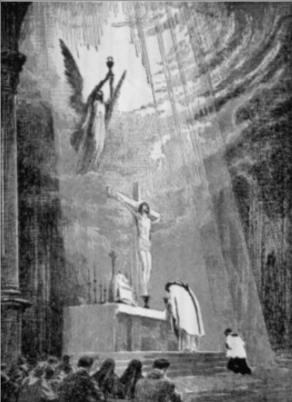
The Solemnity/Feast of Corpus Christi: The Body and Blood of Christ

Greetings, friends. These little talks are intended to be short and pedestrian in content; they do not do justice to the gravity of the theological truth contained in the Sacramental Faith of The Catholic Church. I refer you to the esteemed theologians of Church History for more on them. If you are a new reader of the blog or a follower of the Sioux Falls Diocese where this talk was posted (https://youtu.be/eRrPltaAp7I?si=vhx3255vaqrzF3wj), you may desire to read about my journey into The Catholic Church. You may find that in the site menu below my photo to the left of this post (Category: My Journey into the Catholic Church).

This Sunday, we celebrate The Solemnity/Feast of Corpus Christi or The Feast of the Body and Blood of Christ. On this specific day, we display our belief and gratitude for what we do every day at Mass, but with more pomp and circumstance, hence the designation Solemnity and Feast. We solemnly remember Christ’s Passion for us while we feast on the food of our salvation–His Word to us in the Liturgy of the Word and His Body in the Liturgy of the Eucharist–his Body and Blood, Soul and Divinity-the Whole Grain Bread of Life, so to speak. That is how The Church has done it since its establishment by Christ 2,000 years ago. 

Dress Rehearsal:

The best description I have heard of Mass worship is that it is the dress rehearsal for heaven. So why are so many people skipping out on rehearsal? I wonder. I delayed participating in this dress rehearsal for 56 years, 133 days, and 20 hours! You see, my husband and I converted to The Roman Catholic Church, but we are zealous Johnny-come-lately, true neophytes in all things Catholic.

Journey:

We were committed to Christ and his church as we knew it as Protestant Christians; we even served as “pastor and wife” for 34 years. We knew the Sacred Scriptures inside and out because they were the sole source of our doctrine of belief. Therefore, we thought we knew the whole of the Theology of God passed down from our particular 500-year-old protestant movement, which seemed solid enough then. We didn’t know what we didn’t know! We didn’t know that we hadn’t received the entirety of the Truth of Christ and His Church was held intact since Christ instituted His Church in her 2,000+ years of history. But that’s another story for another time.

On my long intellectual journey from 1996 to Easter Vigil 2015, I worked hard to wrap my brain around the Early Church theology I had not been taught. At first, I relied on the writings of the Saints and The Early Church Fathers–what integrity! And how mind-blowing and life-giving it was to read Church History as it was rather than how I was trained to read it. It wasn’t long before my questions about what I had been taught and what I was observing in the Protestant movement demanded answers, so I studied the Catholic Church’s Catechism over and over again. I recognized the theology that the protestant movement took with it when it left home and departed from our Mother Church’s teachings, but I discovered there was so much that was left behind.

Grappling:

In particular, I grappled with The Real Presence of Christ in the Eucharist, The Four Dogmas of Our Blessed Mother, and The Sacrament of Reconciliation. I often felt like I had been thrown down on a wrestling mat, and the only way to stand back up again was to surrender my misunderstanding and ignorance to the authority of God and His Church. I can’t tell you all about that today right now. Today, I would like to share how the Holy Spirit guided my thinking to surrender to the entire truth of The Eucharist. Suffice it to say that I slowly moved from Communion with Christ as an excellent idea wrapped in a symbol to the firm understanding that the entirety of my mind, soul, and spirit depends on the Real Presence of Christ in The Eucharist in the Worship of the Mass. 

******

Faith is the realization of what is hoped for and ­evidence of things not seen. Because of it the ancients were well attested.

Hebrews 11:1-2

We look not to what is seen but to what is unseen, for what is seen is transitory, but what is unseen is eternal.

II Corinthians 4:18

The Big Questions:

I’m an “If/Then” thinker, so I explored the teachings of the Eucharist by asking myself many questions. 

  1. If I put my faith in and believed God’s Word created the cosmos, and then his Word descended in the miracle of The Incarnation of Jesus–a virgin and the Spirit of God make the Son of God. Say, what?… If I put my faith in and I believed that Jesus, The Word Made Flesh, was the once and for-all fulfillment of God’s plan for our atonement from sin. Christ was dead, then he was alive—stone-cold DEAD, THEN ALIVE!!!
  1. Then why couldn’t I put my faith in and believe that the sacrificial teachings of Salvation History in the Sacred Scriptures were exactly fulfilled in Christ’s Passion and Sacrifice on The Cross?  
  1. Why couldn’t I accept that what appears to me as bread and wine miraculously become Christ’s Flesh, Blood, Soul, and Divinity in the Liturgy of The Eucharist through the Holy Spirit’s power in the Prayer of Consecration said by a priest? I didn’t argue with any other of Christ’s words when He said, “Be healed!” or when he took a meager amount of bread and fish from a boy, blessed it with His words, and distributed it to thousands of hungry people. I didn’t argue that at His Word, “Come,” Peter could walk on water where He was standing ON WATER! 
  1. Over 163 miraculous events are recorded in the Old and New Testaments of the Sacred Scriptures. Why did I come to a full stop about this miracle that Christ’s words declared about his flesh and blood? (St. John 6) Why couldn’t I accept that what appears to me as bread and wine miraculously become Christ’s actual flesh and blood, soul, and divinity in the Liturgy of The Eucharist through the Prayer of Consecration? I didn’t argue with anything else Christ said. Why this miracle in particular? One reason is that I had been taught one thing about this particular miracle that opposed the truth of the matter for 2,000 years.
  1. That led me to this question: Would God still be God if I could comprehend the ways and means of God? What would I be worshipping? The answer finally came with a loud bang—God is God, and I am not. His ways and means are beyond my human understanding; Faith is a mystery that is intended to be beyond my human limitations, 

I Get It, Kind Of:

Doctor of The Church, St. Anselm, wrote, “I do not seek to understand in order that I may believe; I believe in order to understand.… I believe that unless I believe, I shall not understand.” I began to pray, I believe, Lord, but help my unbelief. And sure enough, he did! Then, I asked myself another question. If I believe that the entire purpose of my life is to be transformed into the image of Christ and live with him forever, then why am I relying on the boundaries of human understanding to limit my progress?

Flesh and Blood:

The Holy Spirit reminded me of a reality in my life to grant me insight and understanding into the power of blood. My mother was born with a chronic disease that eventually led to her untimely death. The lifelong disease preceded her eventual death, but because of many, many blood transfusions over the years, it kept her alive and prolonged our years with her. Now, the hematologist could explain how the thrombocytes acted on her blood platelets and make promises based on that scientific knowledge; they could tell her that the transfusions would save the life of her flesh. The transfusions would work whether or not my mother believed in the doctors’ promises; the cure wasn’t dependent on my mother’s understanding of the process. The truth the doctors spoke only depended on one thing: my mother’s permission to receive the life-giving blood. 

Spiritual Transfusion:

We are all born with a disease named Original Sin, and if not treated, we slowly die a spiritual death that deteriorates into eternal death. Consider what God said to his people in the Old Testament, “…The life of the flesh is in the blood, and I have given it to you to make atonement on the altar for yourselves because it is the blood that makes atonement [for one’s life].” (Leviticus 17:11) Friends, our lives depend on the transfusion of Christ’s Body and Blood, Soul, and Divinity! His sacrifice atones for us forever, like the transfusions atoned for my mother’s life temporarily. His Body and Blood—his essence, the cells of his being—infuse us and heal us completely; it is the spiritual transfusion for abundant life here on earth and in eternity, whether or not we understand or believe it doesn’t matter, but what matters is that we must humble our humanity and receive Him to have this life.

What Difference Does it Make?:

When we regularly worship Christ in the Mass, we are transfused with life through Christ’s very lifeblood, his very essence, in The Eucharist! His Body and Blood infuse us with his very nature, and we are transformed into his image in part and finally perfected in eternity. Worshipping in the Mass is not about how well the priest delivers the homily or the appeal of the music. It’s not about how I feel during worship. It is solely about Christ’s Sacrifice on the Cross and His Resurrection from the dead. I can go elsewhere to hear self-improvement tips. I can go elsewhere to listen to the music I prefer. But when I worship in the Mass, I enter Heaven here on earth to participate in the eternal Mass of Heaven. It takes a lifetime of dress rehearsals to prepare for The Wedding Feast of The Lamb, Christ himself, in eternity. Regular worship in The Mass keeps my wedding clothes clean, without spots or wrinkles, and I keep oil in my lamp! (Ephesians 5:27; Matthew 25:1-13)

Conclusion:

Moses said to God’s Chosen People; I have set before you today life and prosperity, death and adversity… Choose life so that you and your descendants may live, loving the Lord your God, obeying him, and holding fast to him, for that means life to you and length of days…  Friends, our very lives–quality and quantity–depend on us choosing life! Why wouldn’t we worship Christ in the Mass? Why wouldn’t we crawl to the altar in humble adoration to consume LIFE?!