
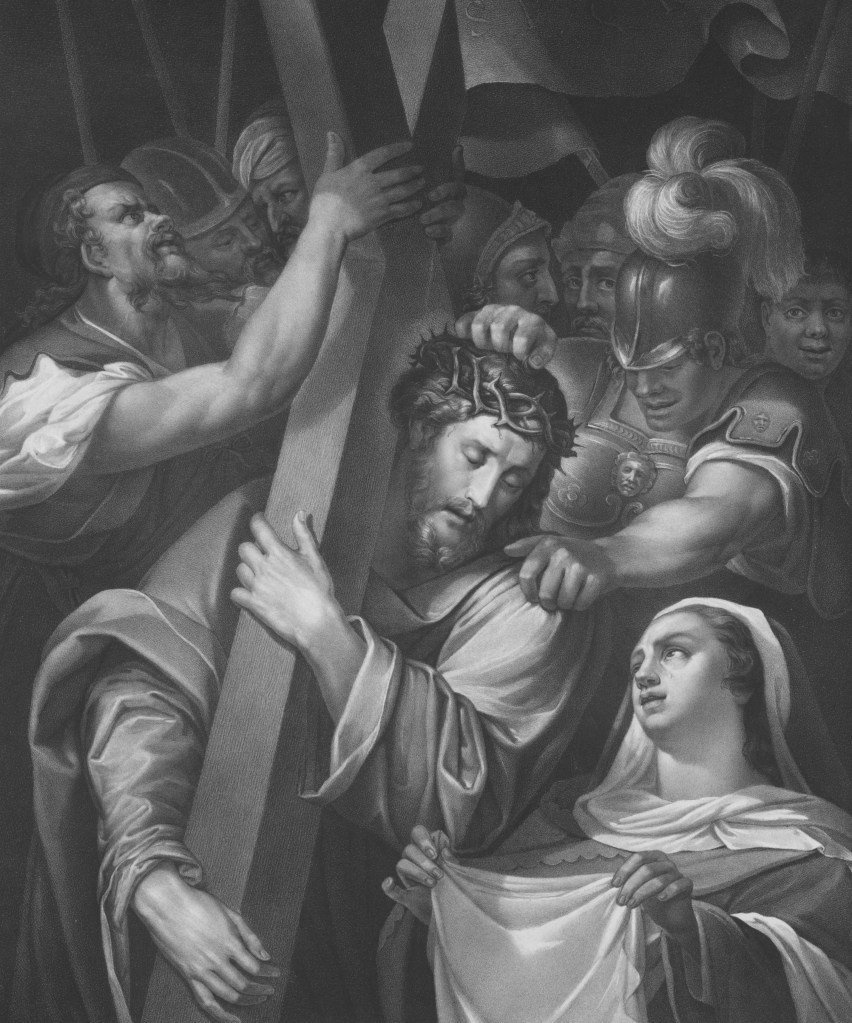
The Way of the Cross

They (the soldiers who had mocked, beaten, and humiliated Jesus) pressed into service a passer-by, Simon, a Cyrenian, who was coming in from the country, the father of Alexander and Rufus, to carry his cross.
~St. Mark 15:21

CONSIDER

Today, we are invited to enter the profundity of all ages–Holy Week. The excruciating events of this week grant us the most extraordinary depth of insight into Jesus’ heart. It is incumbent on our faith in God to enter this week with humility and thanksgiving, for in this week, we see in stark detail what Love beckons us to become.

Jesus taught his disciples that if they wanted to follow him, they must take up their cross (Matthew 10:28). And St. Paul reminded the believers in the Early Church that we complete Christ’s sufferings through our willingness to suffer as Christ suffered (Colossians 1:24). The economy of Salvation stupifies me sometimes—no, much of the time! We gain when we lose, live when we die, and are exalted only through humility.

Let’s keep that in mind as we consider Simon of Cyrene, who physically entered Christ’s suffering by carrying his cross for him. St. Luke observes that after laying the cross on [Simon], they made him carry it behind Jesus. Interesting point. Don’t you want to know what may have run through his mind as he followed the God-man, beaten beyond recognition, stumbling along before him? We do know this: the way (attitude) Simon carried Christ’s Cross changed the trajectory of his life, much in the way the Lord wants to transform our lives. (St. Simon spread The Gospel in northern Africa; he was eventually martyred for his faith in Christ around 100 A.D. His sons, Alexander and Rufus, were among the first believers in the Early Church in Rome. Because of the influence of St. Simon of Cyrene, we can assume The Church was graced with Tertullian, St. Augustine, St. Cyprian, and St. Monica from northern Africa)

If we genuinely desire to follow Christ to eternal life, we must first walk The Way of The Cross. But how exactly do we do that? Jesus told his disciples that he was the Good Shepherd who laid down his life for his sheep. The Greek meaning here is that Christ laid down his life, soul, heart, and mind. He calls us to do the same; how are we doing? Do we lay down our thoughts and words? Do we lay down our desires? How often do our tongues complain when a circumstance or someone messes with our plans? How often do we complain to others about someone who has offended us? How frequently do our minds refuse another’s need because it will cause us discomfort?

Isaiah prophesied that Jesus would be like a lamb, led to slaughter. Have you ever observed lambs? They just follow the sheep who follow the shepherd. Hmm? What if Simon complained and blamed Christ as he bore his burden to The Cross? What would have happened to Alexander and Rufus if Simon had complained about his burden of following Christ to his Cross? What happens in us when we spur suffering as if we don’t deserve it? How are the observers of our lives affected by our attitudes in the face of unwelcomed interruptions?

Every bit of inconvenience, interruption, and disruption is God’s will for us in that moment where we have the choice to lay down our life, soul, heart, and mind. Although minor inconveniences have little consequence, they provide practice in laying down our lives with an attitude of thanksgiving. When the consequential sufferings of our lives come along, we recognize them as the call of Christ to complete his suffering by carrying our cross in what he has allowed in our lives.
Christ went to the Cross to save us from the immense sufferings of sin and death. He allows whatever temporal sufferings–the diagnosis, the betrayal, the tragedy, the loss–to save us from ourselves along the way. He saves us in the circumstances, and our mind, body, and soul will be transformed into his likeness! That is the way of The Cross.

PRAY

Shepherd of my heart and Savior of my life, I exalt you; my soul magnifies you! Yet I so quickly magnify my molehills into mountains when something comes along to mess with my control. Please forgive me for my pride, fear, and self-absorption. You created me in your image; it takes a lifetime of surrendering my will to you. Why do I delay it by resisting Your will for me in each circumstance? Why do I doubt your everlasting love for me? You will never lead me where you do not want me to go, but sometimes I do. Lead me back to the Way of the Cross, the path of my salvation. ~Amen

The Domestic Church: How to Prepare Your Child for Eternity

St. Benedict encouraged in his book “The Rule of St. Benedict,” written around 530 A.D., “to keep death before [our] eyes daily” and “to keep constant watch over [our] actions.” The saint touched on something we do well to remember in 2025 A.D.: We prepare for the inevitability of death as we live. This month, we will consider how best to orient our children and grandchildren to the four last things. As Catholics, we are encouraged to prepare for death, purgatory, heaven and hell. It almost goes without saying that from the inception of this monthly column, we have offered counsel that prepares our children for their entrance into eternity; we will not repeat all that here. Let us dig a bit deeper into this subject and learn ways to improve in our noble profession as parents and grandparents.

“[Parenting] is a noble profession that shapes the character, intellect, and souls of the future generations.”

~St. Elizabeth Ann Seton

Knowing where we came from and what we are here for makes it easier to understand where we are going. The best way, it seems, is to prepare our children for their destination by training them to navigate the “first thing”: knowing the breadth, depth and height of the love of the one for whom they exist. We want to teach them that God’s unfailing love breaks through every border in our lives, and he desires that we live like that! We must teach our children to live purposefully, mindful that the borders of this life are not dead ends; there is always so much more to learn about how God loves us! Living a spiritual life is not a burden but a joyous journey filled with the love of God.

How can we guide our children to lead beautiful lives with Our Lord?

We want to acquaint our children with God’s justice, which is love and mercy. The parables Jesus taught were built upon this truth, the prodigal son (Lk 15) being the most well-known. We can use this parable to expose our children to God’s lavish love for them, just like the father in the parable. The parable displays love and mercy in spades! It also exemplifies the need for forgiveness in the Sacrament of Reconciliation. When we make confession a family practice, we provide opportunities for our children to experience God’s love and mercy. This regular practice not only reassures them of God’s forgiveness but also guides them in understanding purgatory, as the sacrament grants us the grace to purge everything that will not be welcomed in heaven if we turn from the wrongdoing that got us there in the first place and live out our absolution on purpose.

On the way to confession, we can remind them that we practice regular confession to be godly humans and prepare ourselves for God’s beautiful future for each of us. This regular practice of confession is a source of reassurance and guidance for our children, helping them understand and accept God’s forgiveness.

We can also lovingly hold our children accountable and help them train their spiritual muscles in obedience. Son, I know you asked Jesus to forgive you for; how can I help you become a better human and guide you when you struggle with? It is better to help our children nip vice and wrongdoing in the bud before it becomes habitual, leading to sin that separates them from God’s beautiful desire for their lives. We also instill an understanding of the purpose of purgatory when we regularly help them (and ourselves) purge sin from their lives through the sacrament. Better now than later.

How do we teach our children about sin and its effects on our lives and future?

We want our children to know the difference between committed sins and omitted acts of obedience, and this will help them recognize that we are accountable for the wrong we choose to do and the right we do not decide to do. St. James admonishes, “So for one who knows the right thing to do and does not do it, it is a sin” (4:17).

The parable of the 10 virgins and the parable of the talents (St. Matthew 25) can help them recognize we are accountable to God and others for our actions. (As a reminder, always try to follow up what you read to them with the five W’s–who, what, when, where, why–to engage their minds and trigger responsive behavior.) The parables and teachings of Jesus convey that disobedience to our Lord includes the choices we make not to do the right thing. Understanding sin and accountability enlightens our children and empowers them to make responsible choices in their spiritual journey.

Think of what is above, not of what is on earth. … your life is hidden with Christ in God. When Christ your life appears, then you too will appear with him in glory. ~Colossians 3:2-4

How do we teach our children to fix their minds on our Lord?

The beautiful life God wants to give us here and now and in eternity depends upon our responses to him in the way we think and the choices we make that reciprocate our love for him. Therefore, we want to help our children kindle to Jesus’ heart and choose virtuous living out of a deep passion for God, not just fear of hell. Thomas à Kempis wrote the spiritual classic “The Imitation of Christ,” the go-to book for learning to love the Lord our God in thought, word and deed. His life-changing counsel acts as a guidance counselor on fixing our minds on Christ and his example.

The more integrated and uncomplicated one is, the more effortless and astute one will be in their understanding because they will be enlightened from above. … A person who wishes to be good and devout first puts their interior life in order and then attends to his other duties. ~Thomas à Kempis

Friends, when we make goodness and devotion to our Lord the priority of our noble profession, his Holy Spirit imbues us with the fortitude to stay at our post. Above and beyond all these suggestions on preparing for the four last things is praying hedges of protection around our children as we nurture them in the faith. The most effective tool is the Sacred Scriptures, for God’s Word is living and active, sharper than any two-edged sword, piercing the heart and accomplishing his desire (Hebrews 4:12; Isaiah 55:11).

Resources:
Bible story books for children from Arch Books, appropriate for ages 5-9. (The first four parents to request a Family Prayer Guide at standinthegap.sfdiocese@gmail.com will receive a Bible parable storybook free upon request in gratitude to you for praying for your family.)

“The Imitation of Christ for Children: A Guide to Following Jesus” by Elizabeth Ficocelli.

Allegories are also a good tool for teaching spiritual truths in story form. We highly recommend these read-aloud books for children age 9+:

“Hinds Feet in High Places” by Hannah Hurnard.

“Pilgrims Progress” by John Bunyan

“Lord of the Rings” by J.R.R. Tolkien

“The Chronicles of Narnia” by C.S. Lewis

Dante Alighieri’s “Inferno” as told for young people by Joseph Tusiani (12+)

~I am a freelance writer. This post first appeared in a periodical.
Pray It Forward: The Virtue of Fortitude

Prudence, Justice, Fortitude, and Temperance are the foundation of the theory of ethics; they are the hinges for us as parents and grandparents. Our goal is to build the strength of mind in our children to enable them to recognize dangers to their character and bear the pain or adversity with courage, which hinges on how strong their fortitude is.

The need for fortitude is likened to the grit to know your place on a sports team and play well for the game’s good. Chuck Colson wrote, “Remain at your posts and do your duty — for the glory of God and His Kingdom.” Oh, friends, we need to hear that, don’t we? Our children are in a skirmish with the enemy of their souls, who will do anything to distract them from the goal of being morally well-developed humans. The stakes are high and demand we remain at our posts as parents and do our duty to God and our children for the sake of life here and in eternity. Let’s consider a few virtues that hinge on fortitude and how we can help our children grow in their strength of character.

Firmness of Character

Pope Benedict XVI once said, “The ways of the Lord are not comfortable. But we were not created for comfort, but for greatness.” Greatness, or magnanimity, means being great of heart. And just like the Lion in The Wizard of Oz, it requires courage. We can train our children to be stick-to-it-ness at doing all things well for the glory of God (Colossians 3:23). This will teach our overachieving children to be more humble and teach our underachieving children to be more courageous.

Firmness of Purpose

St. Teresa of Calcutta said, “Do small things with great love.” Fortitude enables you to stay in the fight for goodness. Diligence comes easier to some than others, so when our children struggle or give up on a small or large thing, we have a perfect circumstance to teach fortitude. The Book of Hebrews writer encouraged us not to grow weary in well doing…to keep our eyes on Jesus…and to finish the race before us. Finishing doesn’t equate to winning in God’s mind. Finishing is the reward! We can guide our children to be firm in purpose, whether with homework, good behavior, household chores, good choices, or extracurricular activities. Some children may benefit from making a small to-do list that they can check off each day and experience the satisfaction of a job well done–we can gently push them to add “sacrifice” and “hard task” items.

Firmness in Patience and Perseverance

Our children need to learn to accept challenges graciously, without grumbling. Whining and angry outbursts show the need for fortitude; beginning in the toddler years, when we teach our children to wait their turn calmly, we teach them patience. When we train them not to complain about inconveniences, we teach them patience. When we teach our children to pray about a desire of their heart, instead of demanding we fulfill it, we teach them patience. Training them in patience will lay the ground for a lifetime of patiently enduring life when it doesn’t go their way; flexibility is an excellent human virtue. It’s hard to be consistent when our small children’s behaviors wear us out; persevere, dear parents!

Character Studies

When the writer of the Hebrews admonished the first believers to finish the race of faith, he reminded them of a litany of Old Testament saints known for their perseverance. I paraphrase what he then said.… since we are surrounded by so great a cloud of witnesses, let us also lay aside every weight and the sin that clings so closely, and let us run this character race with perseverance (fortitude).… looking to Jesus the pioneer and perfecter of our faith.…

The Sacred Scriptures are replete with saints and sinners; they are there to help us run the race of virtue. History is replete with saints whose lives look much like ours; they are there to help us run the race of virtue. Spending time as a family learning from others who have finished well inspires our children and spurs them on. Here are a few suggestions beyond what we have already suggested for family worship times.

Resources:

Stories of the Saints: Bold and Inspiring Tales of Adventure, Grace, and Courage by Carey Wallace and Nick Thornborrow

A Saint a Day: A 365-Day Devotional Featuring Christian Saints by Meredith Hinds and Isabel Muñoz is appropriate for all ages.

Train the young in the way they should go;
Even when they are old, they will not swerve from it.
~Proverbs 22:5-6

~I am a freelance writer. This post first appeared in a periodical.

Pray It Forward: The Virtue of Temperance

Temperance, otherwise known as moderation or self-restraint, is often relegated to the appetite, but it’s a necessary virtue for all our actions, thoughts, and feelings. One of the definitions of temperance is to know a calmness of mind, so this month, we will explore how to train our children to gain and maintain calmness of mind. St. Agustine defined virtue as “rightly ordered loves.” Aristotle said virtue is, in the mean, the middle between two extremes: excess and deficiency. Developing calmness of mind in our actions, thoughts, and feelings requires vigilance in reordering our loves; our children rely on us to model this before them.

The intemperate child struggles to restrain their passions; if you have passionate children who struggle to restrain their tongue, control their emotions, overcommit, and go to extremes in their pursuits and expectations of themselves and others, they need to be strengthened to moderate their motives and calm their minds. They tend to be high achievers who find it impossible to let themselves off the proverbial hook of their expectations. Passion is a beautiful strength, but as in all strengths, there’s an underbelly–a disordered passion that gives rise to disordered thinking and behavior. Consider the Holy Spirit’s counsel to us in the letter of St. James (4:1): “Where do the wars and where do the conflicts among you come? Is it not from your passions that make war within your members?” Unbridled passion becomes vice when it conflicts with others, eroding goodwill. That’s easy enough to recognize in our children’s conflicts with us and their siblings, but let’s take it further. James refers to the war among your members because he wrote to fellow believers. However, look at it this way: we as individuals have interior “members’ that war with each other: mind, body, and spirit.  St. Paul put that war in this way: “…take heed to yourselves, lest at any time your hearts be overcharged [with untamed] behavior.” (KJV I Cor. 10:12) Let the taming begin!

Inordinate love of the flesh is cruelty because, under the appearance of pleasing the body, we kill the soul. ~St. Bernard of Clairvaux

Tame the Actions

Self-discipline is especially difficult for intemperate children because their passion drives them; this may manifest in impetuous behavior. “Take a beat” may be an excellent cue to use with your impetuous child. Learning to slow down their reaction time by teaching them to wait to speak or do whatever has gotten into their head is good practice for them.  You can train them to moderate in that beat by asking provocative questions while reinforcing their passion and teaching them to be circumspect. I know how exciting it seems to you to do … let’s think about it for a few hours/days and talk to the Lord about your heart’s desire.  What do you hope to learn from your desire? Are you ready to commit to the responsibilities the desire requires? Do you want to spend your money on this desire, or do you want to keep saving it…? Do you want to eat it all now, or do you want to save some to enjoy later?

Tame the Thoughts

Learning to recognize negative thought patterns and restrain extreme emotional responses is a lifelong challenge for all of us. The thought pattern most likely manifested in our childhood, but we may not trained to recognize our emotions were out of control. Children susceptible to fear or anger are susceptible to irrationality. We can help them moderate the irrationality by teaching them to face the fear or anger and learn to cope with it. Through consistent reflective exposure to their fear or anger, we will help them self-moderate. You may want to relate your own stories of struggle and how the Lord helped you through it. There is nowhere you can go or nothing that can happen to you that our Lord doesn’t know about before you do. Isn’t that comforting? Let’s talk about this fear/anger. What made you afraid/angry? What do you think will happen because of this fear/anger? What do you need from Jesus most to help you with this circumstance? 

Tame the Feelings

A highly sensitive child is more sensitive to outside influences and is easily overcome by intense emotions and overwhelming responses to those emotions. We can recognize this in their inability to control their emotions, which drives them to overreact–physical or verbal reactions with others or within themselves.  They need firm boundaries that are secure as they experience their feelings. Rather than blaming their sensitivity for their physical and verbal reactions or sending them into isolation when their emotions flare, we must help them face what they have done to others or themselves during their response. I understand you are frustrated; let’s talk about how you feel. Why do you feel this way? How do you think so-and-so feels when you act like that toward them? This is an excellent time to remind our children what the gifts of the Holy Spirit and the fruits of virtue are by comparing their chosen behavior with the attributes that will strengthen them. The Lord has given you a passionate spirit, and we desire that you learn to discern if your strong desire has tempted you to forget how so-and-so may feel when you don’t control your [anger, frustration, sadness, impatience] towards them. 

Prayer for Temperance

Temper my desires, O Lord,

and turn my focus towards you.

Deliver me from the tendency to go to extremes

that strain both body and soul.

Help me to be content with what I have

instead of constantly seeking more.

May I come to recognize the grace of moderation

that brings both contentment and

appreciation.

Let temperance grow in me

and lead me to discover other virtues

that bring deeper union with you.

In your sacred name, I pray.

~Amen

Seedtime and Harvest

All the days of the earth,
seedtime and harvest,
cold and heat,
Summer and winter,
and day and night
shall not cease…

Six days you may labor, but on the seventh day, you shall rest; even during the seasons of plowing and harvesting, you must rest.

~Genesis 8:22; Exodus 34:21

Consider

To everything, there is a season, the ancient sage writes, a time to plant and a time to uproot the plant. (Ecclesiastes 3:1,2) God has set in his divine order the perennial seasons, but there’s a caveat to that rhythm that our ancestors who lived close to the land understood–the sabbath rest, a fifth season of sorts. A season on which the other seasons rely. The Torah required a sabbath rest for the land–six years they worked the land, on the 7th year, the ground rested, laying fallow … “you must rest.” Just as the fallowing law’s purpose was to restore soil fertility, God ordained the seventh day every week as a day of rest.

This is worth our consideration as we work the land of our existence; there needs to be a quieting time that ushers us into the stillness of God’s grace, a time of anticipation, of awaiting the new mercies He showers us every morning. It’s God’s prescriptive wisdom for a life well-lived; it is only when we cease our striving that His sacred instruction bears the fruit of sabbath rest. It’s what is necessary for what the psalmist was getting at when he said, “The Lord will indeed give what is good, and our land will yield its harvest.” (Psalm 85:12)

This may surprise you, but most people in the United States do not rest on the Sabbath, let alone join others to worship the Lord! We have forgotten what our ancestors innately knew across the ages; unless their ground lay fallow on a day in the week, fertility couldn’t be restored in the soil of their souls. It is one of the most challenging practices for postmoderns.

Pray

Lord, restore my soul, guide me along the right paths to receive your rest, and take measures to protect the Sabbath from interruptions.
Restore unto me the gladness of your salvation; uphold me with a willing spirit to allow you control of my time.
I choose to cease to be enslaved to the tyranny of the urgent!
Help me to desire to dwell with You and take refreshment from Your Word to me.
Guard me against wasting the Sabbath on this world’s “stupid and unintelligent” distractions lest I become wearied by the senselessness in temporal things.
Spirit of the Lord, rest upon me and give me a spirit of wisdom and understanding, counsel and strength, knowledge and reverence for You.

~Amen

(Adapted Psalm 23:3; Psalm 51:4, 80:20, 132:14; Ben Sira 22:13; Isaiah 11:12)

Pray It Forward: The Virtue of Justice

That’s not fair! It isn’t just the exclamation of a child who lost a game anymore; it’s the catchphrase of a self-absorbed society constantly looking for Justice for causes they’ve adopted as their identity. In this article, we will empower ourselves as parents and grandparents by clarifying the virtue of Justice and how we can help our children learn to be just in their relationships inside and outside the home. 

Let’s begin by defining the virtue of Justice as St. Thomas Aquinas did: [moral] Justice is a habit that makes us “capable of doing what is just, and of being just in action and in intention.” The Catechism of the Catholic Church expands on the definition of a just person as the constant and firm will to give their due to God and neighbor and establish harmony in human relationships that promote equity with others. CCC1807 

How good and pleasant it is when we dwell together in unity! ~Psalm 133:1

One of our highest goals for our home environment is harmony, another word for unity because we learn to come together in mutual respect.  Building a harmonious home goes beyond a fundamental desire to hear no quarreling or devouring of one another (Galatians 5:15); it is habituating our family in equity to each other and for the common good of the family. Where do we start? 

And Justice For All 

Love and truth will meet; Justice and peace will kiss. ~Psalm85:11

The entire narrative of the Story of Salvation is where love and truth meet, and justice and peace kiss. We can utilize appropriate Bible storybooks and Bibles as guides for teaching the attributes God desires for us by using the “Where in the World is Waldo?” theme, looking for examples of God’s Justice and man’s injustice in every story. The parables of Christ are particularly helpful since they are short and simple but packed with a moral lesson. Jesus told more than 50 parables to teach us how to live in the Kingdom of God here on earth; at least 11 parables were about Justice according to God’s way of doing things. 

The term “ethics” is from a Greek word that means “habits,” among other things. What we want to model for our children is a familial relationship where we delight in each other, are dear to one another and promote each other’s welfare by serving one another–this is the foundation of Justice. When we make just treatment of each other a habit in our homes, our children learn to be just to others. When we establish a pattern of a virtuous life in our homes, our children live that pattern with those around them. Wouldn’t that be refreshing to our culture? 

You have been told, O mortal, what is good,

You have been told, O mortal, what is good,

    and what the Lord requires of you:

Only to do Justice and to love goodness,

    and to walk humbly with your God.

~Micah 6:8

When we, as a family, approach reality from the vantage of goodness, defined as mercy, we fortify the virtue of Justice in our lives. Let’s do this! Below are some ideas for you:

Teach your children to be grateful. Learning to say “thank you” trains our children in gratitude. How does that teach the virtue of Justice? They are learning to be fair to others by recognizing what others do for them. A thankful heart recognizes that everything is a gift.

Teach your children to be respectful. Consider that they are regularly exposed to unjust behavior like bullying, interrupting people, laughing at others, or harming others. Teach them to see Jesus in others through your example–refuse to allow gossip, complaining, and backbiting in your own life, and it will rub off on your children’s lives.

Model prayer as a conversation with God where we thank him for all the good graces he favors us. We learn to tell him about our frustrations about the “unfair” things in our lives but ask him to help us treat others how we would want to be treated. Make a habit of praying on a daily examen with your children; they learn to have conversations with Jesus as they review their day, and confessing to the Lord their unjust actions toward others helps build their spiritual muscle.*

Prayer for Justice

Lord, I want to be a just person. You told us to love you above all else and love our neighbor. Help me practice the virtue of Justice by being patient with others and grateful for their lives. Please grant me the ability to treat everyone justly and love them by being generous, respectful, honest, and kind. 

~Amen.

*https://www.dsj.org/wp-content/uploads/2016/10/STF-Daily-Examen-for-Families.pdf

Pray It Forward: Fostering the Virtues in our Homes

When we become parents, we choose a vocation as old as time and still the most challenging in history! Snazzy books and curricula line library shelves on how to“raise good humans,” but most of those books predominately dress up Aristotle’s philosophy on cultivating good character for souls to flourish. What’s old has always been what’s new, just with more flashing lights!

Let’s return to the roots of Aristotle’s philosophy by examining the moral and human virtues described in the Catechism of the Catholic Church (CCC) and implicit throughout the Sacred Scriptures.

“Human virtues are firm attitudes, stable dispositions, habitual perfections of intellect and will that govern our actions, order our passions, and guide our conduct according to reason and faith. They make possible ease, self-mastery, and joy in leading a morally good life. The virtuous [person] is [one] who freely practices the good.”

“The moral virtues are acquired by human effort. They are the fruit and seed of morally good acts; they dispose all the powers of the human being for communion with divine love.”
(CCC 1804)

Being a good human requires stability of disposition and purposefulness in efforts, and we are responsible for teaching that as we nurture our children. We do that by stabilizing our children’s emotional and spiritual foundation through the daily practice of virtue.

We often say children look or act just like their parents. It stands to reason since parents passively and actively imprint their image on their children. Just think what can happen in our vocation when we allow our heavenly Father to imprint HIS image first on us! We then bear witness to the Lord’s desires for our children in our motivations and behaviors. We impress upon our children godly character: a flourishing human, stabilized in who they are, who knows why they are here, and who knows their purpose.

God created man in orderly fashion, so must he
also restore him in orderly fashion… An example [of virtue] is all-efficacious when
it both invites to the summit of virtue and shows the way there.
~St. Bonaventure

Over the next several posts, we will consider training our children in virtue by effectively modeling and teaching it daily in family life. By way of reminder, let’s recall the four cardinal virtues (cardinal because the human virtue hinges on the pursuit of them). Like the roots of a tree, prudence, justice, fortitude, and temperance anchor our soul in a good moral conscience. As the soul strengthens, the human virtues of chastity, moderation, charity, diligence, patience, kindness, and humility form our behavior.

Learning to make good decisions in relationships sets our children up for the inevitable truckload of bad choices they’ll be exposed to in life. We can strengthen their prudence by guiding them in self-reflection when a wrong choice has been made. What do you think you could do differently in that conflict? Let’s consider some other actions you can take next time?

First, let’s consider prudence. The Sacred Scriptures teach, “By wisdom, a house is built, and by understanding it is established” (Proverbs 24:3). Prudence is the ability to perceive the right course of action as we prove our soul in virtue. Let’s consider some bricks to build prudence in our children’s souls.

If your child has a problematic relationship with a sibling or friend, help them to consider the other’s viewpoint instead of running off the rails with their emotions. Learning to think before we speak is just a good life skill for all of us! Here are some helpful questions to ask.

Let’s think of all the stuff you like about so and so. What don’t you like about so and so? Is the relationship important enough to you to change the way you play/relate with them?

What we are teaching our children to do is to be circumspect (a virtue closely related to prudence) rather than inconsiderate of others. Future friends and spouses will rise up and bless you for modeling this to them!

Common sense is another meaning for prudence; it helps to keep life in order (prudence and proper order are kin to each other). Good activities for us to engage in with them are playing games that require decision-making and learning to be good sports, which a prudent person always strives to be. Working on projects together that require following instructions teaches them to seek knowledge to do a job well; this trains them in humility to accept authority and instruction. Future teachers and employers will rise up and bless you for teaching this to them.

One other way to teach prudence is to let our children fail when it is safe to do so; helicopter parenting short circuits learning virtue because we always run interference. Allowing our children to make a decision we know isn’t the best one opens up a real-life lesson plan for us to help our children progress in the forethought and contemplation required for wise decision-making.

Heavenly Father, endow us with your virtue as we train our children to be good humans!

Pray It Forward: How to Speak Our Child’s Love Language of Gifts and Acts of Service

This month, we delve into the two remaining love languages some children respond to best. These two love languages–gifts and acts of service–build upon the foundation of the first three love languages: physical touch, words of affirmation, and quality time. Understanding and speaking these languages to our children requires thought, planning, and energy, and sometimes we just don’t feel up to the task, but take heart. Initially, it is challenging, but we can express our love more effectively once we grasp the principle of gifts and service. Let’s start by exploring the concept of a gift.

The word gift has its roots in the Greek word charis,  which means grace or an undeserved gift. This connection to grace is significant, as it reminds us that a gift is not just a material expression but a way to extend love and grace to our children. We can do that through gift-giving and acts of service for our children.

Lest we worry we’ll turn into a Daddy Warbucks or a simpering servant at the beckon of a child, let’s remember that our parental and grandparental ultimate purpose is to nurture children to emerge as beloved children of God who live securely in their identity as well-formed individuals. To prevent our children from greed and laziness, we must remember that a payment gift for a job well done is not a love language; it’s a fair exchange for services rendered. An act of service for our children because they’re lazy is not a love language; it’s enablement. 

A gift given as unmerited grace is a genuine expression of love that will serve our children well as they mature. An act of service given as unmerited grace for our children fills their “love tank” as they become independent. So, let’s consider how we, as parents/grandparents, may create lasting memories of our love for our children and magnify their sense of worth and God’s love for them:

Gift-Giving

–Write a note with affirmation about your child and send it by post. Most kids think it’s a big deal to get their own mail, and a gift-loving child will be extra pleased to receive the note.

–Write some personal coupons (you can find a template online) good for redemption on any of the following: 

  • Go to Adoration with Mom or Dad 
  • A small treat when we go grocery shopping together (a cookie from the bakery is always a hit)
  • Play a game of your choice
  • Read your favorite book
  • Do your favorite activity

–Collect a small cache of gifts your child would appreciate–a shell, stickers, a bookmark, a pressed leaf, something that sparkles, etc. Save them for times you need to encourage your child’s sense of worth with a surprise.  I’ve kept this for you since I went on a walk because it made me think of you and how much you enjoy…

–Often, gift-loving children are collectors, so you may want to help them create a keepsake box to store their found treasures. Give them the first found treasure to put in the box: something from your childhood, something from a grandparent, or a favorite photo of the child.

Acts of Service in the Home

–Sitting at a child’s bedside, placing your hand on them to gently awaken them in the morning may not seem like an act of service, but it can be! Children of all ages reckon this as kind attention (though your teenager might grumble about it; stay the course!) We can give words of affirmation by saying a prayer of entrustment to God for their day: Loving God, I entrust [ ] to your care today, bless [ ] in all they do today. Amen. You can do the same at bedtime, thanking God for what has happened in the day and entrusting the child’s concerns to him.

–Ask your child to list favorite things you do for them, and occasionally do the act of service when they least expect it! Speak words of affirmation by saying, I’m so happy I can serve you in this way today; you are special to me.

When your child is sick, stay with them and pray with them, asking God to help them feel better. You may want to choose a video to watch together or a book to read to them. Serving them in this way communicates that they are more important than your career.

There are many more ideas that space does not allow; again, we recommend Gary Chapman’s book on The 5 Love Languages. Next month, we will consider how our homes are where we learn true friendship and how we can teach our children to be true friends to others.

Pray It Forward: Redeeming Our Time with Our Family

We’ve been examining how we receive love from others through five love languages and how we can reflect God’s love for our children in the way we love them with their love language. Let’s consider quality time and how to speak love to our children and grandchildren this month. When we think of God’s love for us, he is always present, listening and responding. We become an extension of his love as we do the same for our children. Isn’t that a beautiful truth? And when we connect our time and conversation to Him, our children learn to understand him as a benevolent and faithful God.

Quality time is the one love language that every human responds to; it crosses the language barrier, so to speak. We crave undivided attention from those we cherish, but we live in a culture that suffers from attention deficit! Protecting the environment of our home life requires much more discipline than just a few decades ago; focused parental attention is essential. Time is the commodity we all have to learn to use well because there are no do-overs with it. The Holy Spirit will come alongside us and train us to be emotionally and spiritually present to our children; all we need to do is ask.

Gary Chapman writes, “The most important factor in quality time is not the event itself but that you are doing something together, being together.” How can we improve our family’s daily cadence and optimize time as love for our children? Purposefully doing life together can redeem what might be wasted time. Running errands together without the interruption of technology is a great place to start. Consider beginning your errands by inviting God to accompany you with the traveler’s prayer from Psalm 121 when you leave.

Lord, preserve our going out and coming in from this time forth and forever. Preserve our life and get us to our destination and back home safely. ~Amen (Psalm 121:8)

Keep a jar of conversation starters on slips of paper, and allow your child to choose the question to get the car conversation going as you leave the driveway. One question can lead each of you on a path of discovery about the Lord and each other. The internet is your friend for ideas for incorporating the Lord in conversations. Search “Spiritual Questions to Get Your Kids Thinking about God.” Your undivided attention and questions about God are a double-hitter for nurturing holy children.

We can quickly become victims of the urgent rather than protectors of what is essential. Whatever appears urgent to us (a text, a news thread, an online conversation) is not crucial in light of eternity. Make a family policy that all cell phones, technology, and current reading material are silenced and put away in a bin for a determined length of family-only time each day.

Plan your weeks together by first writing down the most important activities–Mass, CCD, and Family-Only time. When your children observe what is important to you, it communicates that life’s priorities are the Lord and the family.

Doing nothing special together is quality time! Walks together after the school day, hanging out in the same room, sorting laundry together, eating together, and cleaning up the kitchen are all opportunities for uninterrupted intentional conversation. As you work together, asking each other what the day’s highlights and lowlights were gives insight into your children’s emotions. A natural segue would be to express our feelings to the Lord. Jesus, thank you for [the highlight]; it made me happy. Or, I had a lousy day, Jesus. Would you help me feel better? Our children will learn intimacy with God when we include him in our quality time.

If your family takes photos of family life, consider assembling a yearly photobook (Shutterfly and Snapfish are easy to do). Have a specific time each month when you look at the photos together, sharing memories of that photo as you work together on that month’s layout.

Working on homework at the same table each evening provides an atmosphere of cooperation as older children might join you in helping younger children. A simple prayer before study heightens the effect of your quality time around the table. Lord, give us peace of mind as we complete our homework. Give us insight so that we might understand what we are studying and helps us remember it. ~Amen (Adapted Salesian Prayer)

Take pilgrimages together, pray novenas together, pray the Rosary together. When we choose quality time with the Lord, he will abundantly bless our lives for generations to come.

Prayer:

Lord Jesus, You have given us so much—life, friends, and family. Help us share Your love with our family through the gift of quality time together. May our children catch a glimpse of Your goodness and grace through us as we parent them. Teach us as a family to reflect You more in our presence to others and our words and deeds. St. Joseph and Mary, pray for us.

~Amen.

Pray It Forward: Revealing our Love for our Children and Grandchildren with the Love Language of Words of Affirmation

In the last Pray It Forward series, we began considering the five love languages: physical touch, words of affirmation, quality time, gifts, and acts of love. We explored communicating the Lord’s love using the Shema (Deuteronomy 6) template: repeat, recite, bind, and write. Today, we explore the love language of words of affirmation.

The best way to speak words of affirmation and love, especially to younger children, is to unite our words with affectionate feelings and physical closeness. When we connect our words of encouragement with warmth and affection, we train them to know our love and God’s love for them.

There is a precious conversation in the book “The Help” by Kathyrn Stockett where Abileen, the maid, holds Mae Mobley, the 3-year-old daughter of her employers. She is face to face with Mae Mobley; as she rocks her, she repeats to the child, “You is kind, you is smart, you is important.” And Mae Mobley recites them back to her. Mae Mobley, ignored by her parents, only had Abileen to nurture her. She loved Mae Mobley and knew she needed verbal affirmation to counter her mother’s intolerance of her. Encourage means to instill courage; Abileen instilled courage into Mae Mobley; those words of affection and endearment communicated to Mae Mobley: I care about you. They nurtured her inner sense of worth and security, which she would never forget.

Gary Chapman writes that “affection and love mean expressing appreciation for a child’s very being, for those characteristics and abilities that are part of the person’s total package.” This is different from praising a child for what they do, such as achievements and conscious attitudes. When we recognize their character, we affirm who they are and how God created them uniquely. We instill courage and envision a unique future for them when we bless them with our words. How can we do that?

The Holy Spirit, our Counselor, comes through with good counsel as we meditate on the Word of God. The Books of Wisdom are timeless with counsel. The Spirit also uses others’ knowledge and insight to guide us; Gary Chapman is a reliable voice to listen to.
Affirmation

When you observe a characteristic you want to affirm in your child, say, “God created us in his own image; you are God’s masterpiece!” (Gn 1:27; Eph 2:10). I can see the image of Jesus in you when you … Or I feel like I’m looking at Jesus when you act … do … (mention their acts of mercy, service, and sacrifice).

Highlight your child’s natural inclinations: I appreciated how you showed kindness to … or I liked your positive attitude during … Your choice reminded me of something God tells us to do: Say what helps build others so that you make them feel better about themselves (Eph 4:29).

Leaning toward your child when you listen to them communicates interest. Holding them as you plan your day communicates camaraderie. Keeping your eyes fixed on them (instead of media) while you talk with each other communicates, you are more important to me than anything else; I enjoy you, I like listening to you, I love you!

Affirm your child’s being when you are running errands or doing chores together: You are so refreshing to be around; it makes me smile, and I bet God smiles, too, as we hang out with him! (Prv 11:25).

Regular conversations with our older children about the future can help to assuage any fearful or doubtful mindset they have about themselves. Dream with them and verbally affirm what they enjoy doing. Encourage them in ways that allow them to pursue their dreams. You can text them regularly or leave a note, where they will see it, about their dreams. A possible script: “I enjoy observing what you are becoming because I know the Lord has plans to make you happy and others happy.” You may want to jot down a personalized scripture for them: “For I know the plans I have for [name],” declares the LORD, “plans to prosper you and not to harm you, plans to give you hope and a future” (Jer 29:11).

*Recommended reading: “The 5 Love Languages of Children” and/or “The 5 Love Languages of Teens” by Gary Chapman