In A Word….”Selah”

Today’s readings from the psalms and oracles of the prophets serve as a soundtrack, as it were, for us as we have been considering the beginnings of God’s chosen people, the Israelites, recorded in Genesis. It’s not hard to recognize the same soundtrack plays as a backdrop for our own lives as we grow into our identity as God’s child. In fact, I believe that is why the psalms and oracles are so prevalent in The Liturgy of the Church, the words unite our spirit with the Spirit of God’s voice throughout the ages.

There is a certain word that is often sung or implied as a theme and by heeding it I may receive the LORD’s help as I walk the path of salvation. The word acts as a pop-up reminder to us to remember who we are and to whom we belong as we tread our own way through the high and low places of our journey of salvation. Consider this paraphrase of Psalm 46.

God is [my] refuge and strength,
    a very present help in trouble.  Therefore [I] will not fear …… Selah

…God is in [my] midst; [I] shall not be moved;
God will help ….
 Selah

….“Be still, and know that I am God.
    I will be exalted among the nations,
    I will be exalted in the earth!”….
 Selah

The words of the psalmist convey the ever-present help of the LORD to us as the way to mindfulness of the LORD’s quiet presence to us. The psalmist ends each phrase with the word “Selah”, which means “forever” or “to lift up; exalt”, its presence in the psalm is a cue for us to pause or to take a breath allowing our minds to take in what the psalmist has proclaimed. It serves as a sacred and silent interlude for us to receive the LORD’s truth. Within this particular psalm, there is the implication of the “if/then” of the fullness of God’s Covenant with us. He calls the people to “Be still and know that I am God,” to consider what the LORD in his mercy is trying to teach us as we live out our salvation: If you will remain silent, listen and linger with me, then you will know I am your fortress; I will be your salvation! Sounds easy enough, doesn’t it? Yet in practice, it can take a colossal effort to remain silent. I am sometimes tempted to rely on my own judgment to quickly plow through the interruptions of life or become so enamored by the shiny parts of life that I’m distracted from the reality of the LORD’s Covenant with me.

We see this evidenced in what we’ve been reading about the history of God’s people; how fear and pride dogged their path, how they allowed the so-called gods of the culture around them to lose sight of the LORD’s Covenant. Eventually, fatigue from their striving to fit in with the culture wears them down. What I have observed in my own life is that if fear and pride don’t drive me to my knees before the LORD, fatigue certainly will. I need “Selah” for I weary of the tug of war between my own will and the LORD’s will…..that’s just like him, isn’t it? He allows us to come to the end of ourselves where we finally cease striving. It’s as if the LORD says, “Lois, I finally have you where I need you…..now, let’s consider how you are striving to achieve and acquire what comes from Me alone.”

Two other passages from the psalms and the prophet are included in the Liturgy today that draws our spirit into a “Selah”. From Isaiah 30:15, “By waiting and by calm you shall be saved. In quiet and in trust your strength lies.” And again in Psalm 124 we can imagine the psalmist seated on a mountainside of the rugged terrain of Israel. As he sits there, he is pondering all the “what ifs” of life and remembers the faithfulness of the LORD as his rock and refuge. In that “Selah” a song formulates in his mind and he begins to sing,

If it had not been the Lord who was on my side
    when people rose up against me,
then they would have swallowed me up alive,
    when their anger was kindled against me;
then the flood would have swept me away,
    the torrent would have gone over me;
then over me would have gone
    the raging waters.”

Friend, are there “what ifs” in your life? Do you sit still before the LORD as you ponder them?…. Selah

Have you come through a time of celebration and are left with a sense of satisfaction and gratitude?… Selah

Were you following a path set before you when circumstances went sideways for you? …Selah

Has someone you trusted betrayed you? ….Selah

Has the pandemic brought about a financial reversal in your life?… Selah

Do you tend to focus on what the LORD hasn’t done for you?… Selah

When you scurry after pleasures that are passing, do you…Selah?

The joy of our salvation comes through our own willingness to Selah; to be still and know that the LORD is forever faithful and true. Only He can truly satisfy.

LORD God, remind us that nothing is new under the sun. You never change and your responses to our own choices are the same as they were to our ancestors in the faith. LORD, you are faithful and true even when we are not. Slow us down, train us to embrace “Selah” in our posture before you.

In the name of the Father and the Son and the Holy Spirit. Amen

God or God and…..

Awhile back I was actively involved with mentoring refugees who had been resettled here in Sioux Falls by the Office of Refugee Resettlement. It was a privilege to walk alongside an individual or a family as they negotiated the very hard transition from a war-torn nation where genocide was destroying tribes because of long-held resentments that reached back hundreds of years. In my training for the ministry I learned that even though a refugee is freed from the impending threat to their life with their refugee status, they were now in a new kind of refugee status: a stranger who had lost everything–land, culture, family–they held dear to them to live in a new land with a culture and language that is vastly different from what they had escaped. I could spend much more time addressing what I observed over those years, but I would like to share what came back to mind as I read today’s Office of Readings.

In reality we are all refugees to some degree because we are not at home in this world’s culture, or at least we should not feel at home. The language and the mind-set of the culture should feel foreign to us. The values of the culture should feel odd when we try to fully embrace them. We should feel like sojourners rather than denizens. The LORD Jesus Christ emphasized this in so many ways as he taught His disciples and the wanna-be followers who tagged along during his earthly ministry. Today’s passage from Matthew 8 is just one exchange he had that reveals to us how we should then live:

“Teacher, I will follow you wherever you go.”
Jesus answered him, “Foxes have dens and birds of the sky have nests,
but the Son of Man has nowhere to rest his head.”
Another of his disciples said to him,
“Lord, let me go first and bury my father.”
But Jesus answered him, “Follow me,
and let the dead bury their dead.”

Jesus wasn’t conveying to his followers that a home or a dead relative wasn’t important, he knew the heart of the men who were asking the questions and could see the reasons for not following him were excuses to stay in their comfort zone. As I read the passaged I recalled a conversation I had with one of the Lost Boys of Sudan who I was helping tutor in order to get his GED. During that conversation, I asked him how had he and the other Lost Boys had survived as orphans during the years of wandering further and further away from their destroyed villages. He replied with words that are forever etched in my memory. We had God. The gaze of his eyes were set on the horizon and I imagined all the moments of despair and hopelessness he must have felt as he literally ran for his life and how God revealed himself to him. After a few moments of silence I asked Deng if he still held to that truth now as a refugee in America, his answer stunned me. “In Sudan we knew God was all we had and all we needed. Here in America I notice that people have ‘God and…,’ I am afraid I will forget God when I get what you American’s have.” We talked about that for quite a bit because I was the one who needed to learn to live as a refugee in this world and Deng was my sage. I am a better person because of Deng’s influence on my life.

Like the men in today’s gospel I was prone to be more concerned about where I lay my head rather than Who I can rest in. I was prone to allow earthly obligations and societal norms to cloud my eyes and detract me from the values of God’s Kingdom. My “God and….” included loop-holes and self-justification. My “God and….” had the disturbingly familiar image of my SELF. My “God and….” was a trinity of me, myself, and I. I would spend hours fretting over what people thought of me or all the ifs and buts that I used to qualify my faith in God.

I am sure that it is not an accident that The Church offers up an example from Abraham’s life in today’s reading. We do well to remember what the God of the Old Testament required of the great heroes of our Faith. Abraham lived much of his life as a refugee, the LORD intended it so. “Go forth from your land, your relatives, and from your father’s house to a land that I will show you…I will bless you…All the families of the earth will find blessing in you.” We will never know how Salvation History would have looked if all God’s people put their faith in what God said and obeyed accordingly. Because of Abraham’s obedience to the LORD we can see how the Story of Salvation did unfold to reveal what LORD intended through His people: Abraham and his descendants. Like us, the people of God got into a lot of trouble when they chose to worship “God and….” and over and over the LORD drew them back by reminding them of their ultimate purpose. Prophets would regularly hand down a message from God to His people that usually began with, “On that day…..” A vision of the “promised land” would then be told where justice and mercy ruled the day. And then God’s people would forget Him because the distractions of what the culture offered up was seemingly more attractive.

It’s the human condition, we forget to remember who we are, where our true home is and what we are to be about. The LORD, ever-patient, allows history to unfold but He is always calling us back to where we belong. The book of Hebrews in the New Testament is the handbook for refugees! The exhortation to remain faithful to what we have seen and heard about our identity as citizens of the Kingdom of God is strong. Abraham is recalled as the example for us as we sojourn in the kingdom of this world: “By faith Abraham obeyed when he was called to go out to a place that he was to receive as an inheritance; he went out, not knowing where he was to go. By faith he sojourned in the promised land as in a foreign country, dwelling in tents…for he was looking forward to the city with foundations, whose architect and maker is God….” Abraham had struggled with trying to serve “God and….” It didn’t go well for him, but in the end he lived his life worshipping God, life improved! The key to the map of faith was this: “…he went out, not knowing where he was to go. By faith he sojourned in the promised land as in a foreign country,…”

How about you, friend? Do you see this world as a foreign country? Does your faith in God include an “and”? What does your “God and….” look like? Perhaps you worship God and…political party or position or reputation or family obligations, or stuff. “God and….” has many faces!

Heavenly Father, remind us again that your Kingdom is not of this world. In you alone we are truly at home, draw us back to You.

In the name of the Father, and the Son, and the Holy Spirit. Amen.

Jacob, Part I

“Truly, the LORD is in this place and I did not know it…How awesome is this place! This in nothing else than the house of God, the gateway to heaven.”

Genesis 28:16-17

The Church offers up a template for transformation that the LORD desires for all his creation in today’s reading from the Old Testament. In Genesis 28: 11-22, we find Jacob in a place that the LORD will use to initiate His transformation. What is behind him is an angry brother and a disappointed father whom he had deceived. What is before him is a path that will includes pitfalls and pratfalls and the formation of a dysfunctional family that eclipses any reality television. The journey will include deception handed back to him many times over, but in the end Jacob will deserve the title “Patriarch of the Faith” that he is remembered for. The first place of his transformation is at Bethel, a sacred place for his grandfather Abraham. Apparently this knowledge had not been passed down to Jacob. This is a clue about his upbringing and it’s a cautionary tale for us. Moses later records the LORD’s instruction to the people of Israel that was woven into the culture of family life.

 “Hear, O Israel: The Lord our God, the Lord is one.  You shall love the Lord your God with all your heart and with all your soul and with all your might. And these words that I command you today shall be on your heart. You shall teach them diligently to your children, and shall talk of them when you sit in your house, and when you walk by the way, and when you lie down, and when you rise. You shall bind them as a sign on your hand, and they shall be as frontlets between your eyes. You shall write them on the doorposts of your house and on your gates.

Deuteronomy 6:4-9

The culture relied on oral tradition and the passing on of the truth depended upon the parents fidelity to this understanding. Perhaps Jacob was forgetful about his family history and the stories that conveyed their faith in God or Isaac had neglected the passing of the baton of faith which included the stories of Abraham’s exemplar trust in the LORD. What we can learn from this is how foundational to a child’s life is the example of faith in the LORD that can be observed in our own lives and in giving examples of the LORD’s faithfulness through the twists and turns of life.

“… And he came to a certain place and stayed there that night, because the sun had set. Taking one of the stones of the place, he put it under his head and lay down in that place to sleep.  And he dreamed, and behold, there was a ladder set up on the earth, and the top of it reached to heaven. And behold, the angels of God were ascending and descending on it!  And behold, the Lord stood above it and said, “I am the Lord, the God of Abraham your father and the God of Isaac. The land on which you lie I will give to you and to your offspring. Your offspring shall be like the dust of the earth, and you shall spread abroad to the west and to the east and to the north and to the south, and in you and your offspring shall all the families of the earth be blessed.  Behold, I am with you and will keep you wherever you go, and will bring you back to this land. For I will not leave you until I have done what I have promised you.” Then Jacob awoke from his sleep and said, “Surely the Lord is in this place, and I did not know it.”  And he was afraid and said, “How awesome is this place! This is none other than the house of God, and this is the gate of heaven.

So early in the morning Jacob took the stone that he had put under his head and set it up for a pillar and poured oil on the top of it.  He called the name of that place Bethel, but the name of the city was Luz at the first. Then Jacob made a vow, saying, “If God will be with me and will keep me in this way that I go, and will give me bread to eat and clothing to wear,  so that I come again to my father’s house in peace, then the Lord shall be my God,  and this stone, which I have set up for a pillar, shall be God’s house. And of all that you give me I will give a full tenth to you.”

Genesis 28:11-22

The encounter that ensues between Jacob and the LORD begins with that “certain place” where decades earlier his grandfather, Abraham encountered the LORD (see Genesis 12) and though Jacob seemed to be unaware of that fact, the LORD chose that place to initiate Jacob into the reality of the LORD’S presence. Jacob was between a rock and a hard place, pun intended, and the sooner he recognized the omnipresent God, the sooner his spirit would be reordered into the man God desired him to be. I believe it is the same for us. The LORD is hounding our tracks as the psalmist puts it, the “greyhound of heaven” who is waiting for us to stop ignoring him and see life as it is, not what we delude our minds into believing.

A stone becomes his pillow and then a memorial. Here is another clue for our own transformation–the needed the rest that we often plow past in our striving as human-doings. The prophet Isaiah puts this truth like this, “In returning and rest you shall be saved; in quietness and in trust shall be your strength.” Jacob was on his way toward the humility required for transformation, and rest is what ushered him into the awareness of God’s presence, a dream follows.

The dream that fills his sleep is a magnificent theophany where the divine touches the temporal; where the veil between earth and heaven is pulled back and Jacob’s eyes are opened to the presence of the tremendous Lover of his soul. His response, “Truly the LORD is in this place and I did not know it!” What the LORD did to remind Jacob of who he was, where he was going, and what he was to be about is exactly what our transformational moments are like when we recognize the presence of the LORD; when we are humbled by the reminder that God is God and we are not! Jacob exclaimed that that place was the house of God (Bethel); “the gateway to heaven“. I wonder how many gateways to heaven are never opened by us because we are too busy running away from something or running to something or because our fear and pride saturate our life with busy-ness or self-delusion.

Jacob’s response upon waking from that dream brings to mind the experience of getting my first pair of glasses when I was about 11 years old. I was having trouble in school because of the nearsightedness we soon found out that I had. The optometrist’s office was on the 5th floor of the tallest building on our town square. When the time came for me to put on my new glasses, the wise optometrist led me to the window and instructed me to look down on a very familiar street. He placed my glasses on my head, and my 11 year-old brain was blown away by what I could now see that I could not see before It was the autumn of the year and the maple trees were displaying their brilliance, I had always enjoyed observing the change of seasons but now my joy had been increased because of the detail I could see. What before were watercolor images to me became pristine in their texture and detail!

Jacob’s eye-opening encounter with God at Bethel blew his mind. Jacob, who had seen his world with the distortion of greed and deception, had been taken to the window of reality where God corrected his sight to the beatific vision that is forever at play before the eyes of those who trust in the LORD and by faith realize that “Surely, the LORD is in this place“.

How’s it with you, friend? Are you running from something you regret or running to something you dread? Perhaps running isn’t even involved and it’s more like sloth; the insipid spiritual laziness that mires us in the rut of self-preservation. Either way, the LORD is purposefully hounding our tracks desiring to lead us into the divine life that is ours when we are completely abandoned to His sovereignty in our lives.

Do you rest in the LORD? Do you allow yourself to receive His peace by simply stopping in a cease-fire from the striving and dis-ease that pervades our culture. I’m a strong advocate for purposeful silence where we refuse the distractions of what is happening around us so that we may be fully present to the LORD.

Father, teach us to trust in you by choosing to rest in you. Help us to close our ears and eyes to the clamor of the culture. Lead us through our pitfalls and pratfalls into the confidence of knowing who we are and what we are about as a child of God.

In the name of the Father and the Son and the Holy Spirit. Amen
“You Act Just Like your Father!”

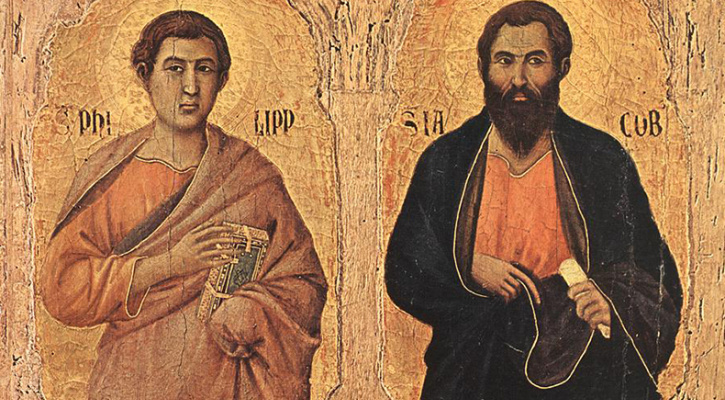
Saints Philip and James, Martyrs

Have you ever been told that you act just like your father? What’s it like to hear that? I imagine it is a good thing to hear if you value the attributes passed on to you. A grateful child will often strive to reflect their father’s values as a way to honor their lives. This thought came to me today as I contemplated the Scripture passages in today’s readings (May 3, 2021) as the Church remembers and celebrates the lives of Saints Philip and James (The Lesser). These early Saints not only acted like Jesus, the Incarnate Father, but they also gave their lives in honor of Him. They stand with the other 12 pillars of the early Church as inspiration and encouragement for us as we, too, endeavor to act just like our Father in heaven.

Saint Paul writes to the believers in Corinth an admonition to remember that they have received the Gospel because men and women were willing to reflect the image of Christ to the world and proclaim His Good News. He writes a mini-lesson on the Passion and Resurrection of Christ, emphasizing that the resurrected Christ appeared to the faithful before his ascension into heaven. The passage ends, “After that he appeared to James, then to all the Apostles. Last of all, as to one born abnormally, he appeared to me.” I wonder why St. Paul makes a point of mentioning the appearance to the apostle St. James. Perhaps St. James had an impact on St. Paul in his early days as a Christian, who knows!

Saint John records in his gospel an encounter St. Philip had with Jesus: “Master, show us the Father, and that will be enough for us.” Jesus said to him, “Have I been with you for so long a time and you still do not know me, Philip? Whoever has seen me has seen the Father…” We see here that St. Philip is remembered for his desire to SEE the Father. There is a theme in the lives of these two apostles that we can learn from as we live in what is now known as the Apostolic Mission of the Church. The age of Christendom that the apostles gave their lives to establish has eroded under the tide of societal ideologies, where the Truth of Christ’s Gospel has “died the death of a thousand qualifications” as Antony Flew once concluded. And now, you and I are called to be the saints-in-the-making for such a time as this, this Apostolic Age version 2, so to speak? How can we, as Saints James and Philip, impact society with the Truth of the Gospel?

Recently, I came across something that Pope Francis said about the necessity of “white martyrdom” of those living in countries where freedom of religion is restricted. As we consider our own country and the growing restrictions on religious expression and freedom of speech, we must not delude ourselves into thinking that if we just keep our head down and continue to be a good neighbor, it will be enough to turn the tide against the escalating hatred of The Faith and the freedom to express that Faith here in the United States. Our white martyrdom is upon us; some of us on the frontline of public debate endure the “cancel culture” mindset every time they speak up for the Truth of Christ. They join the martyrs in this Apostolic Mission we are in now in the 21st century. The bloody martyrdom of Saints James and Philip came about because they did not waver in bearing witness to the Truth of the Gospel. Currently, white martyrs are being marginalized, slandered, maligned, and even imprisoned. Are they losing relationships because of their stand for the Truth of the Gospel? Probably. Does everyone around them cheer them on in their faithfulness to Christ and His Church? Certainly not! Will their lives end in a bloody death? I hope not!

I believe what Pope Francis was getting at in his reference to white martyrdom is a clarion call for you and me. We may not be well-known apologists or public figures; however, we live our lives alongside neighbors, fellow employees, and even family members who would allow the Truth of the Gospel to “die through a thousand qualifications.” If we are to “look just like our Father” by being transformed into the image of Christ, we will be confronted with choices every day that require us to die to our sense of self-protection. Do those around us know us for our faithfulness to the social teachings of Christ’s Church? Do we have the moral backbone to honor Christ’s image in us if we are threatened by their rejection or marginalization?

The white martyrdom of believers who face repeated trials in bearing witness to Christ can be terrifying. When we are tempted to despair over the isolation we may have to endure, we need to remember that the blood of the martyrs was the seed of the Church, and now we must stand up for the Truth they died to protect. We join the company of believers around the world as we stand for this Truth. In doing so, we can water the Church with our faithfulness and courage.

Father, grant us the courage of Saints Philip and James. May we make our own white martyrdom as a total offering to You, where we not only die to ourselves, the world, and its allurements, but we stand against the tide of our culture’s denial of You.

In the name of the Father, and of the Son, and of the Holy Spirit.

Amen

“Lord Jesus, Receive my Spirit.”

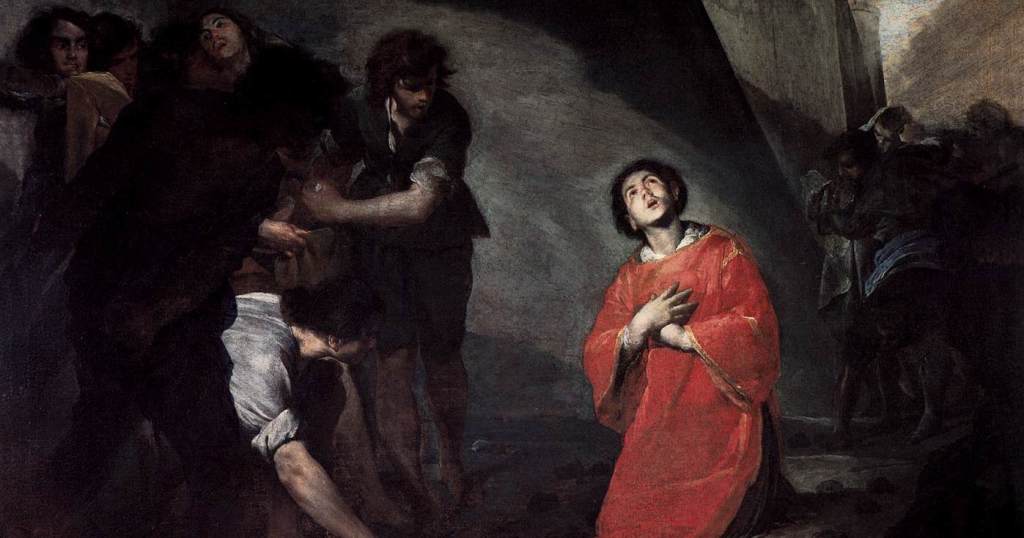
The seventh chapter of the Book of Acts is a nail-biter–the first recorded martyrdom of the early Church. St. Stephen was chosen to be the go-to apostle for that moment in the Church’s history. Why St. Stephen? We understand from the chapter preceding today’s reading that St. Stephen was a deacon of the infant Church, and he was known for being wise, full of faith, and filled with the Holy Spirit. It was written of him that he was full of grace and power, doing great wonders and signs among the people. In short, a holy man who knew who he was, to whom he belonged, and what he was about. St. Stephen inspires me!

As I considered the reading for today, I identified some key takeaways that helped increase my own faith as I strive for fidelity to my Savior. Here are just a few. The interchange between the unbelieving countrymen and Stephen begins with some harsh words:

Stephen said to the people, the elders, and the scribes:
“You stiff-necked people
….”

Not the best way to make friends and influence enemies, right? The problem for the people was that what he was declaring about them was not new to their ears; throughout the Old Testament, the LORD often referred to Israel as stiff-necked because of their constant forgetting to remember who they were–the Chosen People of God. No wonder these first-century Jews were infuriated with St. Stephen’s summation of their actions.

As I think of my life, regretfully, I’m uncomfortably aware of some of my own stiff-necked leanings. There have been times when I’ve been seized by rigid, stiff-necked stubbornness, convinced of my own perspective or by hard-heartedness against someone who didn’t align with my way of thinking. I’m not proud of those moments. More bothersome is when I am more often seized by my own posture; when I spend too much effort on looking to the right and to the left, looking behind me–keeping my head down to look at what’s around me. When I choose only to see the distractions around me, I’m too easily flummoxed into inertia and doubt. And what does the LORD whisper to me when I’m stuck in that posture?

” [Lois] Guard your heart with all diligence, for from it flow springs of life…. Let your eyes look forward; fix your gaze straight ahead. Make a level path for your feet, and all your ways will be sure. Do not swerve to the right or to the left; turn your feet away from evil.”

We also see in St. Stephen’s response to the misguided accusations of the crowd surrounding him an example for us all when we are locked in our regrets about the past or our fears of rejection, or when we are too prideful to change our minds. What did Stephen choose to do? He looked up!

But Stephen, filled with the Holy Spirit,
looked up intently to heaven and saw the glory of God
and Jesus standing at the right hand of God,
and Stephen said, “Behold, I see the heavens opened
and the Son of Man standing at the right hand of God.”

St. Stephen was so convinced that the LORD’s presence surrounded him that his natural response to the fray around him was to look into the eyes of his Saviour. St. Stephen’s vision beyond the perilous reality led him to where he was headed, and he stayed the course! LORD, help us all!

We know that St. Stephen’s life did not end well by man’s standards; some would even surmise that he failed. However, we see the rest of the story. He joined the many martyred saints because he stood firm on the Truth of history and refused to allow what was happening to him in his persecutions to distract him from that Truth. Ultimately, St. Stephen’s words endure as a response for the Church, as we live in a society that grinds its teeth at Truth with a stiff-necked, anti-Christ-like assumption about how life works. Despite the fear and anger we may feel as we, too, are surrounded by a mad crowd, we must persevere! Is the courage to do what is right a challenge for you? St. Stephen’s last plea to the LORD infused him with courage to endure. He had already been filled with the spirit of the Lord, and he knew his destination was not determined by the crowd. No, Jesus was standing, ready, arms open to receive his spirit!

“LORD Jesus, receive my spirit.”

LORD Jesus, transform our spirits with confidence in the truth that you are waiting to receive our spirits in every moment! We only have to let go of our grip on self-preservation.

LORD Jesus, we desire the faith, wisdom, and integrity of St. Stephen, but you know how stiff-necked we can be about our own ideas, rights, and privileges. Forgive us when we’d rather tune into the voices of our society than listen to your Truth, Beauty, and Goodness. Would you restore the proper spirit within us?

LORD Jesus, when we walk the life of Faith with a wobble from always looking back to what has happened rather than looking forward into Your eyes, help us to fix the gaze of our eyes upon You.

St. Stephen, pray for us.

In the name of the Father, and the Son, and the Holy Spirit.

Amen