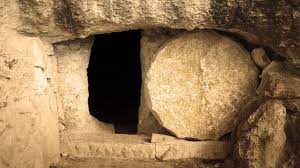
… Mary stood weeping outside the tomb. As she wept, she bent over to look into the tomb; and she saw two angels in white, sitting where the body of Jesus had been lying, one at the head and the other at the feet. They said to her, “Woman, why are you weeping?” She said to them, “They have taken away my Lord, and I do not know where they have laid him.” When she had said this, she turned around and saw Jesus standing there, but she did not know that it was Jesus. Jesus said to her, “Woman, why are you weeping? Whom are you looking for?” Supposing him to be the gardener, she said to him, “Sir, if you have carried him away, tell me where you have laid him, and I will take him away.” Jesus said to her, “Mary!” She turned and said to him in Hebrew, “Rabbouni!” (which means Teacher) … Mary Magdalene went and announced to the disciples, “I have seen the Lord,” and she told them that he had said these things to her. John 20:19-23
Consider: A good habit to have when reading the Sacred Scriptures is placing ourselves in the sandals of our ancestors in the faith to understand the depth of the salvation God grants us through Jesus Christ. With that in mind, let’s consider Mary Magdalene’s thoughts as she walks to Christ’s tomb the morning of His resurrection.
I remember the moment I fell before you, splayed out in the weariness of my bondage, begging for mercy. You saw my bruises from the seven demons that assaulted me day and night, you heard my cries, and you exorcized those demons from me. Hope and joy instantly replaced my despair. I was a new woman! I loved you, I followed you; I believed your promises. You gave me a new name: Beloved. Oh, Jesus, now I’m bereft. You have forsaken me. I don’t know who I am anymore; I’ve forgotten my name.
The tomb is empty, and Mary’s despair has robbed her memory of Christ’s promise. Jesus stands nearby, waiting for Mary to look at him. He quietly calls to her, Mary! She turns and says to him in Hebrew, ‘Rabbouni!’ (which means Teacher).
Despair does that to us, doesn’t it? It can creep into our lives slowly taking possession of us, causing us to forget who we are and who Christ is. Despair can happen in a catastrophic event that quakes the ground beneath us, threatening to destroy us. We have all been there, and still, we soldier on worshipping at mass after mass, confessing our sin confession after confession. We need to hear the word of Jesus: You are my beloved child, I have chosen you, I am with you, I am keeping my promise to you, I will never leave you or forsake you.
Pray: Jesus, your Word reminds me that you knew me before I was born; in my mother’s womb, you named me. Would you remind me of that when despair begins to creep in? I want to know that my love for you is not in vain. When I have spent my last strength to seek you, help me to stay silent and listen for your Words of consolation– ‘You are my servant in whom I will be glorified.’ When I cry out to you, ‘I have labored in vain, and I have spent my strength for nothing in return,’ remind me that my name is inscribed on the palm of your hand, and recompense will come; you will never forget me! ~Amen (adapted Isaiah 49:1-5; 15-16)
Act: We are a Resurrection people! Christ didn’t leave the Magdala in her despair on Resurrection morning, and he doesn’t leave us now, but all too often, we think our despair is ours to carry alone. The tomb you keep mourning is empty of your despair! Christ fought for hope when he conquered death, hell, and the grave. On this Easter Sunday, declare your faith in Our Risen Lord, put down your despair, and turn to follow Jesus to new life.
And [Pilate] said to [the mob], ‘Behold, the man!’ ~St. John 19:5
Consider: The processional for Palm Sunday Mass includes an invitation to Christ’s Passion. With all faith and devotion, let us commemorate the Lord’s entry into the city of our Salvation, following in his footsteps, so that, being made by his grace partakers of the Cross, we may have a share also in his Resurrection and his life. I kindle to the word invitation for it calls for a response. The invitation begins with Pilate’s words to the frenzied mob as the humiliated humanity of Jesus is paraded before them; Pilate exclaims, Behold the Man. That invitation into Christ’s humanity during his Passion begs us to behold. Now, there’s another word I kindle to. We aren’t passing spectators who just glimpse this holiday we call Easter, who color Easter Eggs and bake hams; No! We behold–witness, contemplate, discern, consider, and perceive–because it is not just any man we behold. This Man, the Second Adam, is the Lamb of God who takes away the world’s sin. In him, the curse of the first man is reversed–O happy fault that earned so great, so glorious a Redeemer! Let us behold our Redeemer! In this Holy Week, we see the length, depth, breadth, and height God went to regain his own–us, his beloved children. He exchanged himself as payment to redeem us to himself. This week is truly the path back home to our Father!
Broken and Spilled Out
[Christ Jesus] though he was in the form of God, did not regard equality with God as something to be grasped. Rather, he emptied himself, taking the form of a slave, coming in human likeness; and found human in appearance, he humbled himself, becoming obedient to death, even death on a cross. Because of this, God greatly exalted him and bestowed on him the name that is above every name, that at the name of Jesus every knee should bend, of those in heaven and on earth and under the earth, and every tongue confess that Jesus Christ is Lord, to the glory of God the Father. ~Philippians 2:6-11
Christologists have a word for today’s Epistle passage from St. Paul’s letter to the Philippians (2:6-11): Kenosis. In our commemoration of Christ’s Passion, we will observe the complete ‘self-emptying’ of Christ’s divine nature to suffer humanity–Behold the Man! That is the Savior we need–suffering human emotions and pain to lead us to empty our disordered human nature. God, with skin on, incarnated himself into us so that we may be re-created into our created identity as sons and daughters of The Most High God. Mind-blowing! And the only way of our re-creation is to follow Christ in His Passion. We, as Catholics, refer to this as redemptive suffering as we understand all suffering is a sacrament we unite with our Lord Jesus Christ. No suffering is wasted when we unite it with our Lord Jesus Christ’s suffering for us in His Passion. Let’s begin.
There’s an arresting (no pun intended) moment in today’s Gospel reading from St. Mark 14, hours before Judas’ betrayal, which foreshadows Christ’s Passion. Jesus was in Bethany, just outside of Jerusalem, eating with Simon, the leper, when a woman came with an alabaster jar of perfumed oil, costly genuine spikenard. She broke the alabaster jar and poured it on his head. Accusations and complaints followed about the extravagance of her offering being wasted on Jesus’ head. Jesus replies, Let her alone. Why do you make trouble for her? She has done a good thing for me… wherever the gospel is proclaimed to the whole world, what she has done will be told in memory of her.” Jesus is about to be extravagantly broken and spilled out, for humanity is anointed by a broken and spilled-out woman in thanksgiving and praise. This is the posture, the sacrifice, to be embraced as we behold the Man, Jesus.
What about you, friend? Is your love for Jesus a lavish offering of abandonment to his goodwill, or are you constrained by parsimonious withholding caused by doubt and skepticism? Jesus told us that when we give, it will be given to [us]. A good measure, pressed down, shaken together, running over, will be put into [our] lap, for the measure [we] give will be the measure [we] get back. (St. Luke 6:38)
Pray: Jesus, Son of God, have mercy on me. It is so easy to get caught up in grasping what I think I deserve from this life that I forget this life is not where I belong; I’m on my way home to You. I don’t belong here; therefore, I am not defined or controlled by what others may think of me, what I have or don’t have, what I do or don’t do. Empty me of all that is not You so that I may be permeated by all that is You! ~Amen
Act: Choose your most treasured possession and lavish it on another.
They (the soldiers who had mocked, beaten, and humiliated Jesus) pressed into service a passer-by, Simon, a Cyrenian, who was coming in from the country, the father of Alexander and Rufus, to carry his cross.
~St. Mark 15:21
Consider:
Today, we are invited to enter the profundity of all ages–Holy Week. The excruciating events of this week grant us the most extraordinary depth of insight into Jesus’ heart. It is incumbent on our faith in God to enter this week with humility and thanksgiving, for in this week, we see in stark detail what Love beckons us to become.
Jesus taught his disciples that if they wanted to follow him, they must take up their cross (Matthew 10:28). And St. Paul reminded the believers in the Early Church that we complete Christ’s sufferings through our willingness to suffer as Christ suffered (Colossians 1:24). The economy of Salvation stupifies me sometimes—no, much of the time! We gain when we lose, live when we die, and are exalted only through humility.
Let’s keep that in mind as we consider Simon of Cyrene, who physically entered Christ’s suffering by carrying his cross for him. St. Luke observes that after laying the cross on [Simon], they made him carry it behind Jesus. Interesting point. Don’t you want to know what may have run through his mind as he followed the God-man, beaten beyond recognition, stumbling along before him? We do know this: the way (attitude) Simon carried Christ’s Cross changed the trajectory of his life, much in the way the Lord wants to transform our lives. (St. Simon spread The Gospel in northern Africa; he was eventually martyred for his faith in Christ around 100 A.D. His sons, Alexander and Rufus, were among the first believers in the Early Church in Rome. Because of the influence of St. Simon of Cyrene, we can assume The Church was graced with Tertullian, St. Augustine, St. Cyprian, and St. Monica from northern Africa)
If we genuinely desire to follow Christ to eternal life, we must first walk The Way of The Cross. But how exactly do we do that? Jesus told his disciples that he was the Good Shepherd who laid down his life for his sheep. The Greek meaning here is that Christ laid down his life, soul, heart, and mind. He calls us to do the same; how are we doing? Do we lay down our thoughts and words? Do we lay down our desires? How often do our tongues complain when a circumstance or someone messes with our plans? How often do we complain to others about someone who has offended us? How frequently do our minds refuse another’s need because it will cause us discomfort?
Isaiah prophesied that Jesus would be like a lamb, led to slaughter. Have you ever observed lambs? They just follow the sheep who follow the shepherd. Hmm? What if Simon complained and blamed Christ as he bore his burden to The Cross? What would have happened to Alexander and Rufus if Simon had complained about his burden of following Christ to his Cross? What happens in us when we spur suffering as if we don’t deserve it? How are the observers of our lives affected by our attitudes in the face of unwelcomed interruptions?
Every bit of inconvenience, interruption, and disruption is God’s will for us in that moment where we have the choice to lay down our life, soul, heart, and mind. Although minor inconveniences have little consequence, they provide practice in laying down our lives with an attitude of thanksgiving. When the consequential sufferings of our lives come along, we recognize them as the call of Christ to complete his suffering by carrying our cross in what he has allowed in our lives.
Christ went to the Cross to save us from the immense sufferings of sin and death. He allows whatever temporal sufferings–the diagnosis, the betrayal, the tragedy, the loss–to save us from ourselves along the way. He saves us in the circumstances, and our mind, body, and soul will be transformed into his likeness! That is the way of The Cross.
Pray: Shepherd of my heart and Savior of my life, I exalt you; my soul magnifies you! Yet I so quickly magnify my molehills into mountains when something comes along to mess with my control. Please forgive me for my pride, fear, and self-absorption. You created me in your image; it takes a lifetime of surrendering my will to you. Why do I delay it by resisting Your will for me in each circumstance? Why do I doubt your everlasting love for me? You will never lead me where you do not want me to go, but sometimes I do. Lead me back to the Way of the Cross, the path of my salvation. ~Amen
Act:
Consider taking up the Daily Examination as a habit. I’ve included a link to help you along.
Then the soldiers of the governor took Jesus into the governor’s headquarters, and they gathered the whole cohort around him. They stripped him and put a scarlet robe on him, and after twisting some thorns into a crown, they put it on his head. They put a reed in his right hand and knelt before him and mocked him, saying, “Hail, King of the Jews!” They spat on him, and took the reed and struck him on the head. After mocking him, they stripped him of the robe and put his own clothes on him. Then they led him away to crucify him. Matthew 27:27-31
Consider: Who was in the cohort around Jesus? People like you and me who were patriotic, doing their duty and living according to the laws of Rome. They carry out justice according to the law of the land, well-meaning, yet tragically misled. Jesus had come to show a new law that wasn’t violent, a law where mercy and justice meet. Imagine what thoughts invaded Jesus’ mind while they were torturing him and mocking his deity; we can’t, can we? But we do know that he didn’t call down justice on them at that moment; revenge was not on his agenda. He offered himself as a willing sacrifice for the sins committed against him!
We have all been wounded at some time or another—ganged up on, ridiculed for our beliefs, mocked, and humiliated—no easy recovery from these wounds. Perhaps you are struggling to release yourself into the healing hands of Jesus. In a post-WWI novel, “The Light Between Oceans,” a conversation between a wife and her German husband speaks right to the heart of our struggle. Rachel, the wife, asks her husband, “How can you just get over these things … you’ve had so much strife, but you’re always happy; how do you do it?” Frank replied, “I can choose to spend my time rotting on things in the past and hating people for what happens … or I can forgive and forget … Oh, but it is so much less exhausting; you only have to forgive once; to resent, you have to do it all day. Every day, you have to keep remembering all the bad things—a very long list to make sure you keep remembering all the bad things to make sure that I hated the people on it the right amount and that I did a very proper job with hating too. No, we always have a choice, all of us.”
Pray: Jesus, Suffering Servant of humanity, teach me how to forgive! You suffered my sins on your Cross so that I wouldn’t have to suffer, yet I choose to suffer when I hold tightly to the offenses toward me. Revenge creeps into my soul like a slow cancer, destroying my spirit. Oh, Jesus, forgive me! –Amen
Act: Prayerfully examine your spirit and allow yourself permission to record the suffering you carry with you from past injustices. If possible, take the list with you to Adoration. Tell our Suffering Servant each injustice you are holding onto. Allow your imagination to take you into the governor’s headquarters, and look at Jesus’ eyes as he silently receives the crown of thorns and the strikes to his Sacred Head. He sees your pain; he KNOWS your pain. Allow the Blood that is pouring from his head wounds to flow over your mind and memory; as soon as you can, light a match to your list, surrendering it to the Lover of your soul.
…A centurion there had a slave who was ill and about to die, and he was valuable to him. When he heard about Jesus, he sent elders of the Jews to him, asking him to come and save the life of his slave. They approached Jesus and strongly urged him to come, saying, “He deserves to have you do this for him, for he loves our nation and he built the synagogue for us.” And Jesus went with them, but when he was only a short distance from the house, the centurion sent friends to tell him, “Lord, do not trouble yourself, for I am not worthy to have you enter under my roof. Therefore, I did not consider myself worthy to come to you; but say the word and let my servant be healed. For I too am a person subject to authority, with soldiers subject to me. And I say to one, ‘Go,’ and he goes; and to another, ‘Come here,’ and he comes; and to my slave, ‘Do this,’ and he does it.” When Jesus heard this he was amazed at him and, turning, said to the crowd following him, “I tell you, not even in Israel have I found such faith.” When the messengers returned to the house, they found the slave in good health.
The Gospel according to St. Luke 7:1-10
This gospel passage is a powerful model of faith; it is so poignant that a rendition of the centurion’s request of Jesus is our prayer in the Communion Rite before the Liturgy of the Eucharist in the worship of the Mass. We pray together the Lord’s Prayer asking for God’s kingdom to come into us. We ask for the bread of life to satisfy what we lack in this life, and we ask for forgiveness and deliverance from evil. We declare that the kingdom, the power, and the glory are yours now and forever. We kneel before the feast of our salvation, Christ’s body and blood, perceived as bread and wine.
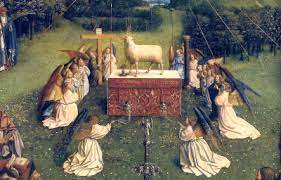
Just after our priest has consecrated the bread and wine, he holds the host up before us and proclaims, Behold the Lamb of God, behold him who takes away the sins of the world. Blessed are those called to the supper of the Lamb. We respond in praying, Lord, I am not worthy that you should enter under my roof, but only say the world and my soul shall be saved just before receiving the real presence of Christ in his body and blood, soul and divinity in the form of bread and wine. Friends, does that moment in the Mass gets to you as it does to me every time? I am a prideful sinner who needs this saving nourishment in the form of bread and wine to transform me. In truth, we all entrapped by the sin in our fallen world.
What can we observe in this narrative that will increase our faith as we pray the Mass? We see that the centurion had power and authority over the people because of his position in the Roman occupation of Israel. We observe his concern for his servant and, more importantly, the esteem he had for Jesus. On the other hand, Jesus had power and authority beyond human understanding! We aren’t sure exactly what the centurion expected other than immediate relief from his problem. But, his faith in Jesus made all the difference in the world for the centurion and his servant. What was in the centurion’s mind and heart that opened the door for the centurion’s servant’s healing from his suffering? It was the humble acknowledgment that he was helpless.
The acknowledgment that he was not worthy opened before him the way of salvation for his servant, but also, I believe, for himself! No one can encounter Jesus and walk away the same as they were before. The disposition of our soul toward Jesus determines our faith and trust in the eternal truth that his passion and sacrifice are our salvation, healing, and hope. This is why we kneel in prayer in the worship of the Mass and as well, in the moment-by-moment surges of the heart toward the reality of the Cross! St. James wrote, Humble yourselves, in the sight of the LORD, and that he will lift you up. The crucifix is the symbol of the central truth of our Faith–Christ suffered death, hell, and the grave for the sake of humanity, and now he intercedes before the Father for us. That should humble us!
I need reminding that the power and might in Christ’s suffering, death, and resurrection are the answer to my deepest longings. For this week, in particular, I have knelt before him, asking for relief for my children and grandchildren’s suffering as we walk together through the long valley in the shadow of death. My ability as a mother and grandmother to comfort is only through Christ’s saving grace at work in our suffering. And so, I humbly bow and say,
Lord, I am not worthy that you should enter under my roof. Only say the word and my loved ones shall be comforted.
In the name of the Father, and the Son, and the Holy Spirit.
As it was in the beginning, it is now, and ever shall be, world without end.
Straight away in the Gospels, the role of St. John the Baptist as the last prophet of Israel is established. The Jews, who were awaiting the New Covenant and the New Exodus that the LORD had inspired Isaiah and other prophets to foretell, gathered around this prophet who described the soon-to-be-fulfillment of the entirety of the Old Covenant God made with his people. Some discerned St. John the Baptist knew what he was talking about; others fought him and his message tooth-and-nail to the death. When Jesus arrives at the Jordan River to fulfill the Old Testament prophecies, St. John the Baptist declares to everyone, “Behold, the Lamb of God, who takes away the sins of the world… .” Fitting words for this Jesus who would now take his place as The Sacrificial Lamb of the Old Covenant.
Yesterday, we entered Holy Week, the most sacred week of our liturgical year. The Church has been guiding us through the Sacred Scripture to this week of The Passion of Christ. Now she calls to us as St. John the Baptist called, “Behold the Lamb of God.” All the liturgies of this sacred and somber week will invite us to consider the Suffering Servant of humanity. As we transport with our imagination into the events of Holy Week, we are more than spectators; we are beholders; we are to enter into the drama of our salvation. The word “behold” means more than to glance or notice; it means to observe and discern. Moses didn’t just glance at the burning bush in the desert; he beheld it. Our Blessed Mother didn’t just nod to Archangel Gabriel’s word on the incarnation of Christ within her; she declared, “Behold, I am the handmaid of the LORD!” One thousand sixty-five times, the inspired Word of God admonishes us to behold; for in observing, meditating, and discerning what the LORD is communicating to us through our senses, he aims for us to see beyond ourselves into Salvation History. The LORD calls us to open our eyes wide open to our salvation!
You have noticed, no doubt, that The Church consistently includes readings from the Book of the Prophet Isaiah in our daily liturgy. Good reason! The book of prophecies is known as the “Fifth Gospel.” Though written hundreds of years before the Incarnation of Christ, the prophet foretells the reality of the promised fulfillment of the Old Covenant. Where once God’s people offered sacrifices of lambs for the atonement of their sins, The Lamb of God, The Messiah, would someday offer his life as the final sacrifice for humanity.
The readings from Isaiah during Lent have been rich with these prophecies, so rich that I find I’ve often prayed with Isaiah as I anticipated this Holy Week. I invite you to join me in praying the words of Isaiah from chapters 42 and 53.
The LORD says to us:
Beloved, here is my servant, Jesus, whom I uphold, my chosen one with whom I am pleased, Upon whom I have put my Spirit; he shall bring forth justice to the nations… Until he establishes justice on the earth; the coastlands will wait for his teaching… Behold my salvation!
Beloved, I formed my servant, Jesus, and set him as a covenant of the people, a light for the nations, To open the eyes of the blind, to bring out prisoners from confinement, and from the dungeon, those who live in darkness… Behold my salvation!
(Isaiah 42)
Jesus says to us:
Beloved, do you believe what you have heard?… Behold my life in your place!
I grew up like a sapling before you, like a shoot from the parched earth; I had no stately bearing to make you look at me, nor appearance that would attract you to me… Behold my life in your place!
I was spurned and avoided by people, I suffered, I was accustomed to infirmity, people even hid their faces, spurned me, and held me in no esteem… Behold my life in your place!
It was your infirmities that I bore, your sufferings that I endured, while you thought of me as stricken, as one smitten by God and afflicted… Behold my life in your place!
I was pierced for your offenses, crushed for your sins; I took upon me the chastisement that makes you whole, by my stripes, you were healed. You had gone astray like a lamb, you followed your own way; but the LORD laid upon me your guilt… Behold my life in your place!
Though I was harshly treated, I submitted and opened not my mouth; like a lamb led to the slaughter or a sheep before the shearers, I was silent and opened not my mouth. Oppressed and condemned, I was taken away, and you would have not thought any more of my destiny… Behold my life in your place!
When I was cut off from the land of the living, and smitten for your sin, a grave was assigned for me among the wicked and a burial place with evildoers, though I had done no wrong nor spoken any falsehood. But the LORD was pleased to crush me in infirmity… Behold my life in your place!
I gave my life as an offering for your sin… and the will of the LORD for you was accomplished through me. Because of my affliction, you shall see the light in fullness of days; through my suffering, I justified many, and your guilt I bore… Behold my life in your place!
I endured my Passion so that you would live in victory from sin and death. I surrendered myself to death and was counted among the wicked; I took away your sin and won pardon for your offenses… Behold Your life in my place!
“What lies behind us and what lies before us, are tiny matters compared to what lies within us.”
–Ralph Waldo Emerson
When Jesus came into Galilee, the Galileans welcomed him, since they had seen all he had done in Jerusalem at the feast; for they themselves had gone to the feast.
Then he returned to Cana in Galilee, where he had made the water wine. Now there was a royal official whose son was ill in Capernaum. When he heard that Jesus had arrived in Galilee from Judea, he went to him and asked him to come down and heal his son, who was near death. Jesus said to him, “Unless you people see signs and wonders, you will not believe.” The royal official said to him, “Sir, come down before my child dies.” Jesus said to him, “You may go; your son will live.” The man believed what Jesus said to him and left. While the man was on his way back, his slaves met him and told him that his boy would live. He asked them when he began to recover. They told him, “The fever left him yesterday, about one in the afternoon.” The father realized that just at that time Jesus had said to him, “Your son will live,” and he and his whole household came to believe…
The Gospel according to St. John 4:43-54
Something my mom used to say came to my mind as I meditated on the gospel reading for today. “Hope springs eternal.” She would tag on the line from the psalms as well, “Weeping may last for the night, but joy comes in the morning.” My mom knew what she was talking about, for she suffered all her life from a chronic disease that eventually took her life, yet her hope for healing never waned. The people that surrounded our LORD’s life as he lived among us were no different; there was always a sense of anticipation as Jesus came near to their reality. The crowds had heard or witnessed that this Jesus was more than meets the eye, and so they hoped!
It took great humility for that royal official to expose his need to this Jew; he could have ridiculed Jesus and the citizens of Israel for their belief in one God rather than the many Roman gods of his country. He could have ignored what the people were saying about Jesus. We don’t know if he had witnessed any of Jesus’ miracles, but he could have dismissed them as trickery and entertainment. He doesn’t do any of that; he boldly went to Jesus and requested out of the brokenness that only a parent can have for a child. Even when Jesus seems to rebuke the crowd, him included, for demanding signs and wonders, the royal official stays on point. Can you sense his urgency when he asks Jesus to come before his child dies? The royal official represents us, doesn’t he? We’ve all been desperate for hope from time to time. We’ve longed to be free from the sorrow we endure for others or ourselves. In God’s kingdom reality, nothing separates us from being in that crowd that day, for his story is our story. Jesus’ words and actions then are his words and actions now, and ever shall be! Hope does spring eternal!
The Church reminds us of this beautiful truth through the other Scripture readings for today’s Mass. Hear the Word of the LORD to Isaiah 65:17-21
Thus says the LORD: Lo, I am about to create new heavens and a new earth; The things of the past shall not be remembered or come to mind. Instead, there shall always be rejoicing and happiness in what I create; For I create you to be a joy and a delight; I will rejoice in you and exult in my people. No longer shall the sound of weeping be heard there, or the sound of crying; No longer shall there be in it an infant who lives but a few days, or an old man who does not round out his full lifetime; He dies a mere youth who reaches but a hundred years, and he who fails of a hundred shall be thought accursed. They shall live in the houses they build, and eat the fruit of the vineyards they plant.
Years ago, the truth of Isaiah’s words; the LORD constantly recreating and restoring what seems dead to life came to me during the early Spring as I was cleaning up winter from our garden. I removed some decaying leaves from the soil and discovered “Hope Springs Eternal.” There beneath the refuse of the past season’s death were the tender green shoots of our Crimean Snowdrops lifting their delicate white caps upward toward the early Spring sun. They seemed to say, “Hello again, beautiful world, I’ve returned to glorify the Creator!”
LORD, there are seasons in our lives when we feel short on hope. Help us see beyond the present moment that threatens to steal our joy by eroding our hope in you, the God of Creation and Recreation. We look at the whole scheme of things happening to us or around us, and we wonder if you are still the LORD of the impossible. We bring our families to you and humbly ask you to recreate us into the fullness of life with you. We offer ourselves and our besetting sins that decay and destroy hope in you. We bring our world to you and urgently ask that you heal the unrest in war-torn countries before there is any more death.
We ask this in the name of the Father, and the Son, and the Holy Spirit.
As it was in the beginning, it is now, and ever shall be, world without end.
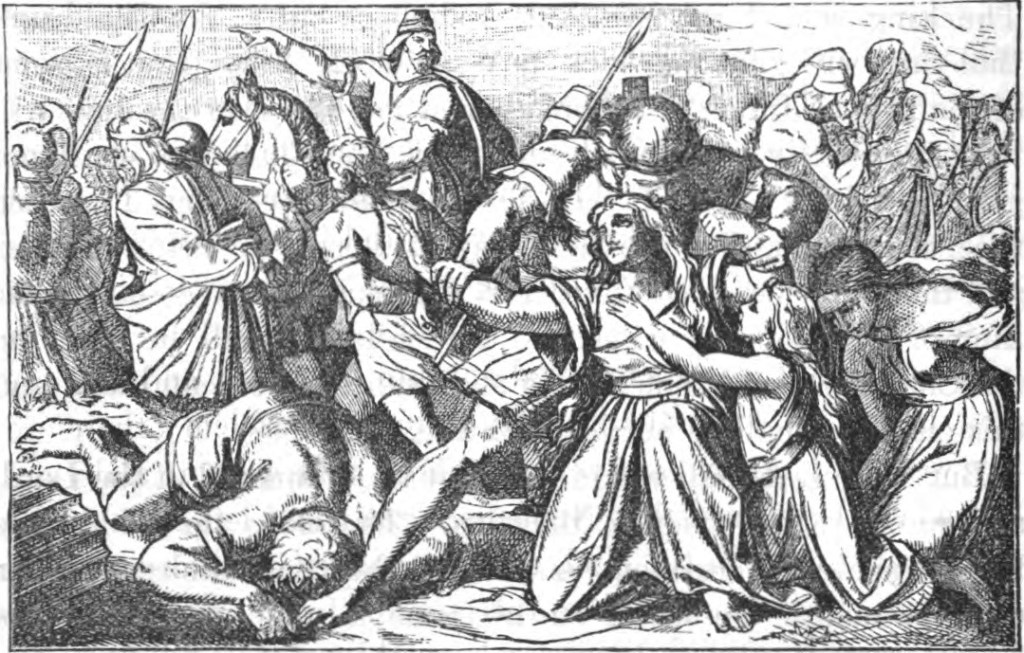
Naaman, the army commander of the king of Syria, was highly esteemed and respected by his master, for through him the LORD had brought victory to Syria. But valiant as he was, the man was a leper. Now the Syrians had captured in a raid on the land of Israel a little girl, who became the servant of Naaman’s wife. “If only my master would present himself to the prophet in Samaria,” she said to her mistress, “he would cure him of his leprosy.” Naaman went and told his lord just what the slave girl from the land of Israel had said. “Go,” said the king of Syria. “I will send along a letter to the king of Israel.” So Naaman set out, taking along ten silver talents, six thousand gold pieces, and ten festal garments. To the king of Israel,he brought the letter, which read: “With this letter, I am sending my servant Naaman to you, that you may cure him of his leprosy.”
When he read the letter, the king of Israel tore his garments and exclaimed: “Am I a god with power over life and death, that this man should send someone to me to be cured of leprosy? Take note! You can see he is only looking for a quarrel with me!” When Elisha, the man of God, heard that the king of Israel had torn his garments, he sent word to the king: “Why have you torn your garments? Let him come to me and find out that there is a prophet in Israel.”
Naaman came with his horses and chariots and stopped at the door of Elisha’s house. The prophet sent him the message: “Go and wash seven times in the Jordan, and your flesh will heal, and you will be clean.” But Naaman went away angry, saying, “I thought that he would surely come out and stand there to invoke the LORD his God, and would move his hand over the spot, and thus cure my leprosy. Are not the rivers of Damascus, the Abana and the Pharpar, better than all the waters of Israel? Could I not wash in them and be cleansed?” With this, he turned about in anger and left.
But his servants came up and reasoned with him. “My father,” they said, “if the prophet had told you to do something extraordinary, would you not have done it? All the more now, since he said to you, ‘Wash and be clean,’ should you do as he said.” So Naaman went down and plunged into the Jordan seven times at the word of the man of God. His flesh became again like the flesh of a little child, and he was clean.
He returned with his whole retinue to the man of God. On his arrival, he stood before him and said, “Now I know that there is no God in all the earth, except in Israel.”
II Kings 5: 1-15
The Old Testaments’ stories of God’s intervention in human circumstances are intriguing to read as all of Sacred Scripture. Everything within it is necessary for our salvation, and we know that the story of Scripture is the story of us. Meditating on the Word of God allows room for his Holy Spirit to direct our lives, transforming our minds, in sum, saving us from ourselves.
Namaan’s attitude toward what the LORD required him to do for his physical healing from leprosy gets at the disposition of the heart that the LORD desires from us. Humility is the path of salvation from ourselves and the mess we can make of our relationships. And then there is a lesson for us through the actions of the nameless servant girl and other servants who were in the background of Namaan’s existence.
Namaan was enslaved by leprosy, yet he was a commander in the formidable Aramaen (modern-day Syria) army; he was not an Israelite; he was an enemy of Israel. Nevertheless, the LORD had brought him victory. “He was a mighty man of valor, but he had leprosy.” We are or have been in Namaan’s sandals, haven’t we? We walk the tightrope of what others know of us–how we are identified based on what we do and how we measure up. It is always honoring to our LORD when we conduct ourselves with integrity. But what comes after the comma of our public self is what is most important about us. There is where our loving LORD desires to bring to order in us his divine image. Namaan’s problem was leprosy was obvious, but it is clear the LORD was after another enslavement by his disordered pride.
He bristled at St. Elisha’s directive to go and wash in the Jordan river 7 times and responded out of his disordered pride:
But Naaman went away angry, saying, “I thought that he would surely come out and stand there to invoke the LORD his God, and would move his hand over the spot, and thus cure his leprosy. Are not the rivers of Damascus, the Abana and the Pharpar, better than all the waters of Israel? Could I not wash in them and be cleansed?” With this, he turned about in anger and left.
We know the story ends well for Namaan, but, left to his own devices, it wouldn’t have, had it not been for the voices of the nameless servants in the background of his life. The little servant girl to Namaan’s wife had the courage and faith in the God of her ancestors to speak up with a beautiful response to Namaan’s disease. Considering that she was a little girl taken captive and enslaved in a raid by Namaan’s Syrian army against her home and family, her response is striking. To Namaan, she was just one of the many spoils of war. In God’s eyes, she was an instrument of healing.
The other nameless slaves, who very well could have been captives themselves, intervened when Namaan wanted to stomp away from the ground where his healing lay:
But his servants came up and reasoned with him. “My father,” they said, “if the prophet had told you to do something extraordinary, would you not have done it?
The motivation of the slaves’ courage to intervene is observed in how they addressed their master, “My father…”. They honored their master.
Friends, do you find yourself in the narrative? I do! As I’ve spent time in meditation on this Scripture, the LORD has reminded me of a few things.
As in Namaan’s life, the enslavement to a physical illness or disability can be healing for our spirit’s deeper disease of Pride, Fear, and Anger. Suffering is the gift from our Suffering Servant and Savior to draw us back to who he created us to be–a beloved child created in his image.
Like the enslaved little servant girl, circumstances that we are in through no fault of our own could make us bitter if we don’t recognize God’s providence is always at work to save us from the unjust suffering of our lives.
Like the enslaved servants of the honorable Namaan, the LORD places us in the lives of others to love and honor them, even make intercession for them. We give of our love through mercy and grace, courage and perseverance to serve the LORD by serving others despite what may be discouraging circumstances in our lives.
Our LORD and Savior, we say with Namaan, we know that there is no God in all the earth, except in Israel. LORD, we desire to worship you with our entire being, but that includes some humiliation and unwanted circumstances from time to time. Would you help us to humble ourselves as Namaan did? Would you help us to forgive others and desire the best for them as the little servant girl did? Please help us to consider our service to others as an offering to you who died serving us! As you destroyed death, hell, and the grave to resurrect us to live with you, may we continue your work of salvation in and through our circumstances and the suffering of our lives.
In the name of the Father, and the Son, and the Holy Spirit.
As it was in the beginning, it is now and ever shall be, world without end.
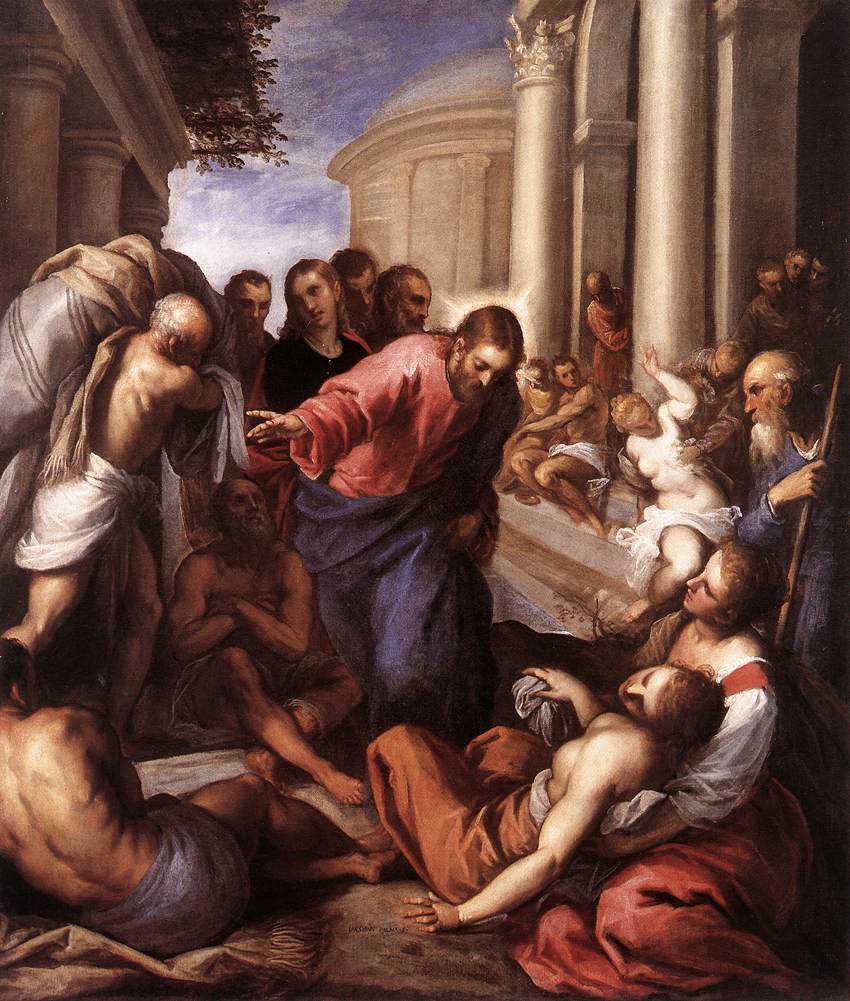
As Jesus came down from the mountain with Peter, James, John and approached the other disciples, they saw a large crowd around them and scribes arguing with them. Immediately upon seeing him, the whole crowd was utterly amazed. They ran up to him and greeted him. He asked them, “What are you arguing about with them?” Someone from the crowd answered him, “Teacher, I have brought to you my son possessed by a mute spirit. Wherever it seizes him, it tears at him; he foams at the mouth, grinds his teeth, and is withered up. I asked your disciples to drive it out, but they were unable to do so.” He said to them in reply, “O faithless generation, how long will I be with you? How long will I endure you? Bring him to me.” They brought the boy to him. And when he saw him, the spirit immediately threw the boy into convulsions. As he fell to the ground, he began to roll around and foam at the mouth. Then he questioned his father, “How long has this been happening to him?” He replied, “Since childhood. It has often thrown him into fire and water to kill him. But if you are able, have compassion on us and help us.” Jesus said to him, “‘If you able!’ All things are possible to one who has faith.” Then the boy’s father cried out, “I do believe, help my unbelief!” Jesus, on seeing a crowd rapidly gathering, rebuked the unclean spirit and said to it, “Mute and deaf spirit, I command you: come out of him, and never again may you enter him!” Shouting and throwing the boy into convulsions, it came out. He became like a corpse, which caused many to say he had died. But Jesus took him by the hand, raised him, and he stood up. When he entered the house, his disciples asked him in private, “Why could we not drive the spirit out?” He said to them, “This kind can only come out through prayer.”
The Gospel According to St. Mark 9:14-29
I’d be hard-pressed to choose a favorite gospel account of Jesus’ healings, but I know this one would be among my top choices. The interaction between the father and Jesus reveals guidance for my prayer life. The truth that “Jesus became flesh and dwelt among us” is in full array in this encounter, and we can receive the same graces through prayer with Jesus as the father and son received from his physical presence to them. Jesus’ life on this side of eternity was a prayer with our heavenly Father, and he consistently invited the observers of his life into the same intimacy. His actions, healings, and teachings, his very flesh, were united with humanity to show us the way back to our created identity of intimacy with our Triune God, and that only comes through the communion of his body and flesh in The Eucharist and the communion of prayer with him.
The father was just another whobody to everyone else, but he was the very reason Jesus approached the folk surrounding him. Long before the father emerged from the crowd, Jesus knew him and how the father had suffered for his son and how the son had suffered because of the presence of an unclean spirit in his life. How life happened to them is not as important to Jesus; no need to connect the dots to cast blame. It had happened to the father and the son, and now Jesus would happen to the father and the son. It is the same for you and me. We are sometimes like father and son, aren’t we? We either suffer on behalf of someone or we are the one who suffers. Jesus sees us just as he saw the father and son long before that encounter. He knows what we silently carry in our hearts and souls.
Jesus comes to us without condemnation, and he sees into our hearts, not our past. He doesn’t see how we may have fumbled; he doesn’t bring up what could have been or what should have been. No, he, the suffering servant of mankind, absorbs our suffering as he did for the father and son, and then, healing transformation unfolds in us. He asks us the same question, “How long have you carried this? Do you want to be made whole…what are you looking for?” He knew the father needed to pour out the pain he had carried before him. The act of speaking our pain before the LORD is a part of healing because it requires humility to confess our need, doesn’t it? The psalmists often prayed, “Hear, O Lord, and be gracious to me! O Lord, be my helper!” (Psalm 30:10) And I can’t help but hear Jesus’ words echoing in the encounter with the father and son,“Come to me, all you that are weary and are carrying heavy burdens, and I will give you rest. Take my yoke upon you, and learn from me; for I am gentle and humble in heart, and you will find rest for your souls.” (St. Matthew 11:28-29)
“If you are able, have compassion on us and help us.” Jesus said to him, “‘If you are able!’ All things are possible to one who has faith.” Then the boy’s father cried out, “I do believe, help my unbelief!”
The scene unfolds in what I imagine to be an intimate conversation between Jesus and the Father. Do you feel the father’s guarded hope as he says to Jesus, “If you are able…” Ever doubted like that? I have. When you’ve tried your best but your best wasn’t good enough, or when you are so attached to a hindrance that you can’t believe it is possible to be free from thinking about it! When you suffer for another who has been seized by a spiritual or emotional disease that has withered them up, tossing them to the ground over and over. Helplessness is too anemic a word to describe that kind of parental anguish. Jesus replies to the father, what he whispers to us, “All things are possible to one who has faith.”
The narrative of the account closes with Jesus’ words to his disciples, “This kind can only come out through prayer.” Interesting conclusion. Something worth remembering when we carry our or another’s struggle to Jesus. We can choose to ignore our pride, fret in our fears, or wallow in our anger, or we can pray, “I believe, help my unbelief.”
“Jesus became flesh and dwelt among us!” to reveal the impossible to those who seek him! He exorcises the evil spirit from the boy and takes him by the hand to raise him to stand. Did Jesus lose any holiness by touching the boy? No, instead, he infused wholeness into the boy so that he and the father and the onlookers could witness the holy compassion of God that saves and heals, restores, and resurrects! How does that come about? What does that mean for us in our life of prayer with Jesus? St. Theresa of Lisieux wrote, “…prayer is a surge of the heart; it is a simple look turned toward heaven, it is a cry of recognition and of love, embracing both trial and joy.” What causes your heart to surge toward God? Joy, Hope, Faith or despair, doubt, and unbelief. It’s all the same to the LORD Jesus because in the surge, the upward glance, he stands ready to reveal himself to us in the embrace of intimate communion with him. How beautiful! How lovely! How mysterious the presence of God is to us, but as we incline toward Jesus, we are saved!
“The whole reason why we pray is to be united into the vision and contemplation of God to whom we pray.”
–Julian of Norwich
LORD Jesus, you took on flesh and dwelt among us to save us from the fear, pride, and anger that cause us to doubt your love!
LORD Jesus, we are flesh of your flesh, restore us to wholeness of life in you!
LORD Jesus, open our eyes to recognize your presence before us!
In the name of the Father, and the Son, and the Holy Spirit.
As it was in the beginning, it is now, and ever shall be, world without end.
The eternal Truth that “Christ took on flesh and dwelled among us” is revealed in how Jesus lived in his Creation alongside humanity. He entered into the joy of celebration and the ordinary, as well as the misery of disease and death, hunger and fear, in sum, all facets of the human condition, to unite his flesh with us so that we may unite our flesh with him and receive the fullness of his salvation. It’s a profound truth that inspires and encourages me as I live my faith in the LORD in my corner of the world! Today’s reading is yet another glimpse into this truth and it’s revealed in how Jesus breaks through the darker side of the human condition.
When they had crossed over, they came to land at Gennesaret and moored the boat. When they got out of the boat, people at once recognized him, and rushed about that whole region and began to bring the sick on mats to wherever they heard he was. And wherever he went, into villages or cities or farms, they laid the sick in the marketplaces, and begged him that they might touch even the fringe of his cloak; and all who touched it were healed.
The Gospel according to St. Mark 6:53-56
These healings follow a series of encounters where Jesus revealed the salvation contained in his flesh by healing the sick, feeding the 5,000, and walking on water. The earthiness of Jesus in the narrative is something to ponder; his flesh infuses into the encounters and saves body and soul!
Jesus offers the same touch to us as he did to the sick and lame upon their mats, the isolated outcasts hidden in crowds. He walks up to the unseen boundaries of our lives and touches us. In Gennesaret he didn’t see an anonymous body lying on a mat, he saw his own flesh! The salvation contained within his touch poured into the lives of those sick in body and reached into their souls. His perfect flesh united with diseased flesh and restored what sin and death had stolen from humanity. The instant salvation from disease opened the heart and mind for the fullness of his salvation. That’s amazing grace, isn’t it?
“And all who touched [him] were made whole.” God’s purpose of incarnating the flesh of humanity was to recreate us into the image of himself, to make us whole! Rampant diseases are somewhat controlled by modern medicine, but the human condition of the sick in soul is pandemic; humanity is reaching in all sorts of directions to remedy what can only be remedied through the incarnation of Christ’s salvation poured into our flesh. How does this actually work? We receive insight into the ways of our LORD in this very gospel reading.
We can observe a few details in the encounters at Gennesaret that are required for us in our own day. The narrative reads, “… they rushed about that whole region and began to bring the sick on mats to wherever they heard he was.“ The anonymous “they” reached for their diseased friends and relatives; therefore, they had to touch them in order to bring them into Jesus’ presence. You and I rub shoulders with the sick of soul in our corners of the world. The salvation we know is the salvation they need; it requires of us the use of our own senses to love and understand them, in other words, to pick up their mats and bring them to Jesus. Jesus touches through us, he listens through us and our lives become conduits of his healing to those around us.
What about the diseased lying on their mats? It may be that we are the one on the mat, sick of soul, helpless, and perhaps even in denial of our own need of the healing touch of our Savior. The morning of January 10 of this year I faced a startling realization about my life that I had successfully denied for 62 years! What brought me to that realization? The willingness to face a humiliating encounter with the LORD; in effect, I was laid out on a mat before him. He wasn’t the one humiliating me, he was the one whose touch reached deep into my mind and heart and revealed how my refusal to humble myself was infecting my soul. I felt the humiliation of the mat I had woven beneath me, even around me. And there were trusted individuals who offered the counsel of the Holy Spirit to me by carrying the mat of my existence to our loving and healing Savior through interceding for me in my low estate. A miracle did happen that day, at once I received the healing that could only come from the Incarnated Savior’s touch and I jumped off that mat for good, never to return. That’s the miracle! And like the sick who were healed, I heard Jesus say what he said to the woman who had struggled for 12 years with her disease (St. Mark 5:24-34), “[Lois], your faith has made you well; go in peace, and be healed of your disease.”
Friend, how is it with you today? Do you find yourself carrying the mat for someone or lying on the mat? Have you isolated yourself from hope? Perhaps you recognize you are sick of soul. Jesus sees the flesh of our hearts that is scarred by what has happened to us or by what we do to ourselves. Jesus took on that flesh and dwelled with us so that his perfect flesh would be absorbed and destroyed in his death. And through his resurrection from eternal disease, he offers his perfect flesh back to us so that he may give us wholeness and holiness.
As we incline toward the LORD by receiving his body and blood, his touch reaches into our fear and anger and the pride that hinders our faith to believe and trust that he can heal the hidden disease of our heart; that he can recreate us into his image. It’s a humbling gesture to admit we will die without his flesh and blood, but that is how faith makes us whole!
LORD, Jesus, Savior, and Healer, we bow before you in humble adoration for dwelling with us, absorbing us, recreating us into your image.
In the name of the Father, and the Son, and the Holy Spirit.
As it was in the beginning, it is now, and ever shall be, world without end.
Amen.
Is this your new site? Log in to activate admin features and dismiss this message





 The Maiden Warrior