Signs of Life

“[The righteous person] is like a tree
    planted by streams of water
that yields its fruit in its season,
    and its leaf does not wither.
In all that he does, he prospers.”

–Psalm 1

One of the favorite things I liked to receive as a child was a connect the dot coloring book. Every page of the book was a new adventure as I traced my way, one dot at a time, to solving the picture puzzle. I would occasionally decide to start with the mid-point and trace forward or backward just to shake things up a bit. Connecting dots is still satisfying for me and I do it every day as I pray the Daily Office of prayers and readings of The Church. The practice of it connects me to the central point of the panorama of Salvation History: Jesus and His Church. Through Jesus and The Church, we connect the Old Covenant with the New Covenant lived out in the history and letters of Early Church.

There is a prevalent theme revealed in today’s readings, or should I say connect the dot picture, as we consider the Gospel in Matthew 12 as well as the Old Testament readings. In reading them we are able to trace our finger to the answer Jesus gives to the skeptical scribes and Pharisees who demanded a sign that Jesus was the expected Messiah.

 “Then some of the scribes and Pharisees answered him, saying, “Teacher, we wish to see a sign from you.”  But he answered them, “An evil and adulterous generation seeks for a sign, but no sign will be given to it except the sign of the prophet Jonah.  For just as Jonah was three days and three nights in the belly of the great fish, so will the Son of Man be three days and three nights in the heart of the earth. The men of Nineveh will rise up at the judgment with this generation and condemn it, for they repented at the preaching of Jonah, and behold, something greater than Jonah is here.  The queen of the South will rise up at the judgment with this generation and condemn it, for she came from the ends of the earth to hear the wisdom of Solomon, and behold, something greater than Solomon is here.

The scribes and Pharisees not only knew what the Old Covenant proclaimed about the promised Messiah, they had memorized much of it. And why? So that they would recognize the fulfillment of the Old Covenant when the Messiah Jesus entered history and established His Church in The New Covenant. Here they were speaking face-to-face with the promised Messiah standing before their eyes; they could touch him, see him, hear him, they even dined with him! Yet they still wanted a sign, their doubt and skepticism and their dislike of what Jesus had to say messed with their own connect the dot picture about God and His Covenant.

How does Jesus respond? He begins with a sign named Jonah and connects himself to him declaring, “Something greater than Jonah is here.” He then connects to another sign named Solomon then repeats, “Something greater than Solomon is here.” I can’t image how exasperated Jesus must have been! A concrete wall comes to mind.

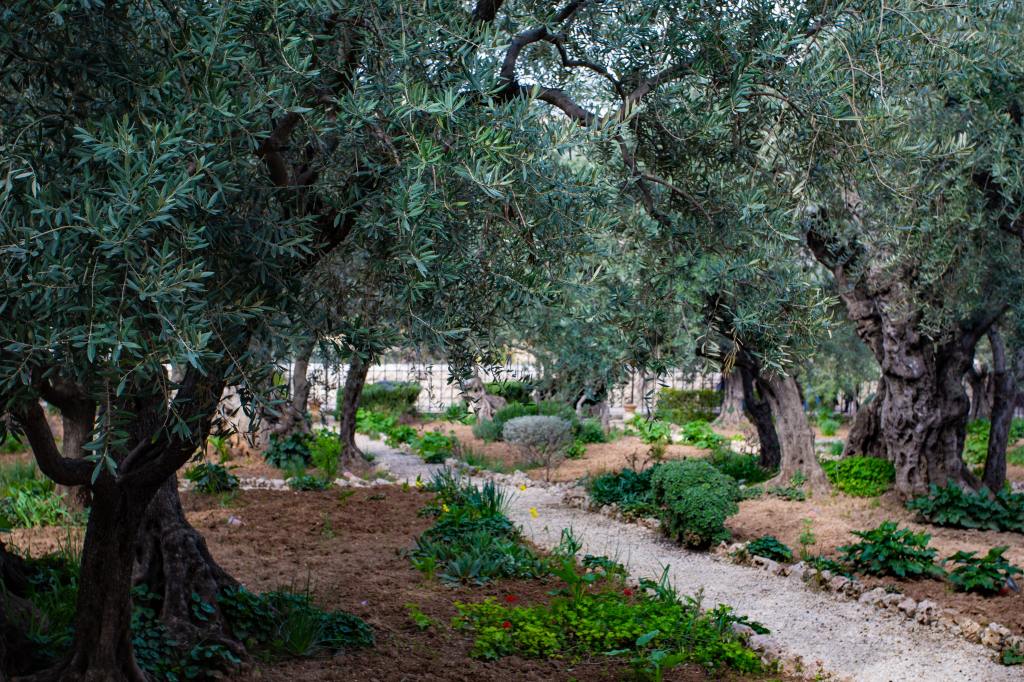
Let’s consider something else about the signs of God’s faithfulness that is recalled in the readings today. The psalmist sings about the righteous person, the person who keeps covenant with the LORD, comparing their life to a tree:

“The righteous person is like a tree
    planted by streams of water
that yields its fruit in its season,
    and its leaf does not wither.
In all that he does, he prospers
.”

The prophet Isaiah describes it another sign by declaring how the streams of living water flows over those who keep covenant with the LORD:

For I will pour water on the thirsty land,
    and streams on the dry ground;
I will pour my Spirit upon your offspring,
    and my blessing on your descendants.
They shall spring up among the grass
    like willows by flowing streams.

Here the Creator is offering up the signs of the fidelity of his creation to usher us into the reality of eternal truths. The sign of the TRUTH’s arrival in humanity, fulfilled in the WORD made flesh and living among us–Jesus. A sign revealed in Christ’s Church, the New Covenant and its Sacramental Tradition in the practice of worship of The Most High God.

When we begin to understand that Jesus is the Living Water of The Covenant fulfilled, we can envision ourselves as trees in the soil by streams of water. We open ourselves to planting our life in the soil of the Word and the celebrations of The Sacraments as we keep covenant with Christ. And as a tree innately thrives when water is abundant, we see how the fruit of the Holy Spirit grows in us as we drink from the Word and receive the Sacraments of His Covenant with us. The word sacrament itself means “a sign of the spiritual reality”. To avoid The Sacraments is to deny the reality of The New Covenant, in fact, it is to deny that Christ is the Son of God (sounds like the scribes and Pharisees, doesn’t it?)

So we’ve come back to Jesus’s response to them in today’s Gospel. “Something greater than [Jonah, Solomon, trees, water and fruit] is here.” In other words fellow Pharisees, we cannot choose what we like about what Jesus teaches and ignore the parts of the His New Covenant that mess with our own connect the dot pictures. Furthermore, if we disregard the conditions of the Covenant as practiced in our Sacramental Faith we ignore the central point of our salvation which leaves us all scribbles and no picture.

How about you? Are you so tangled up in your skepticism about the truth of Jesus and His Covenant that you are all scribbles?

Do you ever ask yourself, “What’s the point of my life?” or “What’s the point of keeping covenant with God in the Sacraments when the stuff around me brings me more pleasure?” 

Heres’s another question many decide not to answer. “What’s the point of weekly worship at Mass or the Sacrament of Confession?” Oh, friends, we are on our way to withering away by all our skepticism about Christ and His Church when we forego the life-giving waters in the practice of the Sacraments of our Faith. Something greater than our skepticism is here among us, it is Christ’s presence in the reading of Sacred Scripture and the receiving of The Church’s Sacraments.

Jesus, in you we live and move and have our being. Place your hand upon ours so that we would allow you to connect the scribble we’ve made of our lives in the signs you have given us through The New Covenant, Jesus in your Church.

In the name of the Father, Son, and the Holy Spirit.

Amen.
Jacob, Part I

“Truly, the LORD is in this place and I did not know it…How awesome is this place! This in nothing else than the house of God, the gateway to heaven.”

Genesis 28:16-17

The Church offers up a template for transformation that the LORD desires for all his creation in today’s reading from the Old Testament. In Genesis 28: 11-22, we find Jacob in a place that the LORD will use to initiate His transformation. What is behind him is an angry brother and a disappointed father whom he had deceived. What is before him is a path that will includes pitfalls and pratfalls and the formation of a dysfunctional family that eclipses any reality television. The journey will include deception handed back to him many times over, but in the end Jacob will deserve the title “Patriarch of the Faith” that he is remembered for. The first place of his transformation is at Bethel, a sacred place for his grandfather Abraham. Apparently this knowledge had not been passed down to Jacob. This is a clue about his upbringing and it’s a cautionary tale for us. Moses later records the LORD’s instruction to the people of Israel that was woven into the culture of family life.

 “Hear, O Israel: The Lord our God, the Lord is one.  You shall love the Lord your God with all your heart and with all your soul and with all your might. And these words that I command you today shall be on your heart. You shall teach them diligently to your children, and shall talk of them when you sit in your house, and when you walk by the way, and when you lie down, and when you rise. You shall bind them as a sign on your hand, and they shall be as frontlets between your eyes. You shall write them on the doorposts of your house and on your gates.

Deuteronomy 6:4-9

The culture relied on oral tradition and the passing on of the truth depended upon the parents fidelity to this understanding. Perhaps Jacob was forgetful about his family history and the stories that conveyed their faith in God or Isaac had neglected the passing of the baton of faith which included the stories of Abraham’s exemplar trust in the LORD. What we can learn from this is how foundational to a child’s life is the example of faith in the LORD that can be observed in our own lives and in giving examples of the LORD’s faithfulness through the twists and turns of life.

“… And he came to a certain place and stayed there that night, because the sun had set. Taking one of the stones of the place, he put it under his head and lay down in that place to sleep.  And he dreamed, and behold, there was a ladder set up on the earth, and the top of it reached to heaven. And behold, the angels of God were ascending and descending on it!  And behold, the Lord stood above it and said, “I am the Lord, the God of Abraham your father and the God of Isaac. The land on which you lie I will give to you and to your offspring. Your offspring shall be like the dust of the earth, and you shall spread abroad to the west and to the east and to the north and to the south, and in you and your offspring shall all the families of the earth be blessed.  Behold, I am with you and will keep you wherever you go, and will bring you back to this land. For I will not leave you until I have done what I have promised you.” Then Jacob awoke from his sleep and said, “Surely the Lord is in this place, and I did not know it.”  And he was afraid and said, “How awesome is this place! This is none other than the house of God, and this is the gate of heaven.

So early in the morning Jacob took the stone that he had put under his head and set it up for a pillar and poured oil on the top of it.  He called the name of that place Bethel, but the name of the city was Luz at the first. Then Jacob made a vow, saying, “If God will be with me and will keep me in this way that I go, and will give me bread to eat and clothing to wear,  so that I come again to my father’s house in peace, then the Lord shall be my God,  and this stone, which I have set up for a pillar, shall be God’s house. And of all that you give me I will give a full tenth to you.”

Genesis 28:11-22

The encounter that ensues between Jacob and the LORD begins with that “certain place” where decades earlier his grandfather, Abraham encountered the LORD (see Genesis 12) and though Jacob seemed to be unaware of that fact, the LORD chose that place to initiate Jacob into the reality of the LORD’S presence. Jacob was between a rock and a hard place, pun intended, and the sooner he recognized the omnipresent God, the sooner his spirit would be reordered into the man God desired him to be. I believe it is the same for us. The LORD is hounding our tracks as the psalmist puts it, the “greyhound of heaven” who is waiting for us to stop ignoring him and see life as it is, not what we delude our minds into believing.

A stone becomes his pillow and then a memorial. Here is another clue for our own transformation–the needed the rest that we often plow past in our striving as human-doings. The prophet Isaiah puts this truth like this, “In returning and rest you shall be saved; in quietness and in trust shall be your strength.” Jacob was on his way toward the humility required for transformation, and rest is what ushered him into the awareness of God’s presence, a dream follows.

The dream that fills his sleep is a magnificent theophany where the divine touches the temporal; where the veil between earth and heaven is pulled back and Jacob’s eyes are opened to the presence of the tremendous Lover of his soul. His response, “Truly the LORD is in this place and I did not know it!” What the LORD did to remind Jacob of who he was, where he was going, and what he was to be about is exactly what our transformational moments are like when we recognize the presence of the LORD; when we are humbled by the reminder that God is God and we are not! Jacob exclaimed that that place was the house of God (Bethel); “the gateway to heaven“. I wonder how many gateways to heaven are never opened by us because we are too busy running away from something or running to something or because our fear and pride saturate our life with busy-ness or self-delusion.

Jacob’s response upon waking from that dream brings to mind the experience of getting my first pair of glasses when I was about 11 years old. I was having trouble in school because of the nearsightedness we soon found out that I had. The optometrist’s office was on the 5th floor of the tallest building on our town square. When the time came for me to put on my new glasses, the wise optometrist led me to the window and instructed me to look down on a very familiar street. He placed my glasses on my head, and my 11 year-old brain was blown away by what I could now see that I could not see before It was the autumn of the year and the maple trees were displaying their brilliance, I had always enjoyed observing the change of seasons but now my joy had been increased because of the detail I could see. What before were watercolor images to me became pristine in their texture and detail!

Jacob’s eye-opening encounter with God at Bethel blew his mind. Jacob, who had seen his world with the distortion of greed and deception, had been taken to the window of reality where God corrected his sight to the beatific vision that is forever at play before the eyes of those who trust in the LORD and by faith realize that “Surely, the LORD is in this place“.

How’s it with you, friend? Are you running from something you regret or running to something you dread? Perhaps running isn’t even involved and it’s more like sloth; the insipid spiritual laziness that mires us in the rut of self-preservation. Either way, the LORD is purposefully hounding our tracks desiring to lead us into the divine life that is ours when we are completely abandoned to His sovereignty in our lives.

Do you rest in the LORD? Do you allow yourself to receive His peace by simply stopping in a cease-fire from the striving and dis-ease that pervades our culture. I’m a strong advocate for purposeful silence where we refuse the distractions of what is happening around us so that we may be fully present to the LORD.

Father, teach us to trust in you by choosing to rest in you. Help us to close our ears and eyes to the clamor of the culture. Lead us through our pitfalls and pratfalls into the confidence of knowing who we are and what we are about as a child of God.

In the name of the Father and the Son and the Holy Spirit. Amen

“Lord Jesus, Receive my Spirit.”

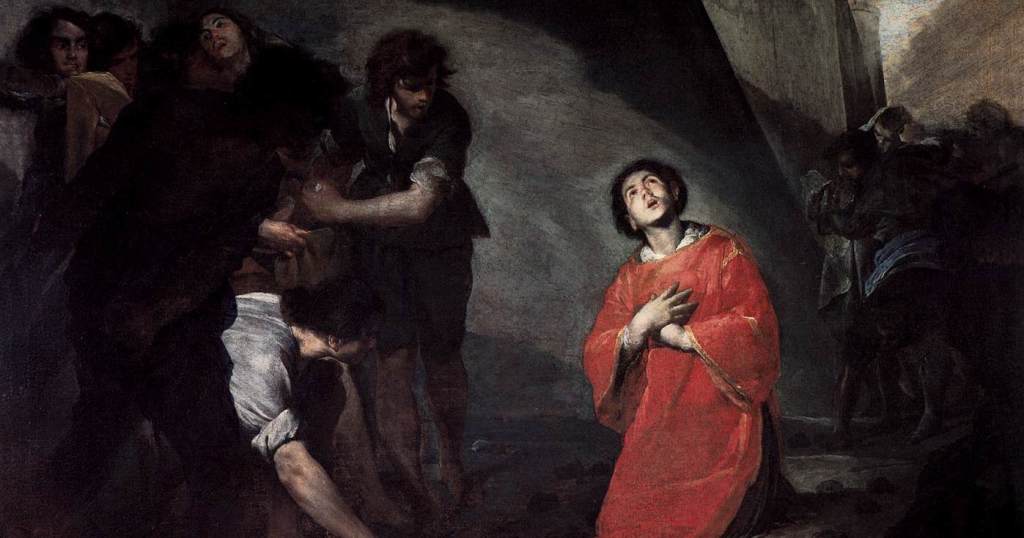
The seventh chapter of the Book of Acts is a nail-biter–the first recorded martyrdom of the early Church. St. Stephen was chosen to be the go-to apostle for that moment in the Church’s history. Why St. Stephen? We understand from the chapter preceding today’s reading that St. Stephen was a deacon of the infant Church, and he was known for being wise, full of faith, and filled with the Holy Spirit. It was written of him that he was full of grace and power, doing great wonders and signs among the people. In short, a holy man who knew who he was, to whom he belonged, and what he was about. St. Stephen inspires me!

As I considered the reading for today, I identified some key takeaways that helped increase my own faith as I strive for fidelity to my Savior. Here are just a few. The interchange between the unbelieving countrymen and Stephen begins with some harsh words:

Stephen said to the people, the elders, and the scribes:
“You stiff-necked people
….”

Not the best way to make friends and influence enemies, right? The problem for the people was that what he was declaring about them was not new to their ears; throughout the Old Testament, the LORD often referred to Israel as stiff-necked because of their constant forgetting to remember who they were–the Chosen People of God. No wonder these first-century Jews were infuriated with St. Stephen’s summation of their actions.

As I think of my life, regretfully, I’m uncomfortably aware of some of my own stiff-necked leanings. There have been times when I’ve been seized by rigid, stiff-necked stubbornness, convinced of my own perspective or by hard-heartedness against someone who didn’t align with my way of thinking. I’m not proud of those moments. More bothersome is when I am more often seized by my own posture; when I spend too much effort on looking to the right and to the left, looking behind me–keeping my head down to look at what’s around me. When I choose only to see the distractions around me, I’m too easily flummoxed into inertia and doubt. And what does the LORD whisper to me when I’m stuck in that posture?

” [Lois] Guard your heart with all diligence, for from it flow springs of life…. Let your eyes look forward; fix your gaze straight ahead. Make a level path for your feet, and all your ways will be sure. Do not swerve to the right or to the left; turn your feet away from evil.”

We also see in St. Stephen’s response to the misguided accusations of the crowd surrounding him an example for us all when we are locked in our regrets about the past or our fears of rejection, or when we are too prideful to change our minds. What did Stephen choose to do? He looked up!

But Stephen, filled with the Holy Spirit,
looked up intently to heaven and saw the glory of God
and Jesus standing at the right hand of God,
and Stephen said, “Behold, I see the heavens opened
and the Son of Man standing at the right hand of God.”

St. Stephen was so convinced that the LORD’s presence surrounded him that his natural response to the fray around him was to look into the eyes of his Saviour. St. Stephen’s vision beyond the perilous reality led him to where he was headed, and he stayed the course! LORD, help us all!

We know that St. Stephen’s life did not end well by man’s standards; some would even surmise that he failed. However, we see the rest of the story. He joined the many martyred saints because he stood firm on the Truth of history and refused to allow what was happening to him in his persecutions to distract him from that Truth. Ultimately, St. Stephen’s words endure as a response for the Church, as we live in a society that grinds its teeth at Truth with a stiff-necked, anti-Christ-like assumption about how life works. Despite the fear and anger we may feel as we, too, are surrounded by a mad crowd, we must persevere! Is the courage to do what is right a challenge for you? St. Stephen’s last plea to the LORD infused him with courage to endure. He had already been filled with the spirit of the Lord, and he knew his destination was not determined by the crowd. No, Jesus was standing, ready, arms open to receive his spirit!

“LORD Jesus, receive my spirit.”

LORD Jesus, transform our spirits with confidence in the truth that you are waiting to receive our spirits in every moment! We only have to let go of our grip on self-preservation.

LORD Jesus, we desire the faith, wisdom, and integrity of St. Stephen, but you know how stiff-necked we can be about our own ideas, rights, and privileges. Forgive us when we’d rather tune into the voices of our society than listen to your Truth, Beauty, and Goodness. Would you restore the proper spirit within us?

LORD Jesus, when we walk the life of Faith with a wobble from always looking back to what has happened rather than looking forward into Your eyes, help us to fix the gaze of our eyes upon You.

St. Stephen, pray for us.

In the name of the Father, and the Son, and the Holy Spirit.

Amen