“The word of God continued to spread; the number of the disciples increased greatly in Jerusalem, and a great many of the priests became obedient to the faith...
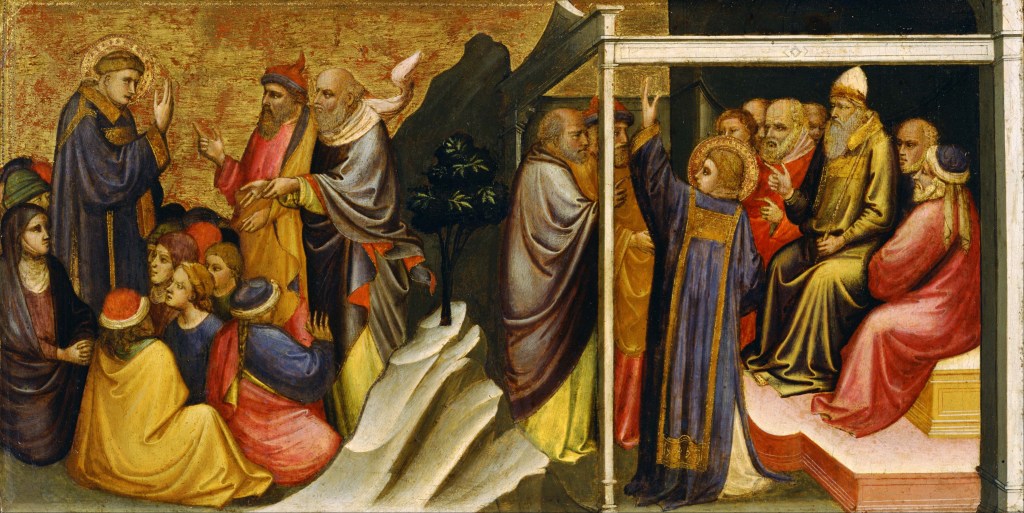
Stephen, full of grace and power, did great wonders and signs among the people. Then some of those who belonged to the synagogue of the Freedmen (as it was called), Cyrenians, Alexandrians, and others of those from Cilicia and Asia, stood up and argued with Stephen. But they could not withstand the wisdom and the Spirit with which he spoke.Then they secretly instigated some men to say, “We have heard him speak blasphemous words against Moses and God.”They stirred up the people as well as the elders and the scribes; then they suddenly confronted him, seized him, and brought him before the council. They set up false witnesses who said, “This man never stops saying things against this holy place and the law; for we have heard him say that this Jesus of Nazareth will destroy this place and will change the customs that Moses handed on to us.” And all who sat in the council looked intently at him, and they saw that his face was like the face of an angel.“
Acts of the Apostles 6:7-15
It is Eastertide! The Church draws our attention to the early days of her actions recorded in the book of the Acts of the Apostles. I like the word Eastertide, for indeed, we witness the tide that changed the world: the Tide of Christ and his Church flowed to the shores of every place the Spirit of God sent the disciples. As the tide flowed, we read of men and women becoming the first saints of The Church. In today’s reading, we witness the courage and wisdom of St. Stephen before he becomes the first martyr of the Church.
Likely, we will not have to endure the extent of subterfuge against us or the persecution and martyrdom St. Stephen faced, but we each face daily circumstances that may be unjust, where gossip and slander against us test our courage as we swim against the tide of gossip and slander. The small sacrifices we make each day for the sake of love for our LORD are sometimes referred to as martyrdom of the self in that we learn to love our LORD more than our self-interest. What can we learn by observing St. Stephen’s character that will spur us on in our swim against the tide of the culture around us?
Stephen was a man of integrity. The Church recognized that he was full of faith and the Holy Spirit. When we choose to empty ourselves of every shred of self-interest, we make room for the presence of the Holy Spirit. I’m learning that if I am going to receive the grace and power of the Holy Spirit, I have to let go of my notions and ideas of how life should go for me and for those I love. I have to let go of the fear of what others may plot against me for my faith. St. Stephen may have expected life to turn out differently for him, but we observe that he was a man whose inclination toward Jesus motivated his responses and actions toward his persecutors.
LORD, my self-interests are often motivated by my obstinance and fear of rejection. And self-absorption sometimes drives me into overweening pride. I desire integrity so that my inner person prefers you and your will for me.
St. Stephen was wise, and the synagogue officials were envious of him and outraged by the Spirit with which he spoke. He was not attached to his reputation or proving his worth to others or defending himself against lies about him. He knew who he was as God’s child, and his eyes fixed on standing firm in that truth and responding to others from that truth.
LORD, free me from self-protection. Guard my tongue; I desire that all the words of my mouth echo the Truth, Beauty, and Godness of The Faith. I can waste a lot of words on a lot of stuff that doesn’t matter. I can use words as weapons for my insecurities. But I desire that you fill me with understanding so that what I say or don’t say is motivated by the wisdom of your Spirit within me.
We learn from the next chapter of the Acts of the Apostles that St. Stephen, amid the stoning that would cause his death, “gazed into heaven and saw the glory of God and Jesus standing at the right hand of God.” The testament of those last moments of his life here on earth revealed the LORD’s faithfulness to him; St. Stephen had received the truth of Christ in his heart and mind; he stood up for the truth about Jesus, now Jesus was standing up for him, waiting to receive him into his presence.
LORD, I desire to fix my gaze on your glory. When I am frightened by the threats around me or the pain I endure, will you lift my chin to look you straight into your eyes? I desire to live in the confidence that you receive my spirit as I choose to remain confident in the truth that you are with me always, no matter what causes me fear.
St. Stephen was a forgiver. His last words echo Christ’s words from the cross, “Lord, do not hold this sin against them.” I’m tempted to cling to injustices and stew in resentments and regrets. I’m tempted to keep mental lists of grievances.
LORD, empty my memories of what others may have done to hurt me; may I only desire to forgive them and will their good. Would you give me emotional amnesia of offenses that can free me to center my heart and mind on you?
St. Stephen, pray for us.
In the name of the Father, and the Son, and the Holy Spirit.
As it was in the beginning, it is now, and ever shall be world without end.
Jesus appeared to the Eleven and said to them: “Go into the whole world and proclaim the Gospel to every creature. Whoever believes and is baptized will be saved; whoever does not believe will be condemned. These signs will accompany those who believe: in my name they will drive out demons, they will speak new languages. They will pick up serpents with their hands, and if they drink any deadly thing, it will not harm them. They will lay hands on the sick, and they will recover.”
Then the Lord Jesus, after he spoke to them, was taken up into heaven and took his seat at the right hand of God. But they went forth and preached everywhere, while the Lord worked with them and confirmed the word through accompanying signs.
-St. Mark 16:15-20
I’ve been thinking quite a bit about how the disciples moved forward with remarkable courage and strength after Christ’s ascension into heaven and the indwelling of his Holy Spirit. He believed and encouraged them to take the Faith to all the known corners of the world in their day with seemingly not a thought given to how they each had cut and run from him when he was arrested, tried, crucified, and died for them. Cowards, yes! But something happened in the after of Christ’s Passion, and that something was the Someone of the Blessed Trinity–the Holy Spirit of God.
Sometimes I forget how world-shaking the reality of Christ’s gospel was to the early followers of The Faith. In today’s gospel reading, Jesus, just before his ascension, tells his followers to go forward and share what they had witnessed about Jesus in all the nooks & crannies of the world. And they did it, which is amazing to consider for at least in their own nooks & crannies, they knew their enemy, but somewhere else? Not so much. They knew nothing about what was ahead of them other than what Jesus told them would happen–driving out demons, speaking a new language, healing the sick–and also there’s the bit about the certain persecution and martyrdom awaiting them because of their obedience to go forward. I believe that if I were in their sandals, I would have asked Jesus if I could just stay home and tell Bible stories to my grandchildren! Wouldn’t you be tempted to respond that way, too?
Near the end of the narrative, St. Mark includes this detail: “But they went forth and preached everywhere, while the Lord worked with them and confirmed the word through accompanying signs.” That reality made all the difference. The LORD worked with them and confirmed them in their faith; that is what made courageous followers of Christ out of cowards. As The Church’s Liturgy shines the light on the acts of those courageous followers in these days leading up to Pentecost Sunday, we notice that the Holy Spirit accomplished through them what he promised. He also accomplished in them what was promised. And that is what gives me the courage to do the same. St. Paul and St. Peter, and other disciples wrote letters that explicitly spell out for new followers of Christ who they were and what they were to be about and by extension, who we are and what we are to be about. I take heart from the letters to the early believers, for it is in the reading, meditation, and prayer with them that the Holy Spirit trains me in courage, hope, and perseverance in “Christing the world,” as spiritual writer Caryll Houselander put it. Those words hold weight for us when we consider that Ms. Houselander could identify with the uncertainties that the disciples stepped into; she herself faced significant childhood difficulties, two world wars, neurosis, and a disease that eventually took her life.
Lately, I’ve really been challenged in Christing my world; it’s a little scary to allow the Holy Spirit to mess with the system of control I’ve developed over my lifetime. I know the message of hope that the Gospel of Christ gives! I can recount the stories of healing and transformation like it’s my own family history. I can write about and teach others the Truth, Beauty, and Goodness of our Faith. Yet when it comes to living side by side with the good, bad, and the ugly around me, I’m often flummoxed because what I know I believe in my head to be true isn’t what I experience in my relationships.
I’ve been hearing the LORD say to me what he said to his cowardly disciples, “Beloved, I desire to work with you and confirm my identity in you.” Caryll Houselander wrote, “One must always have God before one in order to live in any atmosphere.” Do you have trouble living in every atmosphere that you encounter, you are not alone? Our human condition likes control and we can easily worship it more than worshiping God. The disciples had to let go of control or they wouldn’t be up to obeying Christ’s desires for them and the world. Yikes! Am I ignoring what Christ has called me to when I keep a tight grip on maintaining control in order not to be too uncomfortable, too challenged, too vulnerable? Again, Ms. Houselander wrote that “Christ is everywhere; in Him, every kind of life has a meaning and has an influence on every other kind of life.” So in reality, Christ has gone before us as he did for the early disciple. All we have to do is show up as other Christs simply to love others more than we love our sense of control!
LORD, I want to believe that you are working with me as I Christ my world, but sometimes I have serious doubts about how that can be possible in the world right here in front of me. Holy Spirit of God, fill me with your love and patience.
And LORD, I believe you want to confirm your identity within me, but I’ve got a long list of memories that have already convinced me you couldn’t possibly see past the doubts I have about myself or how I’ve failed to let loose of my control. Holy Spirit of God, fill me with courage and hope.
LORD, I desire that my life would have a healing influence on every other life I meet. Holy Spirit of God, fill me with your understanding.
I ask all this in the name of the Father, the Son, and the Holy Spirit.
As it was in the beginning, it is now, and ever shall be, world without end.
Last week, we beheld Christ’s Passion, entering into it with eyes wide open to see the lengths God takes to prove his unfathomable love for us. This first Monday after Easter, we enter into The Octave of Easter, where the Church will draw our minds through the epistle readings to behold the after of Christ’s resurrection and the coming of the Holy Spirit. To help us appreciate the gravity of the Holy Spirit’s power in our lives, we must never forget the before of Christ’s cross. An old saying goes, “It’s Friday, but Sunday’s coming!”
I want to consider with you two moments of that “before”; moments where Jesus beheld us in our low estate as one who betrayed his love and then as one who denied his love for him.
St. Matthew records Judas’ moment of betrayal in the account of The Last Supper when Jesus had just announced to his friends that his love for them would be betrayed by one of them. Just after dipping the bread, at the same time as Judas’ dipped his bread into the bowl of wine, Judas asks, “‘Surely not I, Rabbi?’ Jesus replied, ‘You have said so.'” (St. Matthew 26:25) Hans Urs von Balthasar wrote, “Being singled out by Jesus never means being isolated.” At that moment, Jesus singled out Judas by looking into his eyes, and he gave him an out, a way back from his pride-induced, misconceived treachery. Jesus’ still included him as a friend, but at that moment, Judas hardened his heart and isolated himself beyond redemption in his refusal of Christ’s loving embrace. He regretted it, but he did not repent, and then in his self-imposed isolation, he gave up hope. Judas represents all that we despise in ourselves-pride, fear, anger, dishonesty, and veniality-our despicable me! Yet Jesus peers into our eyes, desiring us and loving us.
St. Luke records the moments of St. Peter’s denial of knowing Jesus by writing, “At that moment, while he was still [denying Christ], the cock crowed. The LORD turned and looked at Peter. Then Peter remembered the word of the LORD; how he had said to him, ‘Before the cock crow today, you will deny me three times.'” The same eyes that peered into Judas’ eyes over his cup of salvation peered into Peter’s from this suffering for our salvation. Just as Jesus offered forgiveness and restoration to Judas, he offered it to Peter. Yet Peter’s response after his denial reveals a different heart, a soft heart that “wept bitterly.”
The events recorded in today’s epistle reading from Acts 2 happen after Christ’s resurrection and the tender restoration encounter beside the Sea of Galilee between Jesus and Peter. Peter isn’t hiding anymore because he now loves Jesus more than himself. The descent of God’s Holy Spirit has filled Peter and disciples and followers of Christ with his amazing grace and courage. And now we behold Peter on the way to becoming the most successful failure of all time.
Why Peter and not Judas? It has something to do with Peter’s heart, but more importantly, it has everything to do with Peter’s faith. Though skittish at times about the Truth of Jesus and Jesus’ belief in him when he declared to him, “…You are Peter, and on this rock, I will build my Church, and the gates of Hades will not prevail against it.” (St. Matthew 16:18), Peter never gave up hope.
We find ourselves, don’t we, sometimes in both men’s redemptive moment when Jesus beholds us, and we weep when we realize what we have done? Some stop weeping as we lose hope, and some weep bitterly as we hope. When we weep bitterly before our loving LORD over our sin, our “before” falls away, and our ever-after opens up before us. That is what we see in Peter, and because of the same Holy Spirit, our “before” can fall away to our ever-after.
What does Jesus see in our before? Are we like Peter or Judas? Peter’s before and after reveals a coward now courageous; short-sighted, now wise; inflated ego, now humble; impetuously angry, now understanding. Wishy-washy, now the rock on which Christ will build his Church.
Perhaps you can already see how your “before” of this lenten season is being transformed into the ever-after Jesus desires for you.
Perhaps you remember the weight and suffering of the guilt of betrayal and denial of God’s love for you, and now you live in an ever-after of faith in Christ’s suffering, death, and resurrection on behalf of you.
Jesus, indeed, singles us out and looks into our eyes, and asks, “Child, do you love me? Do you love me? Do you love me? Do not fear; I am with you ever after.”
Oh Father, lead us into our ever-after with you, deepen our love, hope, and faith.
We ask this in the name of the Father and the Son, and the Holy Spirit.
As it was in the beginning, it is now, and ever shall be, world without end.
Straight away in the Gospels, the role of St. John the Baptist as the last prophet of Israel is established. The Jews, who were awaiting the New Covenant and the New Exodus that the LORD had inspired Isaiah and other prophets to foretell, gathered around this prophet who described the soon-to-be-fulfillment of the entirety of the Old Covenant God made with his people. Some discerned St. John the Baptist knew what he was talking about; others fought him and his message tooth-and-nail to the death. When Jesus arrives at the Jordan River to fulfill the Old Testament prophecies, St. John the Baptist declares to everyone, “Behold, the Lamb of God, who takes away the sins of the world… .” Fitting words for this Jesus who would now take his place as The Sacrificial Lamb of the Old Covenant.
Yesterday, we entered Holy Week, the most sacred week of our liturgical year. The Church has been guiding us through the Sacred Scripture to this week of The Passion of Christ. Now she calls to us as St. John the Baptist called, “Behold the Lamb of God.” All the liturgies of this sacred and somber week will invite us to consider the Suffering Servant of humanity. As we transport with our imagination into the events of Holy Week, we are more than spectators; we are beholders; we are to enter into the drama of our salvation. The word “behold” means more than to glance or notice; it means to observe and discern. Moses didn’t just glance at the burning bush in the desert; he beheld it. Our Blessed Mother didn’t just nod to Archangel Gabriel’s word on the incarnation of Christ within her; she declared, “Behold, I am the handmaid of the LORD!” One thousand sixty-five times, the inspired Word of God admonishes us to behold; for in observing, meditating, and discerning what the LORD is communicating to us through our senses, he aims for us to see beyond ourselves into Salvation History. The LORD calls us to open our eyes wide open to our salvation!
You have noticed, no doubt, that The Church consistently includes readings from the Book of the Prophet Isaiah in our daily liturgy. Good reason! The book of prophecies is known as the “Fifth Gospel.” Though written hundreds of years before the Incarnation of Christ, the prophet foretells the reality of the promised fulfillment of the Old Covenant. Where once God’s people offered sacrifices of lambs for the atonement of their sins, The Lamb of God, The Messiah, would someday offer his life as the final sacrifice for humanity.
The readings from Isaiah during Lent have been rich with these prophecies, so rich that I find I’ve often prayed with Isaiah as I anticipated this Holy Week. I invite you to join me in praying the words of Isaiah from chapters 42 and 53.
The LORD says to us:
Beloved, here is my servant, Jesus, whom I uphold, my chosen one with whom I am pleased, Upon whom I have put my Spirit; he shall bring forth justice to the nations… Until he establishes justice on the earth; the coastlands will wait for his teaching… Behold my salvation!
Beloved, I formed my servant, Jesus, and set him as a covenant of the people, a light for the nations, To open the eyes of the blind, to bring out prisoners from confinement, and from the dungeon, those who live in darkness… Behold my salvation!
(Isaiah 42)
Jesus says to us:
Beloved, do you believe what you have heard?… Behold my life in your place!
I grew up like a sapling before you, like a shoot from the parched earth; I had no stately bearing to make you look at me, nor appearance that would attract you to me… Behold my life in your place!
I was spurned and avoided by people, I suffered, I was accustomed to infirmity, people even hid their faces, spurned me, and held me in no esteem… Behold my life in your place!
It was your infirmities that I bore, your sufferings that I endured, while you thought of me as stricken, as one smitten by God and afflicted… Behold my life in your place!
I was pierced for your offenses, crushed for your sins; I took upon me the chastisement that makes you whole, by my stripes, you were healed. You had gone astray like a lamb, you followed your own way; but the LORD laid upon me your guilt… Behold my life in your place!
Though I was harshly treated, I submitted and opened not my mouth; like a lamb led to the slaughter or a sheep before the shearers, I was silent and opened not my mouth. Oppressed and condemned, I was taken away, and you would have not thought any more of my destiny… Behold my life in your place!
When I was cut off from the land of the living, and smitten for your sin, a grave was assigned for me among the wicked and a burial place with evildoers, though I had done no wrong nor spoken any falsehood. But the LORD was pleased to crush me in infirmity… Behold my life in your place!
I gave my life as an offering for your sin… and the will of the LORD for you was accomplished through me. Because of my affliction, you shall see the light in fullness of days; through my suffering, I justified many, and your guilt I bore… Behold my life in your place!
I endured my Passion so that you would live in victory from sin and death. I surrendered myself to death and was counted among the wicked; I took away your sin and won pardon for your offenses… Behold Your life in my place!
How’s the lenten journey going for you, fellow pilgrim? Do you ever wonder if you’re wasting your time on your lenten vows? It’s a question I asked myself recently; it’s a question I ask myself all the time, not just during Lent. I got to thinking about if Jesus ever wondered if he was wasting time being the Savior of the World? A quick survey of the gospel readings reveal that Jesus seemed to always be on his way to somewhere or leaving somewhere; entering and departing the circumstances of the human condition. A familiar phrase from the gospels goes something like this, “While they were on their way…” We know Jesus got tired; he wearied of people’s refusal to see things the way he saw them; got angry with hypocrites; and wept over people’s suffering. And we know Jesus often parted company with people to retreat into prayer. I wonder what he and our Heavenly Father conversed about during those prayer retreats; we can only imagine.
When questioned by the spectators of his life, he would reply that he was doing the will of the Heavenly Father. It follows that Jesus would never have doubted how he spent his time. It was the Father’s will to incarnate himself into our humanity; therefore, it was the Father’s will that he invested the entirety of his mind, body, and spirit in us! That just blows my mind! Every word that came out of Jesus’ mouth was motivated by the Father’s will! Perhaps when I stop questioning if I’m wasting my time, I will live all of my life as Jesus lived his life, and every word I speak or don’t speak will invest in God’s will. Rather than thinking interruptions and delays are a nuisance, I would see them as opportunities forinvesting in every little movement of my life. The here and there and to-and-fro of my life would become an investment of thanksgiving. Wouldn’t that be something?! To live and move and have my being in the will of my Beloved Father!
There are some questions I’ve started asking the LORD lately about doing his will as I’ve been meditating on the Sacred Scripture readings for our Lenten season.
When I fret or get angry over circumstances beyond my scope as your beloved daughter; am I wasting my time rather than investing trust in Your will? You answer, “Love righteousness…think of [my] goodness and seek me with integrity of heart.” (Wisdom 1:1)
When I insert myself beyond my rightful place as a child of God; am I wasting my time rather than investing obedience to Your will? You answer, “A jealous ear hearkens to everything, and discordant grumblings are not secret. Therefore guard against profitless grumbling, and from scoundrel mongering withhold your tongue.” (Wisdom 1:10-11)
What do I invite into my mind, body, and spirit when I waste energy on pursuits other than investing in Your wisdom? You answer, ‘Learn wisdom…for when you revere the holy precepts, you will find holiness…desire my Word; long for it, and you will be instructed.”
Who do I think is a waste of time? Do they need my emotional investment? You answer, “Beloved daughter, regard the life of the poor [in spirit]; do not keep needy eyes waiting. Do not grieve the hungry [in spirit]….do not turn your face from the helpless…in their pain, they cry out bitterly…listen to them for me.” (Ben Sira 4:1-4)
Am I wasting emotional energy on this relationship; it wears me down. They don’t care about what I have to say; why bother? You answer, “Beloved, ..let no one intimidate you…do not refrain from speaking at the proper time, and do not hide your wisdom…even to death, fight for what is right, and I will do battle for you…Do not let your hand be open to receive, but clenched when its time to give.” (Ben Sira 4: 23-31)
LORD, your very presence invests peace, love, acceptance, forgiveness, mercy, grace! You were always inviting us to join you on the way of abundant life here and in eternity. Every person, every circumstance, every suffering you encountered was an investment on our behalf! Jesus, you are still investing us with your Holy Spirit’s power to go and do likewise. Grant us new eyes to see, new ears to hear, and new hearts to love.
In the name of the Father, and the Son, and the Holy Spirit.
As it was in the beginning, it is now, and ever shall be, world without end.
“What lies behind us and what lies before us, are tiny matters compared to what lies within us.”
–Ralph Waldo Emerson
When Jesus came into Galilee, the Galileans welcomed him, since they had seen all he had done in Jerusalem at the feast; for they themselves had gone to the feast.
Then he returned to Cana in Galilee, where he had made the water wine. Now there was a royal official whose son was ill in Capernaum. When he heard that Jesus had arrived in Galilee from Judea, he went to him and asked him to come down and heal his son, who was near death. Jesus said to him, “Unless you people see signs and wonders, you will not believe.” The royal official said to him, “Sir, come down before my child dies.” Jesus said to him, “You may go; your son will live.” The man believed what Jesus said to him and left. While the man was on his way back, his slaves met him and told him that his boy would live. He asked them when he began to recover. They told him, “The fever left him yesterday, about one in the afternoon.” The father realized that just at that time Jesus had said to him, “Your son will live,” and he and his whole household came to believe…
The Gospel according to St. John 4:43-54
Something my mom used to say came to my mind as I meditated on the gospel reading for today. “Hope springs eternal.” She would tag on the line from the psalms as well, “Weeping may last for the night, but joy comes in the morning.” My mom knew what she was talking about, for she suffered all her life from a chronic disease that eventually took her life, yet her hope for healing never waned. The people that surrounded our LORD’s life as he lived among us were no different; there was always a sense of anticipation as Jesus came near to their reality. The crowds had heard or witnessed that this Jesus was more than meets the eye, and so they hoped!
It took great humility for that royal official to expose his need to this Jew; he could have ridiculed Jesus and the citizens of Israel for their belief in one God rather than the many Roman gods of his country. He could have ignored what the people were saying about Jesus. We don’t know if he had witnessed any of Jesus’ miracles, but he could have dismissed them as trickery and entertainment. He doesn’t do any of that; he boldly went to Jesus and requested out of the brokenness that only a parent can have for a child. Even when Jesus seems to rebuke the crowd, him included, for demanding signs and wonders, the royal official stays on point. Can you sense his urgency when he asks Jesus to come before his child dies? The royal official represents us, doesn’t he? We’ve all been desperate for hope from time to time. We’ve longed to be free from the sorrow we endure for others or ourselves. In God’s kingdom reality, nothing separates us from being in that crowd that day, for his story is our story. Jesus’ words and actions then are his words and actions now, and ever shall be! Hope does spring eternal!
The Church reminds us of this beautiful truth through the other Scripture readings for today’s Mass. Hear the Word of the LORD to Isaiah 65:17-21
Thus says the LORD: Lo, I am about to create new heavens and a new earth; The things of the past shall not be remembered or come to mind. Instead, there shall always be rejoicing and happiness in what I create; For I create you to be a joy and a delight; I will rejoice in you and exult in my people. No longer shall the sound of weeping be heard there, or the sound of crying; No longer shall there be in it an infant who lives but a few days, or an old man who does not round out his full lifetime; He dies a mere youth who reaches but a hundred years, and he who fails of a hundred shall be thought accursed. They shall live in the houses they build, and eat the fruit of the vineyards they plant.
Years ago, the truth of Isaiah’s words; the LORD constantly recreating and restoring what seems dead to life came to me during the early Spring as I was cleaning up winter from our garden. I removed some decaying leaves from the soil and discovered “Hope Springs Eternal.” There beneath the refuse of the past season’s death were the tender green shoots of our Crimean Snowdrops lifting their delicate white caps upward toward the early Spring sun. They seemed to say, “Hello again, beautiful world, I’ve returned to glorify the Creator!”
LORD, there are seasons in our lives when we feel short on hope. Help us see beyond the present moment that threatens to steal our joy by eroding our hope in you, the God of Creation and Recreation. We look at the whole scheme of things happening to us or around us, and we wonder if you are still the LORD of the impossible. We bring our families to you and humbly ask you to recreate us into the fullness of life with you. We offer ourselves and our besetting sins that decay and destroy hope in you. We bring our world to you and urgently ask that you heal the unrest in war-torn countries before there is any more death.
We ask this in the name of the Father, and the Son, and the Holy Spirit.
As it was in the beginning, it is now, and ever shall be, world without end.
Naaman, the army commander of the king of Syria, was highly esteemed and respected by his master, for through him the LORD had brought victory to Syria. But valiant as he was, the man was a leper. Now the Syrians had captured in a raid on the land of Israel a little girl, who became the servant of Naaman’s wife. “If only my master would present himself to the prophet in Samaria,” she said to her mistress, “he would cure him of his leprosy.” Naaman went and told his lord just what the slave girl from the land of Israel had said. “Go,” said the king of Syria. “I will send along a letter to the king of Israel.” So Naaman set out, taking along ten silver talents, six thousand gold pieces, and ten festal garments. To the king of Israel,he brought the letter, which read: “With this letter, I am sending my servant Naaman to you, that you may cure him of his leprosy.”
When he read the letter, the king of Israel tore his garments and exclaimed: “Am I a god with power over life and death, that this man should send someone to me to be cured of leprosy? Take note! You can see he is only looking for a quarrel with me!” When Elisha, the man of God, heard that the king of Israel had torn his garments, he sent word to the king: “Why have you torn your garments? Let him come to me and find out that there is a prophet in Israel.”
Naaman came with his horses and chariots and stopped at the door of Elisha’s house. The prophet sent him the message: “Go and wash seven times in the Jordan, and your flesh will heal, and you will be clean.” But Naaman went away angry, saying, “I thought that he would surely come out and stand there to invoke the LORD his God, and would move his hand over the spot, and thus cure my leprosy. Are not the rivers of Damascus, the Abana and the Pharpar, better than all the waters of Israel? Could I not wash in them and be cleansed?” With this, he turned about in anger and left.
But his servants came up and reasoned with him. “My father,” they said, “if the prophet had told you to do something extraordinary, would you not have done it? All the more now, since he said to you, ‘Wash and be clean,’ should you do as he said.” So Naaman went down and plunged into the Jordan seven times at the word of the man of God. His flesh became again like the flesh of a little child, and he was clean.
He returned with his whole retinue to the man of God. On his arrival, he stood before him and said, “Now I know that there is no God in all the earth, except in Israel.”
II Kings 5: 1-15
The Old Testaments’ stories of God’s intervention in human circumstances are intriguing to read as all of Sacred Scripture. Everything within it is necessary for our salvation, and we know that the story of Scripture is the story of us. Meditating on the Word of God allows room for his Holy Spirit to direct our lives, transforming our minds, in sum, saving us from ourselves.
Namaan’s attitude toward what the LORD required him to do for his physical healing from leprosy gets at the disposition of the heart that the LORD desires from us. Humility is the path of salvation from ourselves and the mess we can make of our relationships. And then there is a lesson for us through the actions of the nameless servant girl and other servants who were in the background of Namaan’s existence.
Namaan was enslaved by leprosy, yet he was a commander in the formidable Aramaen (modern-day Syria) army; he was not an Israelite; he was an enemy of Israel. Nevertheless, the LORD had brought him victory. “He was a mighty man of valor, but he had leprosy.” We are or have been in Namaan’s sandals, haven’t we? We walk the tightrope of what others know of us–how we are identified based on what we do and how we measure up. It is always honoring to our LORD when we conduct ourselves with integrity. But what comes after the comma of our public self is what is most important about us. There is where our loving LORD desires to bring to order in us his divine image. Namaan’s problem was leprosy was obvious, but it is clear the LORD was after another enslavement by his disordered pride.
He bristled at St. Elisha’s directive to go and wash in the Jordan river 7 times and responded out of his disordered pride:
But Naaman went away angry, saying, “I thought that he would surely come out and stand there to invoke the LORD his God, and would move his hand over the spot, and thus cure his leprosy. Are not the rivers of Damascus, the Abana and the Pharpar, better than all the waters of Israel? Could I not wash in them and be cleansed?” With this, he turned about in anger and left.
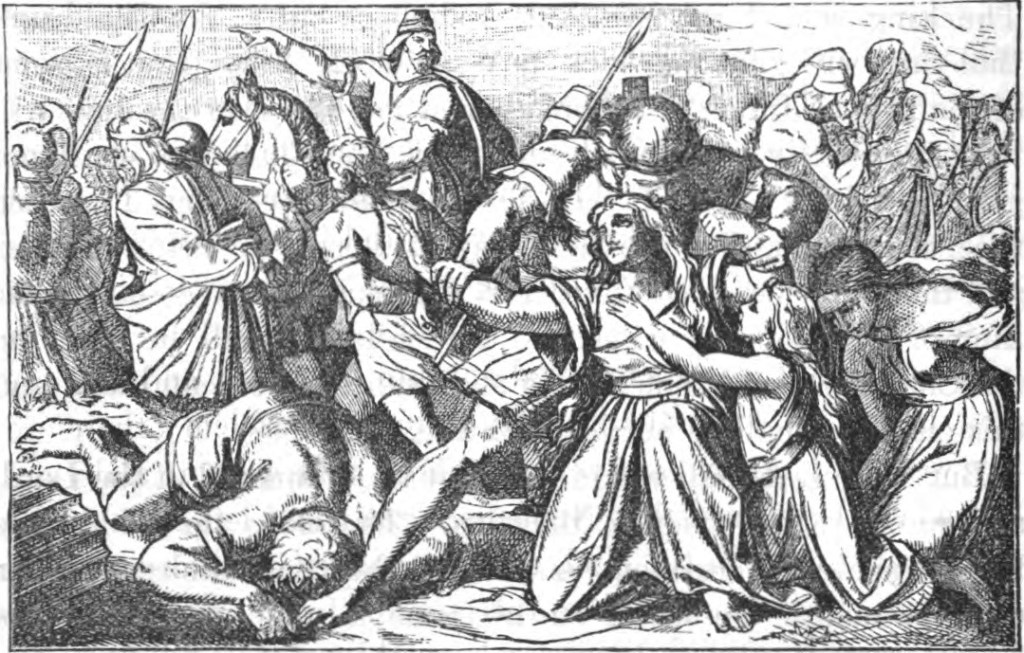
We know the story ends well for Namaan, but, left to his own devices, it wouldn’t have, had it not been for the voices of the nameless servants in the background of his life. The little servant girl to Namaan’s wife had the courage and faith in the God of her ancestors to speak up with a beautiful response to Namaan’s disease. Considering that she was a little girl taken captive and enslaved in a raid by Namaan’s Syrian army against her home and family, her response is striking. To Namaan, she was just one of the many spoils of war. In God’s eyes, she was an instrument of healing.
The other nameless slaves, who very well could have been captives themselves, intervened when Namaan wanted to stomp away from the ground where his healing lay:
But his servants came up and reasoned with him. “My father,” they said, “if the prophet had told you to do something extraordinary, would you not have done it?
The motivation of the slaves’ courage to intervene is observed in how they addressed their master, “My father…”. They honored their master.
Friends, do you find yourself in the narrative? I do! As I’ve spent time in meditation on this Scripture, the LORD has reminded me of a few things.
As in Namaan’s life, the enslavement to a physical illness or disability can be healing for our spirit’s deeper disease of Pride, Fear, and Anger. Suffering is the gift from our Suffering Servant and Savior to draw us back to who he created us to be–a beloved child created in his image.
Like the enslaved little servant girl, circumstances that we are in through no fault of our own could make us bitter if we don’t recognize God’s providence is always at work to save us from the unjust suffering of our lives.
Like the enslaved servants of the honorable Namaan, the LORD places us in the lives of others to love and honor them, even make intercession for them. We give of our love through mercy and grace, courage and perseverance to serve the LORD by serving others despite what may be discouraging circumstances in our lives.
Our LORD and Savior, we say with Namaan, we know that there is no God in all the earth, except in Israel. LORD, we desire to worship you with our entire being, but that includes some humiliation and unwanted circumstances from time to time. Would you help us to humble ourselves as Namaan did? Would you help us to forgive others and desire the best for them as the little servant girl did? Please help us to consider our service to others as an offering to you who died serving us! As you destroyed death, hell, and the grave to resurrect us to live with you, may we continue your work of salvation in and through our circumstances and the suffering of our lives.
In the name of the Father, and the Son, and the Holy Spirit.
As it was in the beginning, it is now and ever shall be, world without end.
Jesus said to his disciples: “Be merciful, just as your Father is merciful.
“Stop judging and you will not be judged. Stop condemning and you will not be condemned. Forgive and you will be forgiven. Give and gifts will be given to you; a good measure, packed together, shaken down, and overflowing, will be poured into your lap. For the measure with which you measure will in return be measured out to you.”
The Gospel according to St. Luke 6:36-38
The best advice I received as a parent of young children was this: “Say yes more than you say no.” It’s a lesson that stayed with me long after our children left home because it applies to all relationships. The child psychologist that wrote that advice was referring to the spirit of “no” that we must guard against in parenting children with rigidity and close-mindedness. We can soften by saying “yes” in the important task of raising children with love, acceptance, and forgiveness. I thought of this as I read the gospel reading today for Jesus; the Master Psychologist is the perfect example of saying yes more than no. His mercy is his yes to us!
The response of mercy is the prerequisite of living as God’s child, you could say it’s in our DNA as a beloved child of the Most High God; woefully dormant sometimes, but it is there. The heart of the good news of Jesus is this: “God so loved the world that he gave…” and the entirety of his giving to us is revealed in Jesus’ actions and teachings. We witness the if/then of saying yes to God as Jesus lived among us giving practical insight into how to say yes more than we say no to our neighbor, be it our child, spouse, sibling, friend, co-worker, or acquaintance.
Perhaps you grew up under the supposition of God as Judge rather than of God as Lover; that kind of thinking can entangle us in a briary patch that only the Lover of our Soul can rescue us. Do you feel me? I think what hinders us in saying yes with mercy and acceptance to others is that we’ve deluded ourselves by believing this of the LORD because sometimes we transfer this thinking to our reactions to others. We so easily default to judgment in our thoughts, words, and actions that others have a hard time seeing mercy and love in us; it’s as though the word “No” is flashing with neon lights from our countenance. The LORD desires to purge us of this sin.
The remedy is the confession of the judgmental spirit we excuse in ourselves. But then, we must allow the Holy Spirit to guide us in choosing to say yes to others as the LORD says yes to us! What makes me think that I can do otherwise? Remembering “For God so loved the world that he gave…..” is helping to remove the proverbial log in my eye as I live beside others in this life; this is how I have been praying that truth over my life, “For Lois so loves God that she gives…..” Wow! That stops me in my tracks when judgment and condemnation begin to poison my thought life. It’s hard work, but Christ is yoked with us as we plow through the weeds that entangle us!
Today’s gospel reading happens to be one of the many “Come-to-Jesus” readings that are helping me relearn the LORD as Lover by unlearning the attitudes and actions I can accumulate in saying “no” to others through my judgmental thoughts and words. I invite you to pray with me the Gospel according to St. Luke 6:36-38
“[Lois] Be merciful, just as your Father is merciful.”
Father, your forbearance and grace cannot be measured; it’s beyond my comprehension. Help me learn to extend my “yes” of love and acceptance of others. Holy Spirit, reveal all the thoughts I have that are contrary to love. Purge them from my mind.
“[Lois] Stop judging and you will not be judged. Stop condemning and you will not be condemned.”
LORD Jesus, you rubbed shoulders with anyone and everyone, even those that we would avoid if left to our own devices. You love! No matter the creed or ethnicity or sexual identity or state of existence! Holy Spirit, expand mercy in me until I no longer see anyone as unequal to me. I love you so much that I choose to give acceptance to everyone. We are your children.
“[Lois] Forgive and you will be forgiven.“
Savior and Redeemer, you love me so much that you forgive me–my sins and failings, my raw edges, my pride, fear, and anger. I choose to love you so much that I desire to forgive others. I choose to love you so much that I extend grace rather than second-guessing judgment when I don’t understand another’s words or actions. I love you so much that I choose to look for you in another’s eyes; I choose to see your face looking back at me. I love you so much that I choose my countenance says yes to everyone, EVERYONE!
“[Lois]Give and gifts will be given to you; a good measure, packed together, shaken down, and overflowing, will be poured into your lap.”
Father of all Good Gifts, you overwhelm me with your grace and mercy, your joy and peace. Your love is endless! Forgive me for putting limits on my love for others. You did not create me this way; would you recreate generosity of spirit in me? I don’t want to give by counting what it will cost me because it already cost you everything to love me. I choose to love you so much that I freely give the gifts of love, joy, peace, patience, kindness, goodness, generosity, gentleness, and faithfulness to others.
“[Lois]… the measure with which you measure will in return be measured out to you.”
Holy Spirit of God, I’m ashamed at how quickly I measure others by impossible standards! Forgive the stingy thoughts that creep into my unguarded mind. Train me to say yes to your love at the first hint of my withholding love from another.
I love you so much that I give my thoughts, words, deeds to you without any measure. I love you so much that I choose to love as you have loved me, laying my life down in favor of the love you desire to give through me.
In the name of the Father, and the Son, and the Holy Spirit.
As it was in the beginning, it is now, and ever shall be, world without end.
Two tourists boarded a ship and sailed to a foreign land. The two tourists disembarked from the ship and stood on the shoreline of the land they had never seen before. Their eyes took in the landscape that was so different from their homeland. They walked the port city streets and observed the buildings’ unique architecture. They observed what seemed like odd customs of the citizens. They watched as the citizens, dressed in unusual clothing, were feasting on unrecognizable food and speaking indecipherable words to one another. Before the day was half over, one tourist quickly walked back to the ship and declared that the place was too strange to explore. He ridiculed the customs of the citizens, declaring them bizarre. He criticized the architecture, saying it was impossible to build like they built in this country. He turned his nose up when he described how unappetizing the food smelled. And he determined that ordinary citizens do not dress like the people of this land. He mocked the citizens’ language, passing it off as mumbo jumbo. He told the ship’s captain, “Take me back to my home; the polyglot of this place makes no sense!”
The second tourist strolled back to the ship just before sunset and called from the dock to the ship’s captain. “I will not be boarding the ship today; I have some things I want to learn about this place. The landscape is inviting, and I need to find a guide to navigate it. The architecture is complex; I must find an architect and learn more about their blueprints. I do not understand the language; I need to find a denizen of this place to interpret the vernacular. I wonder about the customs and why they do things the way they do; I must find a historian to help me learn about their culture. And their feasts are so interesting, I will seek out a chef to learn about their cuisine in the feasts.”
How you respond to what I desire to tell you about the Catholic Church really depends on what kind of tourist you are. Your journey through the Catholic Church will be more like a day trip than a real journey because I am an apprentice guide, a neophyte in the Catholic tradition of the Faith. But what I lack in familiarity, I make up for in passion. Let’s begin our excursion by answering a few questions my husband and I had to ask ourselves the longer we served in Protestant ministry.
Why do you go to Church?
Perhaps you’ve been a member of your church since you were born, and perhaps much of your family is a member of your church; you might even say it’s your family’s church, so that is why you go to it. Perhaps you have found a church that fits your personality or generational style, and you feel comfortable there with the people who go there and look at life through a similar lens, and so that is why you go to it. Perhaps you go to church because you have children who need to grow up going to church. Perhaps the area of the world or country you live in has a church that appeals to your own cultural background. There are many reasons for going to church.
What do you do at Church?
What you do at church is heavily weighted by what kind of church you go to; therefore, there are thousands of practices and opinions on what you do at church. You don’t need to list what you do at your church before we begin our tour of the Catholic Church, but it is helpful for you to be mindful of them as we enter through the cathedral’s doors.
What is Church?
It may seem a bit prosaic to ask this question at the beginning of our tour of the Catholic Church, but it is one of the questions that preoccupied our minds the longer we served in the Protestant movement. You must have an answer if you desire to understand what we see, hear, and do when we enter the grand doors of our cathedral. Is your faith history rooted in a denominational church? Perhaps you attend a “Bible” church, a “Jesus only” church, or a non-denominational church with a sobriquet like “Substance” or “Simple.” Is it a liberal church or a conservative church? Is it an Arminian church or a Calvinistic church? Is it a mainline church or a fundamental/evangelical church? How you answer these questions determines what you consider a church to be. There are thousands of Protestant denominations worldwide, so there are many thousands of ideas about what a church is.
What’s the difference? Church is Church, isn’t it?
Answering this question may take some time, but it is the most critical question to answer before we enter the doors of the Catholic Church. There are voluminous writings on this subject, written by scholarly theologians who have devoted their lives to studying Church history. I must remind you that I am a novice guide, and you are on a day trip, so our pause here before entering through the doors will be brief. As you think of what the Church is, it will be helpful to think of the three things you need to build a brick house: bricks, mortar, and trowel. (I credit Mark Shea for this clear analogy of the Catholic Church.)
What is the Catholic Church?
Think of the Catholic Church as having a big enough pile of bricks to build a brick house. Catholic teaching says written Sacred Scripture is materially sufficient: all the bricks necessary to build its doctrines are in Scripture. However, other necessary and no less essential building materials besides Scripture have been handed down from the apostles and the early Church Fathers. The other building material is stored in the unwritten (and eventually written) Sacred Tradition (this is the mortar that holds the bricks of the written Tradition together in the correct order and position), and the Sacred Authority (Magisterium) or teaching authority of the Church (this is the trowel in the hand of the Master Builder). Taken together, these three things are formally sufficient for knowing the revealed truth of God. You can build a Church that the gates of hell will not prevail against when you have all three materials to build with bricks, mortar, and trowel: Sacred Scriptures, Sacred Tradition, and Sacred Authority.
There are libraries of documents and literary works dedicated to all or some of the three-building materials of the Catholic Church, I cannot do the subject justice. You can refer to my reading list for recommendations on historical and academic writings on the subject. The ancient Church, the Church established by Jesus Christ through the apostles, passed on the faith of the New Covenant with God. They passed it on through oral and written tradition with the authority Christ had established in them. This is the monumental difference in how the Catholic Church has been built as opposed to the Protestant movement.
What is the Protestant Church?
The Protestant movement began with a protest against the authority of the Catholic Church and gradually turned into a movement of protest and innovation. In other words, there was no way that Christ established the universal (Catholic) Church through his apostles would simply start over because of some dissenting voices. Another point needs to be made. If you want to understand what Protestants think of as church and faith in God, then you need to know what the movement was founded on. Sola scriptura–scripture alone (bricks only) is a term used to describe how Protestants build their understanding of Christianity. Protestantism insists that only Scripture is authoritative for Christian faith and life. It denies the Catholic teaching (and historical reality) that Scripture is a written portion of a much broader sacred and authoritative Tradition, which includes other elements passed down orally and by patterns of behavior known as ritual or tradition. When an understanding of the Faith is based on bricks alone without the mortar and trowel of Sacred Tradition and Sacred Authority, serious consideration must be addressed. If Scripture were the only legitimate source of Christian belief and practice, the early Christians who lived before the New Testament was written and circulated could not have lived the Faith. We’ll leave that consideration for you to ponder.
Sola Scriptura (bricks alone) explains one aspect of why there are so many Protestant denominations. If someone or a group of somebodies interpret Scripture by using some handpicked bricks to shape their theology, other bricks are, by necessity, left in the collection of bricks we refer to as Holy Scripture. That is the nature of innovation. The various Protestant denominations (read innovations) have taken the bricks they find truthful, fascinating, satisfying, and consoling. They invented a new form of the church using their ideas, methods, equipment, and technology to attract people to their innovation. The list is endless because innovation is constantly changing according to each generation.
Early in the Reformation history, the rebellion against authority lived up to its eventual moniker, the Protestant Movement. The early reformers of the 16th century would not recognize the movement today; we dare say they would roll over in their graves if they knew what their rebellion put into motion. Within the first fifty years, the Reform movement was indeed moving by fracturing into splinters that fit the notions of some influential voices–Luther, Calvin, and King Henry VIII. And the splintering accelerated as history unfolded. Think of the Reformation this way: A parent has exercised parental leadership through guidance and authority for 18 years of a child’s life. The child’s existence is integrated into the identity of the family name. The necessary boundaries of discipline expand as that child matures in wisdom and understanding about her identity within the family and in the world. Some children reach the age of 18 and continue to mature in fits and start into what it means to be a balanced human being in the family and the culture. Other children (read Luke 15:11-32) take the money and run, giving way to every drive and self-centered attraction and distraction possible. The deeper the rebellious spirit, the farther the rebellion takes a son or daughter down the path of dis-integration from their identity. Some prodigals never return. Has the parent forgotten that child? Has the parent disowned that child? No. But that child has lost some of her identity; her familial integrity has been compromised through her own choices.
So, where did the path lead for this Reformation’s child, known as the Protestant Church? Look at the Protestant Movement’s history like an electrical grid. You can quickly become confused by the energy flow of the movement that the early Reformers started. Let’s look at one of those many examples of this dis-integrating by surveying what is known as the “Holiness Movement.” We will work our way back in history as we consider this movement. Out of this Protestant Movement, there were extreme innovations in the holiness movement known as the “Pentecostal Movements” and milder innovations in the holiness movement known as the “Holiness Movements.” From those movements (still bricks only), a host of denominations innovate their entire theology with certain bricks picked by their leader(s) interpretation of the Scriptures. To further complicate the bricks-only “Holiness Movement,” you can travel a few decades into the past. There, you will find another pile of bricks called “The Great Revival Movement.” Those bricks, used by some of the “Baptist Movement” (but not all) and some of the “Methodist Movement” (but not all), were piled together until protests arose within those Movements.
Bear with me, travel back even further into the short history of Protestantism and you will discover John Wesley and Roger Williams among leaders of the aforementioned bricks-only movements. Those two leaders used bricks from the “Free Church Movement” that had discarded some of the bricks from the “Anglican Movement.” That movement was started in protest by none other than the already noted King Henry VIII, with a brick of his own making, against the Catholic Church. Was his innovation of the Catholic Church built with the mortar and the trowel of Sacred Tradition and Sacred Authority? No, he used his own authority (Sound familiar?). His Anglican Church (The Church of England) was cobbled together and rearranged because of rebellion against the Sacred Scriptures and Sacred Authority of the Church. The Catholic Church would not grant him a divorce from Queen Catherine of Aragon. He had fallen in lust with Anne Boleyn, but Anne Boleyn would not give in to his lust while he was married to Queen Catherine of Aragon, who happened to be a woman of devout faith in God and loyal to the authority of the Catholic Church. Heads rolled because of his contempt for The Catholic Church (pun intended)!
We still just have bricks except for the innovation of the Anglican church, which began with specially fashioned bricks by former Catholic King Henry VIII, who used his kingly authority to innovate a church that would fit his needs. Have you been able to keep track of the scriptures/bricks each of these subsequent factions kept or threw away from the Anglican Movement? Can you trace your denominational authority and tradition by naming each brick that has been kept and each one that has been tossed to support your denomination’s theology? Can you identify any mortar (Sacred Tradition) or trowel (Sacred Authority) that may have been used to build your denomination from your bricks? How old is your denomination? How old is the manufactured mortar and trowel, if there is any?
While examining our denomination’s tenets over the years of ministry, we could never go deeper into history than the late 1960s. Like most denominations, our Protestant history was not more than 500 years old, relatively short, and theologically sparse compared to the weight of the Faith in The Catholic Church. We asked ourselves: What does our denomination build its theology on? How does it stay intact without the mortar and trowel? A standard answer in the Evangelical tradition is that the denomination is like the New Testament Church. But we began wondering how we could know what the New Testament Church was like or what it taught about faith and worship. Often enough, the answer was “The Bible.” But who taught us that the Bible is the authoritative Word of God? Who decided what books would be included in the Bible? We realized that Paul had no New Testament when he wrote to the Thessalonian Christians, “So then, brethren, stand firm and hold to the traditions which you were taught by us, either by word of mouth or by letter.”So, what was holding the vast enterprise of the gospel of Christ in place? Some would answer that it was the Holy Spirit. Indeed it was! The line of biblical authority was held because the Spirit of God equipped The Church to discern and govern the Church that Christ promised would stand united in time and eternity.
Counting the Council of Jerusalem referred to in Acts 15 and Galatians 2, The Catholic Church has convened 22 Church Councils over the 2,000 years of her history. The purpose of nearly every council was to keep the brick house intact by using the trowel of the Church of Christ to respond to heresies. The councils did that by keeping the mortar pure and the trowel sharp. We could spend days discussing the heresies and the Church’s actions against them, but one point will suffice. Christianity is born from the saving action of the Triune God. However, the Christian doctrine of the Trinity is not laid out explicitly in Sacred Scripture. It was through controversies over how to best interpret difficult passages of scripture that the Catholic Church Councils formulated “how the mystery of the Blessed Trinity was revealed, how the Church articulates the doctrine of the Trinity, and how, by the divine missions of the Son and the Holy Spirit, God the Father fulfills the ‘plan of his loving goodness’ of creation, redemption, and sanctification.” (CCC No. 235). In other words, had Christ left us with a mandate to see scripture as the sole authority of the Christian life, we would have been lost from the beginning in controversy about the nature of the Lord himself.
As we began to understand that the Catholic Church is the Church of the early Christians because it is the Church instituted at Christ’s New Covenant, our doubts transformed into secure beliefs. We were more and more attracted to The Roman Catholic Church’s worship. In observing the extreme difference between worship in the Catholic Church and the Protestant movement, we found the answers to the quandary about the ever-changing Protestant worship styles. It was time to reconcile how we had worshipped the LORD in the Protestant movement with what we now understood about worship in The Roman Catholic Church. To reconcile is to settle or resolve differences, and at least for us, we could no longer live with the incongruity in the Protestant movement’s methods of worship and biblically-ordered worship. Those were hard words to hear for our fellow Protestant Christians: hackles raised, words were weaponized, and isolation and rejection came from expected and unexpected places in our relationships. And yet, we persevered!
I recently spent time in the desert Southwest where I admired the unique beauty of the desert landscape, not unlike the desert terrain that Jesus entered in the Judean wilderness in his 40-day temptation from the enemy. My visit to the desert at the beginning of this Lenten season was timely in that the Holy Spirit revealed to me that the desert is necessary for the certain beauty that grows there.
Our Catholic Faith refers to our growth in holiness as the Purgative Way where we cast from our lives the stuff our spirit accumulates when we do not guard our hearts. During the Lenten season, purgation becomes what we refer to as the journey of humiliation, but here’s the thing, it’s the journey of love for the LORD first and foremost. Recognizing this, we see the LORD as the Lover of our Soul rather than a leering judge waiting for us to fail; our perspective on the purpose of humbling ourselves in honor of him transforms into the response of love.
The common question we ask of others at the beginning of Lent is, “What are you offering up for Lent? Perhaps a better question would be, “What are you offering to the LORD for his love for you during Lent?” Consider why Christ journeyed into the desert; his motivation was and always is love for us. Love led him to the desert, he didn’t need to prove who he was by conquering the temptations common to us, but we do; and so he went to show us the way through the desert into the abundance of the love-life in him.
One of the very first scriptures in the daily liturgy this past week was from St. John 13:34:
“I give you a new commandment: love one anotherAs I have loved you, so you also should love one another.”
I’ve been meditating on Jesus’ words as I enter into the Lenten season this year because I desire to choose the practice I offer the LORD as a response of love, for I am overwhelmed by the grace he has poured into my life. We are all familiar with John 3:16, “For God so loved the world that he gave…..” I’m taking the liberty to pray, “For Lois so loves God that she gives…..” And you know what? The Holy Spirit has given me a new perspective; the Lenten Fast can be a Feast as well. I desire to feast on this Lover of my Soul and respond as the beloved. I believe that he will faithfully reveal to me the attitudes of heart that need purging from my life as I remain with him feasting at his table.
I came across this litany recently and now I am praying it these days of the Lenten season:
The Fast Life
Fast from judging others; Feast on Christ dwelling in them. Fast from fear of illness; Feast on the healing power of God. Fast from words that pollute; Feast on speech that purifies. Fast from discontent; Feast on gratitude. Fast from anger; Feast on patience. Fast from pessimism; Feast on hope. Fast from negatives; Feast on encouragement. Fast from bitterness; Feast on forgiveness. Fast from self-concern; Feast on compassion. Fast from suspicion; Feast on truth. Fast from gossip; Feast on purposeful silence. Fast from problems that overwhelm; Feast on prayer that sustains. Fast from anxiety; Feast on faith.
– Author Unknown
LORD Jesus, deepen our love for you that fosters an eagerness to rid our lives of whatever habit or disposition that robs us of the feast you set before us.
In the name of the Father, and the Son, and the Holy Spirit.
As it was in the beginning, it is now, and ever shall be, world without end.





 The Maiden Warrior