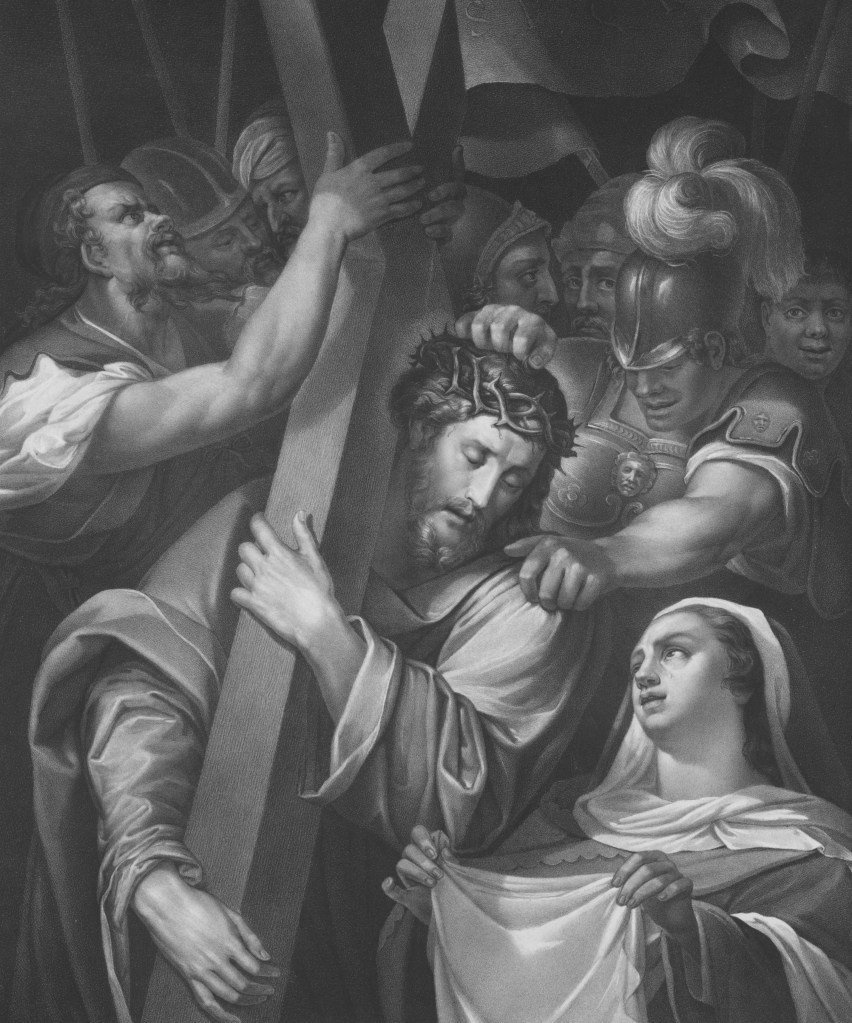
The Way of the Cross

They (the soldiers who had mocked, beaten, and humiliated Jesus) pressed into service a passer-by, Simon, a Cyrenian, who was coming in from the country, the father of Alexander and Rufus, to carry his cross.
~St. Mark 15:21

CONSIDER

Today, we are invited to enter the profundity of all ages–Holy Week. The excruciating events of this week grant us the most extraordinary depth of insight into Jesus’ heart. It is incumbent on our faith in God to enter this week with humility and thanksgiving, for in this week, we see in stark detail what Love beckons us to become.

Jesus taught his disciples that if they wanted to follow him, they must take up their cross (Matthew 10:28). And St. Paul reminded the believers in the Early Church that we complete Christ’s sufferings through our willingness to suffer as Christ suffered (Colossians 1:24). The economy of Salvation stupifies me sometimes—no, much of the time! We gain when we lose, live when we die, and are exalted only through humility.

Let’s keep that in mind as we consider Simon of Cyrene, who physically entered Christ’s suffering by carrying his cross for him. St. Luke observes that after laying the cross on [Simon], they made him carry it behind Jesus. Interesting point. Don’t you want to know what may have run through his mind as he followed the God-man, beaten beyond recognition, stumbling along before him? We do know this: the way (attitude) Simon carried Christ’s Cross changed the trajectory of his life, much in the way the Lord wants to transform our lives. (St. Simon spread The Gospel in northern Africa; he was eventually martyred for his faith in Christ around 100 A.D. His sons, Alexander and Rufus, were among the first believers in the Early Church in Rome. Because of the influence of St. Simon of Cyrene, we can assume The Church was graced with Tertullian, St. Augustine, St. Cyprian, and St. Monica from northern Africa)

If we genuinely desire to follow Christ to eternal life, we must first walk The Way of The Cross. But how exactly do we do that? Jesus told his disciples that he was the Good Shepherd who laid down his life for his sheep. The Greek meaning here is that Christ laid down his life, soul, heart, and mind. He calls us to do the same; how are we doing? Do we lay down our thoughts and words? Do we lay down our desires? How often do our tongues complain when a circumstance or someone messes with our plans? How often do we complain to others about someone who has offended us? How frequently do our minds refuse another’s need because it will cause us discomfort?

Isaiah prophesied that Jesus would be like a lamb, led to slaughter. Have you ever observed lambs? They just follow the sheep who follow the shepherd. Hmm? What if Simon complained and blamed Christ as he bore his burden to The Cross? What would have happened to Alexander and Rufus if Simon had complained about his burden of following Christ to his Cross? What happens in us when we spur suffering as if we don’t deserve it? How are the observers of our lives affected by our attitudes in the face of unwelcomed interruptions?

Every bit of inconvenience, interruption, and disruption is God’s will for us in that moment where we have the choice to lay down our life, soul, heart, and mind. Although minor inconveniences have little consequence, they provide practice in laying down our lives with an attitude of thanksgiving. When the consequential sufferings of our lives come along, we recognize them as the call of Christ to complete his suffering by carrying our cross in what he has allowed in our lives.
Christ went to the Cross to save us from the immense sufferings of sin and death. He allows whatever temporal sufferings–the diagnosis, the betrayal, the tragedy, the loss–to save us from ourselves along the way. He saves us in the circumstances, and our mind, body, and soul will be transformed into his likeness! That is the way of The Cross.

PRAY

Shepherd of my heart and Savior of my life, I exalt you; my soul magnifies you! Yet I so quickly magnify my molehills into mountains when something comes along to mess with my control. Please forgive me for my pride, fear, and self-absorption. You created me in your image; it takes a lifetime of surrendering my will to you. Why do I delay it by resisting Your will for me in each circumstance? Why do I doubt your everlasting love for me? You will never lead me where you do not want me to go, but sometimes I do. Lead me back to the Way of the Cross, the path of my salvation. ~Amen


The Domestic Church: How to Prepare Your Child for Eternity

St. Benedict encouraged in his book “The Rule of St. Benedict,” written around 530 A.D., “to keep death before [our] eyes daily” and “to keep constant watch over [our] actions.” The saint touched on something we do well to remember in 2025 A.D.: We prepare for the inevitability of death as we live. This month, we will consider how best to orient our children and grandchildren to the four last things. As Catholics, we are encouraged to prepare for death, purgatory, heaven and hell. It almost goes without saying that from the inception of this monthly column, we have offered counsel that prepares our children for their entrance into eternity; we will not repeat all that here. Let us dig a bit deeper into this subject and learn ways to improve in our noble profession as parents and grandparents.

“[Parenting] is a noble profession that shapes the character, intellect, and souls of the future generations.”

~St. Elizabeth Ann Seton

Knowing where we came from and what we are here for makes it easier to understand where we are going. The best way, it seems, is to prepare our children for their destination by training them to navigate the “first thing”: knowing the breadth, depth and height of the love of the one for whom they exist. We want to teach them that God’s unfailing love breaks through every border in our lives, and he desires that we live like that! We must teach our children to live purposefully, mindful that the borders of this life are not dead ends; there is always so much more to learn about how God loves us! Living a spiritual life is not a burden but a joyous journey filled with the love of God.

How can we guide our children to lead beautiful lives with Our Lord?

We want to acquaint our children with God’s justice, which is love and mercy. The parables Jesus taught were built upon this truth, the prodigal son (Lk 15) being the most well-known. We can use this parable to expose our children to God’s lavish love for them, just like the father in the parable. The parable displays love and mercy in spades! It also exemplifies the need for forgiveness in the Sacrament of Reconciliation. When we make confession a family practice, we provide opportunities for our children to experience God’s love and mercy. This regular practice not only reassures them of God’s forgiveness but also guides them in understanding purgatory, as the sacrament grants us the grace to purge everything that will not be welcomed in heaven if we turn from the wrongdoing that got us there in the first place and live out our absolution on purpose.

On the way to confession, we can remind them that we practice regular confession to be godly humans and prepare ourselves for God’s beautiful future for each of us. This regular practice of confession is a source of reassurance and guidance for our children, helping them understand and accept God’s forgiveness.

We can also lovingly hold our children accountable and help them train their spiritual muscles in obedience. Son, I know you asked Jesus to forgive you for; how can I help you become a better human and guide you when you struggle with? It is better to help our children nip vice and wrongdoing in the bud before it becomes habitual, leading to sin that separates them from God’s beautiful desire for their lives. We also instill an understanding of the purpose of purgatory when we regularly help them (and ourselves) purge sin from their lives through the sacrament. Better now than later.

How do we teach our children about sin and its effects on our lives and future?

We want our children to know the difference between committed sins and omitted acts of obedience, and this will help them recognize that we are accountable for the wrong we choose to do and the right we do not decide to do. St. James admonishes, “So for one who knows the right thing to do and does not do it, it is a sin” (4:17).

The parable of the 10 virgins and the parable of the talents (St. Matthew 25) can help them recognize we are accountable to God and others for our actions. (As a reminder, always try to follow up what you read to them with the five W’s–who, what, when, where, why–to engage their minds and trigger responsive behavior.) The parables and teachings of Jesus convey that disobedience to our Lord includes the choices we make not to do the right thing. Understanding sin and accountability enlightens our children and empowers them to make responsible choices in their spiritual journey.

Think of what is above, not of what is on earth. … your life is hidden with Christ in God. When Christ your life appears, then you too will appear with him in glory. ~Colossians 3:2-4

How do we teach our children to fix their minds on our Lord?

The beautiful life God wants to give us here and now and in eternity depends upon our responses to him in the way we think and the choices we make that reciprocate our love for him. Therefore, we want to help our children kindle to Jesus’ heart and choose virtuous living out of a deep passion for God, not just fear of hell. Thomas à Kempis wrote the spiritual classic “The Imitation of Christ,” the go-to book for learning to love the Lord our God in thought, word and deed. His life-changing counsel acts as a guidance counselor on fixing our minds on Christ and his example.

The more integrated and uncomplicated one is, the more effortless and astute one will be in their understanding because they will be enlightened from above. … A person who wishes to be good and devout first puts their interior life in order and then attends to his other duties. ~Thomas à Kempis

Friends, when we make goodness and devotion to our Lord the priority of our noble profession, his Holy Spirit imbues us with the fortitude to stay at our post. Above and beyond all these suggestions on preparing for the four last things is praying hedges of protection around our children as we nurture them in the faith. The most effective tool is the Sacred Scriptures, for God’s Word is living and active, sharper than any two-edged sword, piercing the heart and accomplishing his desire (Hebrews 4:12; Isaiah 55:11).

Resources:
Bible story books for children from Arch Books, appropriate for ages 5-9. (The first four parents to request a Family Prayer Guide at standinthegap.sfdiocese@gmail.com will receive a Bible parable storybook free upon request in gratitude to you for praying for your family.)

“The Imitation of Christ for Children: A Guide to Following Jesus” by Elizabeth Ficocelli.

Allegories are also a good tool for teaching spiritual truths in story form. We highly recommend these read-aloud books for children age 9+:

“Hinds Feet in High Places” by Hannah Hurnard.

“Pilgrims Progress” by John Bunyan

“Lord of the Rings” by J.R.R. Tolkien

“The Chronicles of Narnia” by C.S. Lewis

Dante Alighieri’s “Inferno” as told for young people by Joseph Tusiani (12+)

~I am a freelance writer. This post first appeared in a periodical.

Three Minutes of Grace

BEHOLD!

The essence of the Christian message is not ‘Behave!’ but ‘Behold!’
~Jared C. Wilson

Behold, I make all things new.
~Revelation 21:5

******

CONSIDER

Behold or a variation of the word appears about 1,500 times in the Old Testament and 200 times in the New Testament, depending on the translation of the Scriptures. Instead of the word behold, it is often translated as see or look and carries a sense of captivation. One commentary reads, “When you behold something, you see it with your eyes, but you also hold your gaze on it to search and understand.” The word behold is often paired with an exclamation mark—the grammatical equivalent of a slap in the face. We frequently need that, don’t we?

For instance, upon seeing the Burning Bush, Moses said, “I must turn aside to look at this remarkable sight” (Exodus 3:3). He didn’t just glance at it; he stopped in his tracks, pondered it, and examined it. It was strange enough to witness spontaneous combustion, but what seized Moses’ attention was what happened after he turned aside from the path he was on. “When the Lord saw that he had turned aside to look, God called out to him from the bush: Moses! Moses! He answered, ‘Here I am’” (v.4). Apparently, the Lord waits for us to notice his presence. That begs the question: What am I missing from the Lord when I obsess about my agendas? What would he want to say to me if I paused and considered my life from his perspective? As far as Moses is concerned, his response to the Lord that day changed the trajectory of the Israelite nation. What do you suppose the Lord has in store for you this day if you turn aside from your schedule and behold him?

PRAY

Lord God, my mind can be captivated by so many distractions, but I choose to acknowledge your presence in all the circumstances of my life today by beholding the truth of your Word. Captivate my heart with your mercy. Show me the way of sincerity that opens my heart to receive your wisdom. I am grateful that you are the Guardian of my life. I need not worry about stuff because you have taken care of it. You are my salvation; I entrust my responsibilities and their outcomes to your goodwill. Save me from fear and doubt that you won’t come through for me. Your hand is never shortened, that it cannot save me from my errors; nor is your ear dull, that you cannot hear me when I call. Lead me with your strong hand in the way I should go. I trust you to enable me to correct my past errors and to grant me discernment to recognize the new behavior I need. Behold, you do make all things new!

~Amen

~I am a freelance writer. This post first appeared in a periodical.

The Domestic Church: Teach Your Child How to Mourn

“Blessed are those who mourn, for they will be comforted.”

We usually think of death when we hear the word mourn, but there are significant losses in life, such as divorce, that we mourn. To mourn is to feel deep sorrow or regret, which we can also experience with other losses. The virtue of fortitude in facing loss is not something we witness very much. We tend to short-shrift mourning to a set time and place and become uncomfortable about grieving outside the prescribed boundaries. That’s just not healthy!

There is a time for sadness, and it can be good for us; Jesus tells us that in what is referred to as the Sermon on the Mount. We need more space for mourning divorce and death instead of shoving our broken spirits under the proverbial rug. How can we do that for our children? How can we help them through mourning into the comfort the Lord promises for us?

This month, we will explore practical ways to help our children navigate some of the most complex emotions they will ever have. Next month, we will discuss the four last things: death, judgment, heaven, and hell, and how we can acquaint our children with the reality of dying and death.

When we are in sorrow, it can reveal the deep love of our Lord for us when we recognize that suffering strengthens faith, hope, and love in us.

The most important thing to remember is that children grieve deeply those closest to them, but their tender hearts can also mourn for others’ suffering. It is vital to build an atmosphere in our homes where our children feel safe with their emotions and can be honest about their feelings; they learn best from how we handle grief in divorce, death and loss.

Regardless of age, children have questions about loss and the suffering it causes them; ask them about their questions. If you don’t have an answer, explore suffering with your priest together (more about this next month). Sometimes, children will feel that accidents, divorce and death are somehow their fault. You can help them by talking about your feelings of fault in those circumstances that have caused the suffering.

Encourage them to talk to Jesus about the suffering they are going through. It is of eternal importance that we acknowledge our Lord’s suffering and that he is acquainted with our grief. Remind them that Jesus was “spurned and avoided by men, a man of suffering, knowing pain … Yet it was our pain that he bore, our sufferings he endured” (Isaiah 53:3a, 4a). Talk about Jesus mourning over his friend, Lazarus (St. John 11:1-34-3), and ask them about their own feelings at seeing their loved one depart or die.

Remind them of our Blessed Mother’s suffering in St. Luke 2:22-38 and St. John 19. Talk about the feelings Jesus and Mary must have felt while they suffered. Assure them that the Lord understands their fear, and they can express their doubts about his love and care for them as they mourn.

Prudently talk about the realities of a loved one’s last days of suffering or the circumstance that took a loved one away from them (death or divorce). Their imaginations can cause all sorts of feelings, so make sure you are the one to attend to them when they do. If they are mourning the absence of their mother or father due to separation and divorce, guard your tongue! Too often, the suffering children endure because of divorce can be underestimated by the parent who is listening to them if feelings of bitterness or anger are harbored against the other parent.

Grieving can come in fits and starts. One minute, your child may seem to be adjusting to their loss, the next, they may be in tears or acting out in anger when they see something that reminds them of their loved one. In fact, it is much easier for a child to act on their feelings rather than talk about them—we know this, don’t we? There really are no words adequate to express the raw emotions death and loss cause.

If possible, visit the cemetery where the loved one is in repose. Some children benefit from taking a remembrance item to place on the grave; allowing them to decide on the item provides a sense of empowerment for them. Writing letters or drawing pictures to give to a loved one is healing for any age person, but especially for children. It is helpful to your children when you express your sadness and pray with the Lord about it in their hearing; this encourages them to talk to the Lord when they are overcome with emotions.

Help your children understand that a cemetery is sacred ground by praying before you leave your car for all those who have died that their souls would be welcomed into the light of God’s eternal presence. Reverently walk through the cemetery, avoiding walking on graves.

Expressing suffering through artwork can help many children who can’t put the complexity of emotions, including guilt, shame, regret and anger, into words. Have your child describe what is happening in their artwork and refrain from negative feedback about the emotions. Acknowledge the feelings and express how you feel what they are feeling.

Creating a memorial place in your home for a deceased loved one is an ancient practice that would be helpful for us to do when we have suffered a death. The space can be used for prayers for those you mourn and anyone close to them, and it can help normalize feelings. Explain to your children that strong feelings are part of grief, that they can come and go for a long time, and that you will keep the memorial there as long as they need it. The memorial can be used as a sacred space for prayer and the sharing of memories for you with your children.

Lord Jesus, I am so sad; I miss [loved one] so much that it hurts awful. I know that you hurt really bad when your family and friends suffered, too, so would you wrap your arms around me and listen to me when I cry?

I am angry at you, Lord Jesus, why did you let [loved one] die? Don’t you know how much I miss [loved one]? Help me not to be so lonely for [loved one], and help me to forgive you for allowing [loved one] to die.

I feel like it was my fault that they (loved one) left/died, and I wish I could bring them back! I don’t know what to do with my feelings! Do you feel what I am feeling?

These fears need to be prayed for the sake of voicing them; don’t interject how you think they should feel about their worries. The Holy Spirit is the Wonderful Counselor; allow your children the freedom to pray in their raw emotions. He, in his way, will counsel their hearts according to their most profound need.

St. John Henry Newman wrote a beautiful prayer worth considering as a bedtime prayer for your family; it subtly acquaints them with the understanding of a “holy rest” that awaits us all.

O Lord, support us all the day long till the shadows lengthen and the evening comes and the busy world is hushed and the fever of life is over and our work is done. Then in your mercy, grant us a safe lodging and a holy rest and peace at the last.

~Amen

~I am a freelance writer. This post first appeared in a periodical.

Three Minutes of Grace

ON PRAYING THE SCRIPTURES

The thoughtful reading of a Scripture passage–a scene, a sentence, a word–
and it’s challenge to present circumstances and private choices
is the foundation of a faith rooted in the spirit of Jesus.

~Sister Joan Chittister, O.S.B.

******

CONSIDER

Lectio is the contemplative reading of Scripture where we reflect on what has been said and what it means for us here and now; it is the most effective way to read the Scriptures because we have to face what a passage is beckoning us to. However, Lectio can also be a method for praying (responding to the Lord). The Church teaches that all of Scripture is written for our salvation. It follows that when we pray the Scripture, we cooperate with the Holy Spirit in our salvation. Don’t you want that, friend?

When we immerse ourselves in Sacred Scripture, it becomes the backdrop for all our attitudes and actions. Think of it this way: A scrim is a theater backdrop that appears opaque when a scene is front-lit but transparent when it is back-lit. The scene behind the scrim explains the meaning and context of the what, when, and why of the events in the forward scene.

And so it goes with our lives. The meaning and purpose of our lives cannot be understood or even navigated well unless we are mindful of God’s kingdom, which runs parallel to the events of our lives. So, what’s happening behind the scrim? It is the never-ending pattern of God’s story that began before time and will never end. (There’s nothing new under the sun. Israel’s story is our story.) Knowing that would put a bunch of those empty nothings we get so caught up in in their proper order, wouldn’t it?

PRAY

Today, let’s contemplate a teaching of Jesus and respond in prayer for our priests and ourselves:

The lamp of the body is the eye. If your eye is sound, your whole body will be filled with light, but if your eye is bad, your whole body will be in darkness. And if the light in you is darkness, how great will the darkness be.
~Matthew 6:22-23

PRAY

Light of the World, enlighten my eyes and fix my gaze upon “your Kingdom come on earth as it is in heaven.” My little fiefdom is like a wave of the sea that is driven and tossed about by the wind, and I am sick and tired of it. I know that you are not the God of disorder but of peace; confusion doesn’t come from you but from my darkened understanding of life. Oh, Father of lights! Please fill me with all the good you want to give me; grant me the perfect gift of wisdom. Your Word declares that in you, there is no alteration or shadow caused by change! I desire that stability; grant it, Lord!
~Amen

(Adapted Matthew 6:22-23; 1 Corinthians 14:33; James 1:6,17)

~I am a freelance writer. This post first appeared in a periodical.

The Domestic Church: Teach Your Children Poverty of Spirit

We have explored the four cardinal virtues—prudence, justice, fortitude and temperance—and are now ready to strengthen these dispositions in our children. The Lord intends the pursuit of virtue to be a daily journey we travel together as a family. In his goodness, he gave us the Beatitudes to act as signposts on the path of virtue.

Blessed are the poor in spirit, for theirs is the kingdom of heaven.

Father Jacque Philippe writes that this beatitude is “the source of all the others; it contains them all, as a seed contains a plant.” He describes spiritual poverty as “the freedom to receive everything freely and to give everything freely.”

What poverty of spirit doesn’t look like:

Johnny always wants to be first in line and first to be recognized before everyone else. He’s sly about it, but he is nearly always successful in manipulating circumstances and others to ensure he gets what he wants; sometimes he complains, accuses, pouts, or storms out of the room when he doesn’t get what he wants.

Sally keeps score on everything; when slighted, she never forgets, and everyone knows about it! She goes out of her way to find fault in others and to tell everyone else about them. She lies about others to make herself look better. Sally shows little respect for her parents, siblings, teachers and others.

We may be Johnny or Sally, and our children may be Johnny or Sally! What can we do to assume the spiritual posture of poverty and recognize that everything comes to us from God for his goodwill and purpose?

What poverty of spirit does look like:

Johnny’s parents have taught him to practice J.O.Y.: Jesus, Others and You. He can’t remember when his family didn’t love Jesus; everything about their lives is about loving Jesus more than anything else. His family worships at Mass every Sunday. They celebrate the liturgical year every day by praying with the Lord about all the things in their lives that trouble them, and they always thank God for his love and goodness. They regularly learn about the saints of salvation history to learn how to love Jesus and others.

One of his parents helps him through an examination of conscience most nights, guiding him in taking his self-centered tendencies that hurt others to Jesus for forgiveness. He’s learned to recognize that manipulation of others and a complaining spirit cause his parents and siblings pain; therefore, he goes with his parents to the Sacrament of Reconciliation to confess his sin of hurting others and receive absolution. His parents help him to obey the priest’s command, “Go and sin no more.”

He is inspired by his parents’ careful attention to not cause others trouble. He seldom hears them complain or sees them get angry, but when he does, they are quick to apologize for their attitudes and actions.

Sally’s family practices J.O.Y. as well, and their faith practices are similar to Johnny’s. Sally’s parents are hospitable to others and are very careful to speak well of everyone. Her parents regularly address Sally’s trouble with getting along by helping her see how her behavior towards others disrespects the Lord and them. When angry or rude, her parents teach her to be a good human by taking her to confession, holding her accountable for her behavior, apologizing, and asking for forgiveness from the person she hurt. They guide Sally to see the best in others by discussing the offensive behavior and helping her develop alternative responses to others.

Sally’s family challenges each other to perform acts of mercy by serving others in a family-friendly competition. Each week, they choose one of the fruits of virtue—love, joy, peace, patience, kindness, faithfulness, goodness, gentleness and self-control—keeping a tally on their J.O.Y. board. The week’s winner chooses a game they can play where they can practice the fruits of virtue on each other.

Children have an innate desire for leadership, authority, and security; we can leverage this desire to trust and follow our beloved Lord. When we cooperate with the Lord in our vocation as their parents, he will enable us to create a joyful atmosphere in our homes!

~I am a freelance writer. This post first appeared in a periodical.

Three Minutes of Grace

THE FAST OF THE HEART

Does the Lord delight in burnt offerings and sacrifices as much as in obedience to the Lord’s command? Obedience is better than sacrifice, to listen, better than the fat of rams. ~I Samuel 15:22-24

******

CONSIDER

The Church has given us the grace of the lenten fast in the pattern of Jesus’s 40-day fast in the wilderness, but in reality, we are to fast daily because fasting, first and foremost, is a fast of the heart. Samuel, the prophet of the Lord, reprimanded King Saul for his half-heartedness in obedience to the Lord’s command concerning the battle of the Amalekites. (The Amalekites were the archenemies of Israel; it’s a fascinating story, worth your time and attention!) The takeaway for us is this: the Lord is much more interested in a continual sacrifice of our hearts than he is with us sacrificing from our appetite for 40 days. 

When Samuel confronted Saul about his half-hearted obedience to the Lord’s command, he confronted the stubbornness of Saul’s heart. Saul was duplicitous, deceitful, and power-hungry for recognition and fame; there wasn’t a ram anywhere that could atone for that if Saul wouldn’t have a change of heart. What about us, friends? What niches of our heart do we ignore while we “clothe ourselves in ashes?” Jealousy, resentment, pride, fear, anger…..OH! We could make long lists, couldn’t we? This lenten fast, let’s allow the Holy Spirit to lead us to  “wholeheartedness.”

PRAY

Holy God, Your Word declares that if I come before you wholeheartedly, you will deliver me from my enemies—even my frenemies of vice! You search and know me fully and how I fixate my heart on my desire to be noticed and approved by others more than I desire to be wholly acceptable in your eyes. I really don’t like that about myself; please forgive me, Lord. Why do I fight against your will when I know it is perfectly designed for me as your beloved child?

Father, grant me the fortitude of a willing spirit; purge me of apathy! Grant me a forgiving heart free of bitterness and resentment; purge me of pettiness and self-righteousness. May my sacrifice this lenten fast be a contrite spirit, for a contrite and humble spirit, O God, you will not spurn.

Amen

(Adapted prayer from 1 Samuel 7:3; Deuteronomy 10:12; 2 Maccabees 1:3-4; Jeremiah 24:7; Joel 2:12-13; Psalm 51)

~I am a freelance writer. This post first appeared in a periodical.

Pray It Forward: The Virtue of Fortitude

Prudence, Justice, Fortitude, and Temperance are the foundation of the theory of ethics; they are the hinges for us as parents and grandparents. Our goal is to build the strength of mind in our children to enable them to recognize dangers to their character and bear the pain or adversity with courage, which hinges on how strong their fortitude is.

The need for fortitude is likened to the grit to know your place on a sports team and play well for the game’s good. Chuck Colson wrote, “Remain at your posts and do your duty — for the glory of God and His Kingdom.” Oh, friends, we need to hear that, don’t we? Our children are in a skirmish with the enemy of their souls, who will do anything to distract them from the goal of being morally well-developed humans. The stakes are high and demand we remain at our posts as parents and do our duty to God and our children for the sake of life here and in eternity. Let’s consider a few virtues that hinge on fortitude and how we can help our children grow in their strength of character.

Firmness of Character

Pope Benedict XVI once said, “The ways of the Lord are not comfortable. But we were not created for comfort, but for greatness.” Greatness, or magnanimity, means being great of heart. And just like the Lion in The Wizard of Oz, it requires courage. We can train our children to be stick-to-it-ness at doing all things well for the glory of God (Colossians 3:23). This will teach our overachieving children to be more humble and teach our underachieving children to be more courageous.

Firmness of Purpose

St. Teresa of Calcutta said, “Do small things with great love.” Fortitude enables you to stay in the fight for goodness. Diligence comes easier to some than others, so when our children struggle or give up on a small or large thing, we have a perfect circumstance to teach fortitude. The Book of Hebrews writer encouraged us not to grow weary in well doing…to keep our eyes on Jesus…and to finish the race before us. Finishing doesn’t equate to winning in God’s mind. Finishing is the reward! We can guide our children to be firm in purpose, whether with homework, good behavior, household chores, good choices, or extracurricular activities. Some children may benefit from making a small to-do list that they can check off each day and experience the satisfaction of a job well done–we can gently push them to add “sacrifice” and “hard task” items.

Firmness in Patience and Perseverance

Our children need to learn to accept challenges graciously, without grumbling. Whining and angry outbursts show the need for fortitude; beginning in the toddler years, when we teach our children to wait their turn calmly, we teach them patience. When we train them not to complain about inconveniences, we teach them patience. When we teach our children to pray about a desire of their heart, instead of demanding we fulfill it, we teach them patience. Training them in patience will lay the ground for a lifetime of patiently enduring life when it doesn’t go their way; flexibility is an excellent human virtue. It’s hard to be consistent when our small children’s behaviors wear us out; persevere, dear parents!

Character Studies

When the writer of the Hebrews admonished the first believers to finish the race of faith, he reminded them of a litany of Old Testament saints known for their perseverance. I paraphrase what he then said.… since we are surrounded by so great a cloud of witnesses, let us also lay aside every weight and the sin that clings so closely, and let us run this character race with perseverance (fortitude).… looking to Jesus the pioneer and perfecter of our faith.…

The Sacred Scriptures are replete with saints and sinners; they are there to help us run the race of virtue. History is replete with saints whose lives look much like ours; they are there to help us run the race of virtue. Spending time as a family learning from others who have finished well inspires our children and spurs them on. Here are a few suggestions beyond what we have already suggested for family worship times.

Resources:

Stories of the Saints: Bold and Inspiring Tales of Adventure, Grace, and Courage by Carey Wallace and Nick Thornborrow

A Saint a Day: A 365-Day Devotional Featuring Christian Saints by Meredith Hinds and Isabel Muñoz is appropriate for all ages.

Train the young in the way they should go;
Even when they are old, they will not swerve from it.
~Proverbs 22:5-6

~I am a freelance writer. This post first appeared in a periodical.

Three Minutes of Grace

THE GREAT FAST

Everything nonessential in us must fall away like ashes in a furnace so that the pure gold of our being, thus refined, may shine in the light of grace. The Lord holds you in his hand: know then, dear friend, that you belong to the Lord, whether you live or die.

For the peace of the Christian begins only in death…with the inexpressible bliss of supreme life, which is supreme wakefulness, supreme activity, and supreme intensity, and at the same time deepest calm, peace, and security….  ~Hanns George von Heintschell-Heinegg  (poet and theology student put to death by Nazis 1944 for being a part of the Resistance)

******

CONSIDER

We have entered the Great Fast, a journey through the furnace of self-denial. We don’t enter the fast as a self-help endeavor; we enter it to die to the self so that we may live as Christ who “though he was in the form of God, did not regard equality with God something to be grasped. Rather, he emptied himself…[and] humbled himself, becoming obedient to death, even death on a cross” (Philippians 2:6-8). He laid down the pattern for us, and as we follow it, we come to know the deep calm, peace, and security of belonging to him. 

Hanns George von Heintschell-Heinegg faced “emptying himself” in the extreme. As he awaited his execution, he was forced to come to terms with all the nonessentials of life. Let’s use his counsel to inventory our motives in this year’s Lenten fast.

*Do I stake my life on belonging to the Lord, or does my autonomy consume me? If the latter, we need the journey through the furnace of self-denial.

*Am I at peace in my relationships, pursuits, past, present, and future? If not, we need to journey through the furnace of self-denial.

*Do I know the bliss of supreme life in Christ? Do I delight in sacrificing my time and resources for God’s good work? Do I desire the happiness of detachment from all my fascinations more than stockpiling distraction upon distraction? If not, we need the journey through the furnace of self-denial.

*Am I supremely aware of my vices and sinfulness? Am I supremely aware of the Lord’s forgiveness? If not, we need the journey through the furnace of self-denial.

*Do I strive for moral excellence in my attitudes and actions? If not, we need the journey through the furnace of self-denial.

*Am I supremely intent on receiving the fullness of the gifts of the Holy Spirit—wisdom, understanding, counsel, fortitude, knowledge, piety, and reverence for the Lord? If not, we need the journey through the furnace of self-denial.

*Do I desire the deepest calm, peace, and security that comes from the Lord alone? If not, we need the journey through the furnace of self-denial.

PRAY

Jesus, Lord, and Savior of my life, this year, I desire to endure the furnace of fasting from myself—all my attractions and fascinations, my self-will and self-promotion, my pursuits and persuasions.  I need your Holy Spirit’s strength to climb higher and fight harder for the restoration of your image in me. Grant me the honesty with myself to die to the behavior I excuse in myself. Illuminate my mind with your truth, and strengthen me in my weakness. Burn, Lord, burn! ~Amen

~I am a freelance writer. This post first appeared in a periodical.