Greetings, friend.
"In silence and rest is your salvation" are words from the prophet Isaiah that echo the desire of my life. I've been following that desire my entire life as I seek to live and move and have my being in what the LORD desires for me. I'm still learning the beauty of silence and rest as my salvation, it's a long obedience in the right direction. This is my journey.
And the congregation of those who believed were of one heart and soul; and not one of them claimed that anything belonging to him was his own, but all things were common property to them. And with great power the apostles were giving testimony to the resurrection of the Lord Jesus, and abundant grace was upon them all.
–Acts 4:31-32
Consider:
The weeks between Easter Sunday and Pentecost Sunday are called Eastertide in our Catholic tradition. One way to interpret the daily readings from the Acts of the Apostles is that they are the diary of how the great tide of Christianity began. Over the next several posts, we will consider the lives of some of the apostles.
The overriding message of the early Church was its worship, the believer’s unity in purpose, and persecution, and the tide still rolls the same today. Ten original disciples/priests were martyred, and one was exiled for The Faith (St. John). Most of the believers in the Early Church were persecuted and martyred! We know very little of persecution for The Faith here in the United States, so sometimes we can forget how great a personal sacrifice it can be to worship the Lord in the Mass. We do well to remember that we aren’t “suffering” to the point of death.
What we don’t observe in the Acts of the Apostles is resistance over the purpose of corporate worship of God and where and when or how it would occur. In other words, protest against the Apostles was the furthest from their minds; gratitude and thanksgiving for the great favor of God ruled the hearts and minds of our ancestors in The Faith. The disciples would roll over in their graves to observe the dissension and protest that has fractured God’s people. How we got here took about 500 years! Unity and cooperation are essential if we are going to restore the single-minded purpose of The Church–to proclaim the Good News of Christ crucified once and for all people!
Pray:
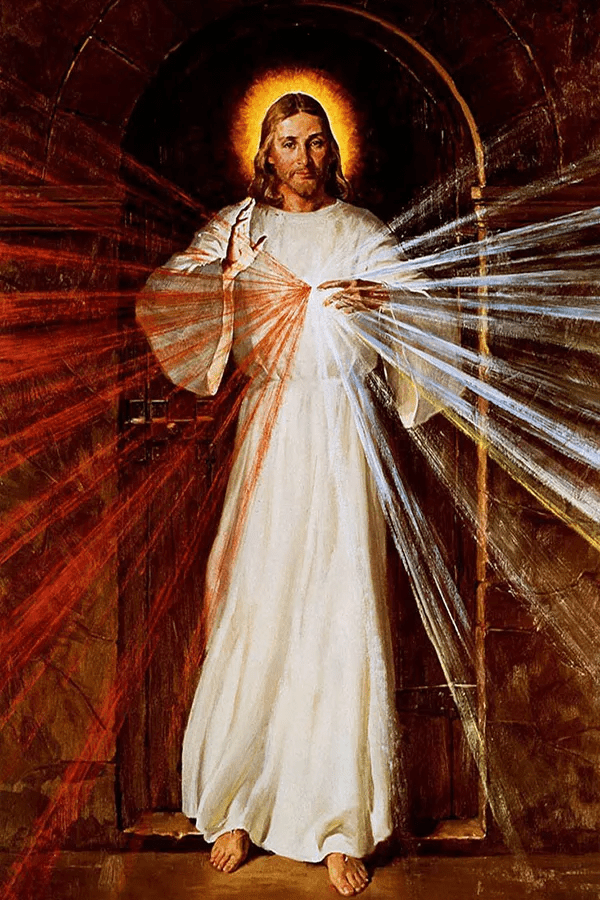
Father, I am eternally grateful for your sacrificial love for me. Thank you for the blood and water from your Sacred Heart that has flowed down through history to reach me–your divine mercy astounds me! I desire to worship and glorify you with all my heart, mind, and strength. I can become so comfortable in the conveniences of this life that I forget to remember you sacrificed your very life for me! I forget to recognize the privilege I have in our free country to worship you with other believers without fearing for my life. I forget to remember that you have gifted me with (priest’s name) to celebrate you in the source and summit of The Faith. What a privilege, what a beautiful life you have given to me. Forgive me for my apathy about coming together with other believers in the worship of The Mass. When I am tempted to complain, murmur, or protest against The Truth, Goodness, and Beauty of The Faith.
We all receive love in one or more ways: physical touch, words of affirmation, quality time, gifts, and acts of service impact each of us in varying degrees. The five love languages don’t limit how the Lord demonstrates his love to us, but he has created us to receive his love unique to each of us. No doubt, you can remember moments of consolation where he spoke love to you profoundly; more than likely, you received that love in your language. What would happen in our families if we united our passion for each other with God’s love for us in our conversations by speaking each other’s language? This month, let’s consider the first of the five languages to discover how we can help our children develop emotionally and spiritually.
Everyone needs physical contact, but love shouts through touch when our primary love language is physical touch. Some children just light up when they receive physical touch. Two of our grandchildren always sit extra close rather than far away; they are quick to cuddle and stroke their parents. Now, how can we draw them into feeling God’s love? With this in mind, let’s consider how to teach our children how God loves them uniquely. Consider reading or telling this beautiful account of Jesus and the children while you rock them or sit close to them. Perhaps a good time would be at bedtime when you can rub their back or stroke their arms as they lie listening to you.
People were bringing little children to him so that he might touch them, and the disciples spoke sternly to them. But when Jesus saw this, he was indignant and said to them, “” Let the little children come to me; do not stop them; for it is to such as these that the kingdom of God belongs. Honestly, I tell you, whoever does not receive the kingdom of God as a little child will never enter it.””And he took them up in his arms, laid his hands on them, and blessed them.
(Mark 10:13-16)
Some questions to ask her:
What part of that story did you like best?
If you were Jesus, how do you think you’d feel when you got to hug the children?
If you were one of the children, what would you like best: Jesus holding you, Jesus placing his hands on your head, or hearing Jesus say nice things about you?
A Prayer:
Jesus, thank you for always holding us safe in your arms even though we can’t see you. ~Amen
You may even encourage your physical lovers to kiss the crucifixes and Bibles in your home as a way for them to love God in their language. You could purchase a cross-shaped pillow for them to hug as they sleep at night (Etsy is a great resource) to remind them of Jesus’ love for them.
The teen years can be tumultuous because our children are at loose ends about who they are and their place in the world. These are prime years for them to learn of God’s unfailing love for them, and we are the ones to model that love (even when we like to send them back to the cabbage patch!) One of our teenage grandchildren who “speaks” physical touch visibly softens when she is touched. Her parents are diligently training her strong will in these hormone-driven years. How can we draw her into feeling God for her when we are in a conflict? Tenderly speaking words of understanding coupled with an embrace (even though her attitude may bristle) or a touch on the shoulder may reach her better than any lecture.
Consider this passage from St. Matthew 23: 37 Jesus said, “”Jerusalem, Jerusalem, the city that kills the prophets and stones those who are sent to it! How often have I desired to gather your children together as a hen gathers her brood under her wings, and you were not willing!
Some thoughts to share with her as you stroke her arm or rub her back:
I know you are angry, and I understand how frustrated you may feel about [ ]. You aren’t the first person to feel that way; Jesus was angry and saddened by people’s behaviors and choices, he once told them he desired to gather them into his arms like a hen gathered chicks under her wing, but they were unwilling to let him. I believe Jesus wants to gather you into his arms and hold you close as you tell him what you are angry about. Would you be willing to let me hold you like Jesus wants to hold you?
A prayer:
Jesus, I love [ ] so very much, but I know you love her even more than I do. Please help us calmly share our feelings about what is happening. Would you draw us into your arms and shelter us from hurting each other with our words?
The Lord instructed us to train up our children in the way they are destined to go. When they are old, they will not depart from it (adapted Proverbs 22:6). When we love our children the way they are created to receive love, we ensure they will receive the Lord’s love more readily as they mature in their faith.
Recommended Reading:
The 5 Love Languages of Children and/or The 5 Love Languages of Teens by Gary Chapman
… Mary stood weeping outside the tomb. As she wept, she bent over to look into the tomb; and she saw two angels in white, sitting where the body of Jesus had been lying, one at the head and the other at the feet. They said to her, “Woman, why are you weeping?” She said to them, “They have taken away my Lord, and I do not know where they have laid him.” When she had said this, she turned around and saw Jesus standing there, but she did not know that it was Jesus. Jesus said to her, “Woman, why are you weeping? Whom are you looking for?” Supposing him to be the gardener, she said to him, “Sir, if you have carried him away, tell me where you have laid him, and I will take him away.” Jesus said to her, “Mary!” She turned and said to him in Hebrew, “Rabbouni!” (which means Teacher) … Mary Magdalene went and announced to the disciples, “I have seen the Lord,” and she told them that he had said these things to her. John 20:19-23
Consider: A good habit to have when reading the Sacred Scriptures is placing ourselves in the sandals of our ancestors in the faith to understand the depth of the salvation God grants us through Jesus Christ. With that in mind, let’s consider Mary Magdalene’s thoughts as she walks to Christ’s tomb the morning of His resurrection.
I remember the moment I fell before you, splayed out in the weariness of my bondage, begging for mercy. You saw my bruises from the seven demons that assaulted me day and night, you heard my cries, and you exorcized those demons from me. Hope and joy instantly replaced my despair. I was a new woman! I loved you, I followed you; I believed your promises. You gave me a new name: Beloved. Oh, Jesus, now I’m bereft. You have forsaken me. I don’t know who I am anymore; I’ve forgotten my name.
The tomb is empty, and Mary’s despair has robbed her memory of Christ’s promise. Jesus stands nearby, waiting for Mary to look at him. He quietly calls to her, Mary! She turns and says to him in Hebrew, ‘Rabbouni!’ (which means Teacher).
Despair does that to us, doesn’t it? It can creep into our lives slowly taking possession of us, causing us to forget who we are and who Christ is. Despair can happen in a catastrophic event that quakes the ground beneath us, threatening to destroy us. We have all been there, and still, we soldier on worshipping at mass after mass, confessing our sin confession after confession. We need to hear the word of Jesus: You are my beloved child, I have chosen you, I am with you, I am keeping my promise to you, I will never leave you or forsake you.
Pray: Jesus, your Word reminds me that you knew me before I was born; in my mother’s womb, you named me. Would you remind me of that when despair begins to creep in? I want to know that my love for you is not in vain. When I have spent my last strength to seek you, help me to stay silent and listen for your Words of consolation– ‘You are my servant in whom I will be glorified.’ When I cry out to you, ‘I have labored in vain, and I have spent my strength for nothing in return,’ remind me that my name is inscribed on the palm of your hand, and recompense will come; you will never forget me! ~Amen (adapted Isaiah 49:1-5; 15-16)
Act: We are a Resurrection people! Christ didn’t leave the Magdala in her despair on Resurrection morning, and he doesn’t leave us now, but all too often, we think our despair is ours to carry alone. The tomb you keep mourning is empty of your despair! Christ fought for hope when he conquered death, hell, and the grave. On this Easter Sunday, declare your faith in Our Risen Lord, put down your despair, and turn to follow Jesus to new life.
And [Pilate] said to [the mob], ‘Behold, the man!’ ~St. John 19:5
Consider: The processional for Palm Sunday Mass includes an invitation to Christ’s Passion. With all faith and devotion, let us commemorate the Lord’s entry into the city of our Salvation, following in his footsteps, so that, being made by his grace partakers of the Cross, we may have a share also in his Resurrection and his life. I kindle to the word invitation for it calls for a response. The invitation begins with Pilate’s words to the frenzied mob as the humiliated humanity of Jesus is paraded before them; Pilate exclaims, Behold the Man. That invitation into Christ’s humanity during his Passion begs us to behold. Now, there’s another word I kindle to. We aren’t passing spectators who just glimpse this holiday we call Easter, who color Easter Eggs and bake hams; No! We behold–witness, contemplate, discern, consider, and perceive–because it is not just any man we behold. This Man, the Second Adam, is the Lamb of God who takes away the world’s sin. In him, the curse of the first man is reversed–O happy fault that earned so great, so glorious a Redeemer! Let us behold our Redeemer! In this Holy Week, we see the length, depth, breadth, and height God went to regain his own–us, his beloved children. He exchanged himself as payment to redeem us to himself. This week is truly the path back home to our Father!
Broken and Spilled Out
[Christ Jesus] though he was in the form of God, did not regard equality with God as something to be grasped. Rather, he emptied himself, taking the form of a slave, coming in human likeness; and found human in appearance, he humbled himself, becoming obedient to death, even death on a cross. Because of this, God greatly exalted him and bestowed on him the name that is above every name, that at the name of Jesus every knee should bend, of those in heaven and on earth and under the earth, and every tongue confess that Jesus Christ is Lord, to the glory of God the Father. ~Philippians 2:6-11
Christologists have a word for today’s Epistle passage from St. Paul’s letter to the Philippians (2:6-11): Kenosis. In our commemoration of Christ’s Passion, we will observe the complete ‘self-emptying’ of Christ’s divine nature to suffer humanity–Behold the Man! That is the Savior we need–suffering human emotions and pain to lead us to empty our disordered human nature. God, with skin on, incarnated himself into us so that we may be re-created into our created identity as sons and daughters of The Most High God. Mind-blowing! And the only way of our re-creation is to follow Christ in His Passion. We, as Catholics, refer to this as redemptive suffering as we understand all suffering is a sacrament we unite with our Lord Jesus Christ. No suffering is wasted when we unite it with our Lord Jesus Christ’s suffering for us in His Passion. Let’s begin.
There’s an arresting (no pun intended) moment in today’s Gospel reading from St. Mark 14, hours before Judas’ betrayal, which foreshadows Christ’s Passion. Jesus was in Bethany, just outside of Jerusalem, eating with Simon, the leper, when a woman came with an alabaster jar of perfumed oil, costly genuine spikenard. She broke the alabaster jar and poured it on his head. Accusations and complaints followed about the extravagance of her offering being wasted on Jesus’ head. Jesus replies, Let her alone. Why do you make trouble for her? She has done a good thing for me… wherever the gospel is proclaimed to the whole world, what she has done will be told in memory of her.” Jesus is about to be extravagantly broken and spilled out, for humanity is anointed by a broken and spilled-out woman in thanksgiving and praise. This is the posture, the sacrifice, to be embraced as we behold the Man, Jesus.
What about you, friend? Is your love for Jesus a lavish offering of abandonment to his goodwill, or are you constrained by parsimonious withholding caused by doubt and skepticism? Jesus told us that when we give, it will be given to [us]. A good measure, pressed down, shaken together, running over, will be put into [our] lap, for the measure [we] give will be the measure [we] get back. (St. Luke 6:38)
Pray: Jesus, Son of God, have mercy on me. It is so easy to get caught up in grasping what I think I deserve from this life that I forget this life is not where I belong; I’m on my way home to You. I don’t belong here; therefore, I am not defined or controlled by what others may think of me, what I have or don’t have, what I do or don’t do. Empty me of all that is not You so that I may be permeated by all that is You! ~Amen
Act: Choose your most treasured possession and lavish it on another.
They (the soldiers who had mocked, beaten, and humiliated Jesus) pressed into service a passer-by, Simon, a Cyrenian, who was coming in from the country, the father of Alexander and Rufus, to carry his cross.
~St. Mark 15:21
Consider:
Today, we are invited to enter the profundity of all ages–Holy Week. The excruciating events of this week grant us the most extraordinary depth of insight into Jesus’ heart. It is incumbent on our faith in God to enter this week with humility and thanksgiving, for in this week, we see in stark detail what Love beckons us to become.
Jesus taught his disciples that if they wanted to follow him, they must take up their cross (Matthew 10:28). And St. Paul reminded the believers in the Early Church that we complete Christ’s sufferings through our willingness to suffer as Christ suffered (Colossians 1:24). The economy of Salvation stupifies me sometimes—no, much of the time! We gain when we lose, live when we die, and are exalted only through humility.
Let’s keep that in mind as we consider Simon of Cyrene, who physically entered Christ’s suffering by carrying his cross for him. St. Luke observes that after laying the cross on [Simon], they made him carry it behind Jesus. Interesting point. Don’t you want to know what may have run through his mind as he followed the God-man, beaten beyond recognition, stumbling along before him? We do know this: the way (attitude) Simon carried Christ’s Cross changed the trajectory of his life, much in the way the Lord wants to transform our lives. (St. Simon spread The Gospel in northern Africa; he was eventually martyred for his faith in Christ around 100 A.D. His sons, Alexander and Rufus, were among the first believers in the Early Church in Rome. Because of the influence of St. Simon of Cyrene, we can assume The Church was graced with Tertullian, St. Augustine, St. Cyprian, and St. Monica from northern Africa)
If we genuinely desire to follow Christ to eternal life, we must first walk The Way of The Cross. But how exactly do we do that? Jesus told his disciples that he was the Good Shepherd who laid down his life for his sheep. The Greek meaning here is that Christ laid down his life, soul, heart, and mind. He calls us to do the same; how are we doing? Do we lay down our thoughts and words? Do we lay down our desires? How often do our tongues complain when a circumstance or someone messes with our plans? How often do we complain to others about someone who has offended us? How frequently do our minds refuse another’s need because it will cause us discomfort?
Isaiah prophesied that Jesus would be like a lamb, led to slaughter. Have you ever observed lambs? They just follow the sheep who follow the shepherd. Hmm? What if Simon complained and blamed Christ as he bore his burden to The Cross? What would have happened to Alexander and Rufus if Simon had complained about his burden of following Christ to his Cross? What happens in us when we spur suffering as if we don’t deserve it? How are the observers of our lives affected by our attitudes in the face of unwelcomed interruptions?
Every bit of inconvenience, interruption, and disruption is God’s will for us in that moment where we have the choice to lay down our life, soul, heart, and mind. Although minor inconveniences have little consequence, they provide practice in laying down our lives with an attitude of thanksgiving. When the consequential sufferings of our lives come along, we recognize them as the call of Christ to complete his suffering by carrying our cross in what he has allowed in our lives.
Christ went to the Cross to save us from the immense sufferings of sin and death. He allows whatever temporal sufferings–the diagnosis, the betrayal, the tragedy, the loss–to save us from ourselves along the way. He saves us in the circumstances, and our mind, body, and soul will be transformed into his likeness! That is the way of The Cross.
Pray: Shepherd of my heart and Savior of my life, I exalt you; my soul magnifies you! Yet I so quickly magnify my molehills into mountains when something comes along to mess with my control. Please forgive me for my pride, fear, and self-absorption. You created me in your image; it takes a lifetime of surrendering my will to you. Why do I delay it by resisting Your will for me in each circumstance? Why do I doubt your everlasting love for me? You will never lead me where you do not want me to go, but sometimes I do. Lead me back to the Way of the Cross, the path of my salvation. ~Amen
Act:
Consider taking up the Daily Examination as a habit. I’ve included a link to help you along.
Then the soldiers of the governor took Jesus into the governor’s headquarters, and they gathered the whole cohort around him. They stripped him and put a scarlet robe on him, and after twisting some thorns into a crown, they put it on his head. They put a reed in his right hand and knelt before him and mocked him, saying, “Hail, King of the Jews!” They spat on him, and took the reed and struck him on the head. After mocking him, they stripped him of the robe and put his own clothes on him. Then they led him away to crucify him. Matthew 27:27-31
Consider: Who was in the cohort around Jesus? People like you and me who were patriotic, doing their duty and living according to the laws of Rome. They carry out justice according to the law of the land, well-meaning, yet tragically misled. Jesus had come to show a new law that wasn’t violent, a law where mercy and justice meet. Imagine what thoughts invaded Jesus’ mind while they were torturing him and mocking his deity; we can’t, can we? But we do know that he didn’t call down justice on them at that moment; revenge was not on his agenda. He offered himself as a willing sacrifice for the sins committed against him!
We have all been wounded at some time or another—ganged up on, ridiculed for our beliefs, mocked, and humiliated—no easy recovery from these wounds. Perhaps you are struggling to release yourself into the healing hands of Jesus. In a post-WWI novel, “The Light Between Oceans,” a conversation between a wife and her German husband speaks right to the heart of our struggle. Rachel, the wife, asks her husband, “How can you just get over these things … you’ve had so much strife, but you’re always happy; how do you do it?” Frank replied, “I can choose to spend my time rotting on things in the past and hating people for what happens … or I can forgive and forget … Oh, but it is so much less exhausting; you only have to forgive once; to resent, you have to do it all day. Every day, you have to keep remembering all the bad things—a very long list to make sure you keep remembering all the bad things to make sure that I hated the people on it the right amount and that I did a very proper job with hating too. No, we always have a choice, all of us.”
Pray: Jesus, Suffering Servant of humanity, teach me how to forgive! You suffered my sins on your Cross so that I wouldn’t have to suffer, yet I choose to suffer when I hold tightly to the offenses toward me. Revenge creeps into my soul like a slow cancer, destroying my spirit. Oh, Jesus, forgive me! –Amen
Act: Prayerfully examine your spirit and allow yourself permission to record the suffering you carry with you from past injustices. If possible, take the list with you to Adoration. Tell our Suffering Servant each injustice you are holding onto. Allow your imagination to take you into the governor’s headquarters, and look at Jesus’ eyes as he silently receives the crown of thorns and the strikes to his Sacred Head. He sees your pain; he KNOWS your pain. Allow the Blood that is pouring from his head wounds to flow over your mind and memory; as soon as you can, light a match to your list, surrendering it to the Lover of your soul.
Then they seized [Jesus] and led him away, bringing him into the high priest’s house. But Peter was following at a distance. When they had kindled a fire in the middle of the courtyard and sat down together, Peter sat among them. Then a servant-girl, seeing him in the firelight, stared at him and said, “This man also was with him.” But he denied it, saying, “Woman, I do not know him.” A little later, someone else, on seeing him, said, “You also are one of them.” But Peter said, “Man, I am not!” Then about an hour later, still another kept insisting, “Surely this man also was with him; for he is a Galilean.” But Peter said, “Man, I do not know what you are talking about!” At that moment, while he was still speaking, the cock crowed. The Lord turned and looked at Peter. Then Peter remembered the word of the Lord, how he had said to him, “Before the cock crows today, you will deny me three times.” And he went out and wept bitterly.
Luke 22:54-62
Consider:
Let’s first consider Peter in this heart-rending exchange between Jesus and himself. Peter, the bold and outspoken natural leader, is caught cowering away from this man whom he had declared the Messiah, the Son of the Living God (Matthew 16:16). Peter had witnessed the Transfiguration of Christ and heard God speak from heaven, “This is my beloved Son, with whom I am well pleased; listen to him.” (Matthew 17:5).
Peter’s zeal drove him to strike off the ear of one of the soldiers who came to arrest Jesus just hours earlier (John 18:10-11). But now, we see Peter, the most successful failure of all time, on his worst day ever! What happened to all of Peter’s resolve and determination to die for Jesus rather than see him harmed?
The underbelly of courage is fear, and we see in Peter how quickly fear takes control of us when we allow it. We are Peter! We come before the Lord to worship him; we declare our belief in him as the Son of God. We sit, stand, kneel, sing and pray, all out of love and devotion to Jesus Christ. But then we walk into a world that doesn’t honor and worship Christ. We choose silence in the face of resistance. We back down when we should stand up. We are so good at making resolutions, and we are even better at failing. Yes, the shoe fits all too well.
Let’s consider Jesus in this moment. Jesus has yet to endure the brutality and mockery of his Passion, but the pain he experiences at this moment surpasses the physical pain to come. The psalmist foreshadowed Jesus’s extreme abandonment at this moment:“It is not enemies who taunt me—I could bear that; it is not adversaries who deal insolently with me— I could hide from them. But it is you, my equal, my companion, my familiar friend, with whom I kept pleasant company” (Psalm 55:12- 14). And yet, and yet, Jesus turned to look at Peter through his eyes of love and forgiveness.
Pray:
Jesus, I’m so good at making resolutions and I’m even better at failing! Forgive me for the times I serve my fear rather than loving and serving you. Grant me the courage to love you with abandon. Jesus, you had me in your sights when you were mortified, flogged and beaten, mocked, and crucified, but none of it causes you as much pain as when I turn away from you every time I am afraid, or I’ve failed. You are the God of second chances…. a thousand chances; there is nowhere I can run from you that you aren’t there, waiting for me to look at you. ~Amen
…The chief priests stirred up the crowd to have him release Barabbas for them instead. Pilate spoke to them again, “Then what do you wish me to do with the man you call the King of the Jews?” They shouted back, “Crucify him!” Pilate asked them, “Why, what evil has he done?” But they shouted all the more, “Crucify him!” So Pilate, wishing to satisfy the crowd, released Barabbas for them; and after flogging Jesus, he handed him over to be crucified.
St. Mark 15:11-15
Consider:
Just as a scapegoat symbolically bore the sins of the Israelites in the Old Testament ritual of atonement, We see in this narrative how Jesus became our scapegoat for our sins. The scapegoat “took on” the sins of the people (Barabbas) and was then driven over a precipice to die. Isaiah prophesied that “[Christ] was despised and rejected by men … He poured out His life unto death and was numbered with the transgressors. For He bore the sin of many, and made intercession for the transgressors” (Isaiah 53:3a, 12). Imagine the mental and emotional wounding Christ must have felt as he heard his people cry out for his crucifixion. These people who had witnessed his healing power and listened to his words of life now turned against him in mass hysteria.
St. Polycarp exhorted the Early Church to “leave untouched the idle prattle and the error of the masses.” Protest, at its extreme, sent Christ to the Cross. We may believe we aren’t capable of that kind of cruelty, but think again. Consider the pattern of human behavior when confronted by something or someone that messes with our system or disrupts our conveniences. The temptation is to engage in “idle prattle” (read complaining and murmuring) that can lead to dissent and protest, making someone or something a scapegoat for our complaints. Ah. That we understand, don’t we?
St. Polycarp went on to say in his letter to “make Christ’s commandments our rule of life and love what he loves.” Can you think of any circumstances that have messed with your system, and you are tempted to murmur and complain, even protest? Remember that Christ’s commandments are built on the humble acceptance that we are not in control. His rule of life includes harmony with others. His Word declares, How very good and pleasant it is when kindred live together in unity! (Psalm 133:1)
Pray:
Jesus, Your Word says you were led to your Crucifixion like a lamb to the slaughter–silently following Your Father’s will. Forgive me for the times I complain and murmur over stored grievances and petty inconveniences. Holy Spirit, confront me when I am party to the error of the masses. Holy Spirit of God, will you set my spirit aright to accept any suffering you allow willingly?
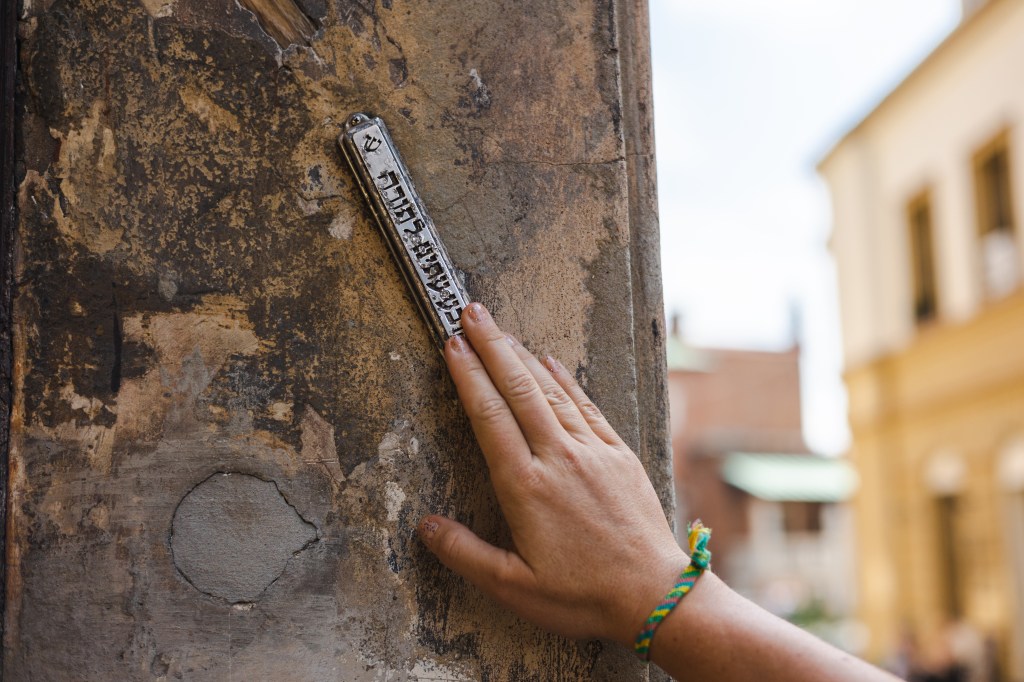
Hand touching mezuzah at the entrance to the house
In the last Pray It Forward post, we learned how foundational it is to know why we are here and why we choose to be Catholic in a culture of competing worldviews. The logical question for us now is: If we understand why we are here and what we are about, how should we live? Let’s consider this question in the context of our home life.
If someone were to walk into our home today, would they see evidence of our Catholic faith? Moreover, if someone were to listen in on our daily conversations with our children and grandchildren, would they hear evidence of our Catholic faith? Sure, relationships can be strained occasionally; that’s a given when you learn to love, but what is the overall atmosphere in our homes?
When we pray, “Thy Kingdom come…on earth as it is in heaven,” we must remember that it begins in the home—as the home goes, so goes the country. Our Catholic faith places a high value on sacramental living, so let’s consider how to fill our homes with tangible evidence of our belief in God.
A Humble Abode
Life lived according to God’s way, lived under the banner of love, teaches us and others through a humbling beauty.1
It is a sad fact that the pell-mell pace of modern life takes us away from home rather than to it. What can we do to shift back to home-centric family life? Observing the Sabbath with the grace and reverence God desires is a good starting place. What can we do to make Sunday feel different for our family? How we begin the day sets the tone for the Sabbath rest that awaits us. The priority of worship of the Mass is a given, but what can we do in the hours before we leave for Mass? Simply saying with joyful anticipation to our children that we get to honor the Lord by worshiping him with other believers sets the tone for the day.
Planning a special meal to prepare together can foster excitement for the day. It may be as easy as a brunch for lunch or as adventurous as a new ethnic recipe you prepare together; the food choice doesn’t matter as long as it is out of the ordinary from the rest of the week. Also, eating together at a table set in a unique-to-Sunday style. A lit candle or a small statue of the Holy Family are excellent centerpieces, and dinnerware reserved for Sunday and Feast Days draws attention to how much we value practicing our Catholic faith.
A special table blessing is reasonable to say together at every meal, but you may want to add a question after the blessing to begin a conversation. Search “family dinner conversation,” and you’ll find many conversation starters. The goal of the conversation is to unite our family with the Lord’s desire to bless us. Count on it! He will!
Heavenly Father, Giver of all good things, In a world where so many are hungry. May we eat this food with humble hearts?In a world where so many are lonely,May we share this friendship with joyful hearts. ~Amen.
From Here to Eternity
The family that prays together—If you spend the first ten years with your children, they will spend the next ten years with you.”2
Hear, O [Family]: The Lord our God, the Lord is one. Love the Lord your God with all your heart and with all your soul and with all your strength.3
Our vocation is to orient our family life toward eternity. Moses instructed the people of God on how to do just that: “Bind them (the precepts of God’s desire for his beloved) as a sign on your hand, fix them as an emblem on your forehead, and write them on the doorposts of your house and on your gates” (Dt 6:7-9). God’s instruction to the Jews relied on the determination of fathers and mothers to act on their faith in God as parents. The instruction hasn’t changed; action is still required! Here’s an idea: A mezuzah (pictured above) is a sacred Jewish object placed on the threshold of the home, which blesses and sanctifies their living space. A special parchment that has the scriptures of Deuteronomy 6:4-9 and 11:13-21 inscribed upon them is contained in the receptacle. You could develop a habit with your children that whenever you enter or leave your home, you say the first two lines from the passage together, amending it to say, Hear, O family…
Are we present to our family? Prioritizing our lives around the family would seem obvious, but we live in a culture that messages otherwise. Preferring our family needs to go beyond our own preferences. Have you looked at any photos of family gatherings lately? Notice how many people are looking at their cell phones. That should disturb us! Where in our days can we shelter our family from outside influences? A time when they know they have our undivided attention?
Consider having a container in a closet where all the silenced cell phones/devices go when you spend time together! If you go out to eat, leave the cell phones/devices in the car. Consider scheduling a read-aloud in your shelter time; it will reap remarkable developmental benefits. Listening to or reading virtuous books was a favorite pastime with our children; now, their families enjoy doing the same. Good habits are usually continued from generation to generation. Consider what that time will do when we combine it with books that teach biblical values, truth, and virtue! Search “storybooks on Christian virtue” to discover age-appropriate resources for your home library. I recommend The Children’s Book of Virtues by William J. Bennett as a go-to anthology of read-aloud stories for children of all ages.
So, friends, how, then, shall we live as Catholic Christians? Prayer, intentionality, and consistency are the answers. Seek the Holy Spirit’s guidance for your family; he is faithful to pour His gifts of wisdom, understanding, and counsel.
Jesus, Mary, and Joseph pray that I have the courage and fortitude to align my family lifeto God’s will and purpose. ~Amen
Resources
1Theology of Home: Finding the Eternal in the Everyday by Carrie Gress, Noelle Mering, and Megan Schrieber.
2Around the Year with the Von Trapp Family by Maria Von Trapp.
When he reached the place, he said to [his disciples], “Pray that you may not come into the time of trial.” Then he withdrew from them about a stone’s throw, knelt down, and prayed, “Father, if you are willing, remove this cup from me; yet, not my will but yours be done.” Then, an angel from heaven appeared to him and gave him strength. In his anguish, he prayed more earnestly, and his sweat became like great drops of blood falling down on the ground. St. Luke 22:40-44
Consider: The core of many human fears is abandonment and rejection; the emotional weight of those fears is seen in the agony Jesus endured as he prayed in the Garden of Gethsemane just hours before his arrest. Undoubtedly, the most excruciating wounds of his Passion would be the betrayal and abandonment of his disciples in this garden and, later, in Jerusalem. St. Luke writes about how anguished he was in spirit that his sweat became like great drops of blood falling down on the ground as he prayed. Hours later, his own lifeblood would fall to the ground as his emotional anguish united with the physical trauma of his Passion. It’s hard to take in, isn’t it? Whoever came up with the idiom, “Sticks and stones may break my bones, but words will never harm me,” had it all wrong. Words are like spears piercing our minds and emotions, leaving indelible wounds.
Enter into those moments. Let the agony of betrayal and abandonment penetrate your spirit. He’s bowed low; sweat flows like blood under the weight of what is to come. You have never seen him so vulnerable, so consumed by what love bids him to endure for your sake. He struggles to stand to come closer to you. Listen, do you hear Jesus ask you to “Stay awake and pray that you may not come into the time of trial; the spirit indeed is willing, but the flesh is weak.” (Matthew 26:41)
Pray: Oh, Lord! There is no trial I will ever endure that you haven’t already suffered for me. Suffering Servant, I desire to unite my fears of abandonment and the wounds from past betrayals with your Passion for me. When I am tempted to be embittered and resentful, You desire to hear me say, “Not my will, but yours be done.” When I am tempted to stew in self-pity, strengthen my spirit to stay alert in prayer against the enemy of my soul. –Amen