The Beloved: Feast Day of St. John, the Evangelist

When I realized that today is the feast day of St. John the Evangelist, and that I am privileged to share my thoughts about St. John, I didn’t know where to start! The Holy Spirit has guided me in my journey into the fullness of our Faith using the incredible gift we have in St. John’s contemplative narration of Jesus’ life as well as his letters to the Early Church. St. John’s gospel is quite different than the other three; it is more like a conversation between friends. Yes, we observe Jesus’ compassion and passion as Jesus spoke his salvation into others, but St. John draws us to see Jesus right here, right now in our daily round. Salvation is a noun, yet as we live our life, it is a verb that unfolds through the extremes and the mundane of our life. I need that reminder so that I will allow myself to be saved from myself through living my ordinary life. Learning to live intimately inclined to Jesus as the Lover of my Soul has been a hard-fought battle. It wasn’t until I reclined in conversation with the Jesus of St. John’s gospel that I saw him beholding me!

The next day John again was standing with two of his disciples, and as he watched Jesus walk by, he exclaimed, “Look, here is the Lamb of God!” The two disciples heard him say this, and they followed Jesus. When Jesus turned and saw them following, he said to them, “What are you looking for?” They said to him, “Rabbi” (which translated means Teacher), “where are you staying?” He said to them, “Come and see.”

Seeing or beholding is a prevalent theme St. John uses throughout his gospel narrative. He begins his gospel with the words, “In the beginning was the Word, and the Word was with God, and the Word was God…What has come into being in him was life, and that life was the light of all people. The light shines in the darknessand the darkness did not overcome it…And the Word became flesh and lived among us, and we have seen his glory.” St. John proceeds to narrate the fullness of this truth by pleading with us to “come and see”; to behold our Savior through contemplation.

Take a moment to place the palm of your hand close to your face. What do you see? What can’t you see? In essence, what St. John is asking us to do is to pull away OUR palm (our SELF) and see what lies before us. Do you have trouble with your vision? Is it hard for you to see the life our Savior desires for you? I’ve struggled most of my life to look for God with my palm in front of my face. Through tremendous healing, I learned to remove my palm from my vision. Beholding the LORD through John’s eyes was transforming. What I saw in that light was that I am the beloved daughter of the Most-High God. I kindle to that word, “beloved.”

Today’s mass readings include a passage from one of St. John’s letters to the Early Church that begins with the greeting, “Beloved,” and concludes with, “We are writing this so that our joy may be complete.” Isn’t that what we long to know? That we are beloved and that our joy can be complete. Seem’s impossible sometimes, does it not? How do you feel about yourself and your life right now, right this minute? Is there a permeating understanding that you are God’s beloved and that joy is complete because of it? Or are you still waiting for some next thing to make you feel Beloved and joyful?

Beloved:
What was from the beginning,
what we have heard,

what we have seen with our eyes,
what we looked upon
and touched with our hands
concerns the Word of life —
for the life was made visible;
we have seen it and testify to it
and proclaim to you the eternal life
that was with the Father and was made visible to us— 
what we have seen and heard
we proclaim now to you,
so that you too may have fellowship with us;
for our fellowship is with the Father
and with his Son, Jesus Christ.
We are writing this so that our joy may be complete.

I John 1:1-4

Eugene Peterson wrote that the two most difficult things to get straight in life are love and God. Do you agree with that? I’ve come to believe it to be true in my own life. I know how messy my understanding of God has been and how that affected how I received his love and gave love to others. Is it just me, or do you struggle to detach “love” from approval and performance from abuse or neglect? For much of my life, I saw God as Judge, period. It wasn’t until these later years of my life that I’ve allowed myself to consider God as Lover, it has and continues to save me!

A turning point for me was a moment I shared with our eldest grandchild when she was eight months old. I was taken up in the wonder of Margot, the dimples on her tiny hands that would one day emerge as knuckles, her blue eyes that were so much like our sons, every detail of her existence swept me up in a love that only a grandparent can know for a grandchild. I adored her as I had never adored anyone else! We sat alone one day on the floor as she watched a Baby Einstein video. Observing her delight in the show caused me to delight. She would turn to me and look at me and smile and giggle, then point back to the television as if to invite me to watch the show with her. Into those moments, I dropped that proverbial palm from my face, and the LORD spoke very clearly to me, “Lois, I know that you could gaze at Margot for a long, long time, you would move heaven and earth for Marguerite to remain safe and secure in your presence and your love for her. Lois, I adore you more than you can adore Margot. I enjoy you; you are a pleasure to love; you are MY beloved daughter! Will you adore me as I adore you?” Tears poured from a wound that had never healed, a wound caused by conditional love and harsh judgment, a wound that infected my understanding of God, my Father. What followed was a journey guided by St. John’s gospel and letters.

God is love. When we take up permanent residence in a life of love, we live in God and God lives in us. This way, love has the run of the house, becomes at home and mature in us, so that we’re free of worry on Judgment Day—our standing in the world is identical with Christ’s. There is no room in love for fear. Well-formed love banishes fear. Since fear is crippling, a fearful life—fear of death, fear of judgment—is one not yet fully formed in love. We, though, are going to love—love and be loved. First, we were loved, now we love. He loved us first.

I John 4:17-19 (The Message)

I’ve learned that God desires to dwell with ME! Where once I felt I had to get things just right, say the right things, look the right way, perform in a certain way, I now see him sitting on the floor beside me. He doesn’t reject me; he adores me! There is nothing that would ever change his mind about me.

Friend, do you have a wound that festers in your life? A wound that blinds you to the truth of God’s love for you and infects how you love others. God adores you!

What are the messes you have made because of your fear that God will not come through for you or that you have to earn his love? God still adores you!

Does your fear, your pride, or your anger cripple you? Stand in line. Our first parents acted on their fear but God still loved them. God did, God does, and God will always adore you!

Lover of our Soul, teach us to see you; to behold you; to adore you!

In the name of the Father, and the Son, and the Holy Spirit.

As it was in the beginning, it is now and ever shall be, world without end.

Amen

WAITING

I have learned to appreciate the posture of waiting over the last decade or so of my life. There are all kinds of waiting, but there is the silent waiting and yearning to see God come through for you. Sometimes our pain or desire is so private that we can’t bring ourselves to voice to the LORD what is so horrible or magnificent to contemplate. That is where I found myself about ten years ago during the Advent season-a tragedy in our family that turned our world upside down. We were robbed of hope and trust, and in exchange, grief so heavy to bear set into our lives for years. St. Paul reminds us that the Spirit of God knows the groanings of our hearts, good thing, for during that time in my life there were no words to form into prayer. Yet the LORD knew and he miraculously brought about healing and restoration, not instantly, but in his good time. Friend, do you ever let out a deep groan of pain over loss in your life? Or do you treasure some dream that you don’t dare put to words for fear of rejection or failure? I believe we’ve all been there from time to time.

I came across this quote a while back, “We can wait empty, or we can wait full. It all depends on what we do with the time. Those who wait empty get irritated or dissipated. Those who wait full get richer as time goes by. Those who wait empty; wait aimlessly. Those who wait full do something that changes them by the time they get what they are waiting for.” I like that! It is a constant reminder to me to take a deep breath, step back, and allow the LORD to reveal himself when he desires so. And he always does, not dramatically, but over time his recompense comes, steadily and surely out of ashes beauty emerges.

Have you noticed how much the Church turns our attention to Isaiah’s oracles during this season of Advent? The Holy Spirit inspired Isaiah to deliver the oracles about the coming of the long-expected Messiah with a familiar preamble of “On that day.” Isaiah’s words offered hope for the coming day that the LORD had ordained from the beginning. Isn’t that what we all need when we wait for God’s intervention in our circumstances? Isaiah wrote:

“It will be said on that day,
    Lo, this is our God; we have waited for him so that he might save us.
    This is the Lord for whom we have waited;
    let us be glad and rejoice in his salvation.”

Isaiah 25:9

About 400 years of suffering in the darkness of the times ensued after the Old Testament period. The waiting was rife with the unremitting hopelessness of the human condition. For the Jews, they endured without a word from a prophet. Some waited empty–embittered by persecution and subjection but, there were a few, a remnant, that refused to lose the gift of expectancy, even when all signs pointed the other direction. They waited full of hope, HOPE in God, to reveal himself as the promised Messiah.

Then, one night in a forgotten town in a forsaken country, the Messiah made his humble entrance into the world in the most ordinary way–a birth. Six pounds of pure flesh filled the emptiness of the world! The scriptures say, “In the fullness of time…,” The Sovereign LORD knew what had to be fulfilled before he incarnated himself into our darkness. I also think he came because of those waiting full; the moment was according to plan, the right humans were in place. They saw hope revealed because they never lost sight of the truth that God is good! How they waited made all the difference for them and the rest of history.

I wonder, friend if during this particular Advent you are facing circumstances where the malignant enemy of despair has you in its clutches. You aren’t alone, many stand as witnesses before you to show that waiting was eventually satisfied and hope eventually fulfilled. Hope sometimes comes immediately, other times it unfolds as the years go by. What seems dreadful to us can come to life through the power of that 6 pounds of flesh incarnating himself into our humanity.

In these days of Advent, a season of waiting and penance, as we prepare to celebrate Christ’s first coming, let’s remember that He waits to be invited into our flesh and into our weakness in, the second coming of sorts. Come, LORD Jesus, we wait for you!

Perhaps the garish display of unforgiveness in our lives hides the wisdom of our Wonderful Counselor as he waits for us to invite him into our relationships. Come, LORD Jesus, we wait for you!

Our Mighty King may be waiting for us to stand down from our pride and fear and fall to our knees in complete surrender to his sovereign will in our lives. You may have a desire that is voiced only to the LORD, he hears your heart. Come, LORD Jesus, we wait for you!

Could it be that the Prince of Peace sits with us ready with his oil of peace to anoint every nook and cranny of our spirits with the peace that surpasses all understanding? Come, LORD Jesus, we wait for you!

Our Mighty God is mighty to save us from ourselves, which can be our worst enemy. He waits for us to stop striving to be junior Holy Spirits for the circumstances and relationships of our life. Come, LORD Jesus, we wait for you!

Everlasting Father, your psalmists so often proclaim that in silence and rest we enter into your presence. You know just how hard it is for us to wait, worse yet, to trust you will come through for us. Why do we doubt what has already been given to us in your incarnation into our flesh? You suffer with us, you celebrate with us, you redeem us. Come, LORD Jesus, we wait for you!

In the name of the Father, and the Son, and the Holy Spirit. As it was in the beginning, it is now, and ever shall be, world without end. Amen.

In the name of the Father, and the Son, and the Holy Spirit. As it was in the beginning, it is now, and ever shall be world without end.

Amen.

Making Room for Christmas

I’m making room for Christmas in all sorts of ways. I’m finding more hours in my days to clean and scrub, deck the halls and trim the tree. My rooms will be clean and ready to welcome holiday guests.

I’ve cleared some room on my counters to hold all the sweet treats I plan to make in the room I make for Christmas. With my grocery list in hand, I’ll scan the market aisles and find all my ingredients and even some more along the way. I’ll slice, and I’ll dice. I’ll bake, and I’ll shake as I make room for Christmas.

With each treat and hors d’oeuvre that passes my lips, I’ll find room in my stomach and some on my hips. Then when I find there’s no more room in my clothes, I’ll find more room in my days to work out at the gym. I’ll jog ’til I faint, lift weights ’til I ache. I’ll dance ’til I’m trim or maybe go for a swim. If that all fails, I can always shop ’til I drop for clothes that will fit; I’m sure the credit card company will happily help me find more room for holiday excess. An increased line of credit is their promise–somehow, I think I might regret it come January when I’m no longer making room for Christmas.

Maybe I’ll remember to make room in my schedule to hold a quiet vigil on the night before Christmas. I’ll remember the Savior and ponder His birth. Why was there no room in the inn, I’ll wonder to myself? Who doesn’t have room for Jesus?! But I don’t have any room to consider that right now. I have gifts to purchase, parties to attend, and neighbors to impress. There are roomy stockings to stuff and cards to send. But what’s this feeling settling into my chest? I can’t seem to breathe.

What’s that I hear? Is it you, Savior in a cradle? Or is it your Blessed Mother that proved able to carry Christmas to the world from a stable? Ah, it’s Blessed Mary, Mother of God, adoring You, treasuring all that You gave on that first Christmas and pondering it in her heart. As you filled the empty room of this world with Your presence, she knew where to start, “My soul magnifies the Lord, and my spirit rejoices in God my Savior!”

Could it be that all my business is just crowding the room in my soul that only You can decorate? Could it be that all my indulging leaves no room for you to feed my deep hunger? All this clutter just makes me mutter, “Is this all there is?” And then I remember the words of the prophet,

…the Lord himself will give you a sign. Look, the young woman is with child and shall bear a son, and shall name him Immanuel.

Isaiah 7:14

For a child has been born for us,
a son is given to us;
authority rests upon his shoulders;
and he is named
Wonderful Counselor, Mighty God,
Everlasting Father, Prince of Peace
.

Isaiah 9:6

Savior of the World, you emptied yourself and came into a world crowded by agitation and discord, a world that chased after other shiny things to satisfy the ache in their soul. A world of useless endeavors for peace and contentment, joy and hope. Come into me.

Wonderful Counselor, guide me as I empty my life of futile endeavors.

Mighty God, reveal all the shiny things I strive after that are nothing more than just idols that twinkle and glimmer.

Eternal Father, fill the room of my heart with the everlasting gifts of Your Spirit.

Prince of Peace, teach me to ponder the gift of You to the world and treasure my salvation.

Immanuel, God with us, I magnify You and my spirit rejoices in you my Savior.

In the name of the Father, and the Son, and the Holy Spirit. As it was in the beginning, it is now, and ever shall be, world without end.

Amen.

“The-Saint-Who-Stocks-Me”

Remain in Me. It is the Word of God who gives this order, expresses this wish. Remain in Me, not for a few minutes, a few hours which must pass away, but remain… permanently, habitually, Remain in Me, pray in Me adore in Me, love in Me, suffer in Me, work and act in Me. Remain in Me so that you may be able to encounter anyone and anything; penetrating further still into these depths. This is truly the ‘solitude into which God wants to allure the soul that He may speak to it,” the prophet sang.‘”

–St. Elizabeth of the Trinity

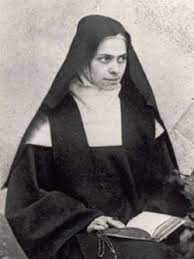
I was visiting a friend recently, and I noticed a new picture on her wall of one of the Saints of the Church. I commented on it and asked if the saint was her patron saint. She replied, “No, it’s The Saint-Who-Stocks-Me!” She went on to explain how the writings and prayers of the saint had compelled her so many times in her walk with the LORD. I knew what she was getting at because I had had the same experience with St. Elizabeth of the Trinity. I had talked with my spiritual director about how the timeliness of St. Elizabeth’s prayers and letter at a point in my life was a surprise blessing for me. She said that St. Elizabeth had chosen me. My experience confirmed what she said. And now, since hearing my friend’s title for the saint on her wall, I refer to St. Elizabeth as The-Saint-Who-Stocks-Me. Her prayers have so melted into my prayers that, at times, I’m not sure who’s voicing my prayer, me or St. Elizabeth through the power of the Holy Spirit praying through me!

It’s been three years since St. Elizabeth began stocking me. You see I had reached a point in my life where after three surgeries to give me relief from a genetic disease failed to stay the deterioration of my physical abilities. I was in a dark place, unable to see any good coming out of the physical suffering. I was more focused on what I had lost than what I might find. And then came St. Elizabeth of the Trinity, offering me insight and wisdom from her physical suffering with Addison’s disease that eventually took her life at age 26 in 1906. Me, I suffer because of loss of ability and chronic pain, but it is unlikely I will end in a physical death because of it. I had so much to learn and so much joy and hope yet to discover! St. Elizabeth stocks me as a persistent companion along the path of holiness.

The first words recorded from her final days begin with the Latin word, Nescivi–“I no longer know anything.” That’s quite a declaration coming from a nun who consumed the Word of God as breath itself! I think, though, I know what she was getting at. We come to the place in life where we realize all that we thought was sure, dependable, and controllable illudes us. I echo her thoughts, for I no longer know anything that I thought I knew before permanent deterioration set in. Have you been in a place where your spirit screams Nescivi? We can say with St. Elizabeth in response to an altered reality, “I no longer know anything. I do not want to know anything except ‘to know Him, to share in His sufferings, to become like Him in his death.'”

The LORD’s ultimate goal for us is to conform us into the image of Jesus, our LORD with skin on. How he allows life to unfold to accomplish that perfection in us varies, but it will always include suffering in some form or another. According to the letter to the Hebrews in the New Testament, God redeems suffering: “It was fitting that God, for whom and through whom all things exist, in bringing many children to glory, should make the pioneer of their salvation perfect through sufferings.” St. Paul wrote to the Colossians, “I am completing what is lacking in Christ’s afflictions for the sake of his body, that is, the church.” As uncomfortable it is to take in this truth, it does offer hope. My physical suffering isn’t unique when I consider this truth, and learning from St. Elizabeth’s short life is how the LORD opened my spirit to acceptance of life as it is and freedom from the futile doubting that delays spiritual transformation.

St. Elizabeth prayed, “O my God, Trinity whom I adore, help me to forget myself entirely so as to be established in you as still and as peaceful as if my soul were already in eternity. May nothing be able to disturb my peace…” She desired that every moment of suffering from Addison’s disease carry her into the depths of God. She asked Him to pacify her soul and make it His heaven. When I read that, I regretted the time I had wasted being agitated by what God had allowed in my life. I began to recognize that He chose me as his beloved daughter, and nothing escaped his divine plan for me. I began praying with St. Elizabeth in her prayer, “Come into me as Adorer, as Healer, as Savior. O Eternal Word, Word of my God, I want to spend my life listening to you; I want to be completely docile, ready to learn everything from You. Then, through all nights, all voids, all weakness, I want to fixate on you always and to remain under your great light.” 

What about you, friend? Is your spirit bogged down in the miry clay of disappointment and regret? Do you wonder if God is a loving God intimately acquainted with your existence? The Saints of the ages have suffered and questioned God’s love, too. They stand as witnesses to us, sometimes weeping with us, sometimes instructing us, always cheering us on in the good fight of Faith in God. The Saints do stock us because they have eternity’s perspective to offer us if we will but seek the LORD in the Communion of Saints.

Dear loving Father, into your hands we commit our spirits.

In the name of the Father, and the Son, and the Holy Spirit. As it was in the beginning, it is now and ever shall be, world without end.

Amen.

Friends in High Places

The saints have always known that the power of good is something incalculable.

–Sigrid Undset

This month of November is, for Catholics, a month of remembering those individuals who have gone before us into eternity. We concentrate our intercession for their souls as they await judgment. But every day of the year offers moments to join our prayers with the Saints who have gone before us, who are before the Throne of God in worship, praise, and intercession for us. They are our mentors and guides as we make our way to Eternity; they surround us, interceding for us, the Church here on earth! (Book of Revelation 5-22).

There are saints among us, as well; saints-in-the-making. The ordinary people in our lives whom the Holy Spirit has placed there to spur us on and intercede for us. No doubt you can think of the names of the people who the LORD has sent at the right time in the right place to walk with you in our journey in sainthood. St. Paul lists a cadre of people in his letters who were nobodies by the world’s standard but were a part of the community of saints-in-the-making who assisted him.

I have benefited from the influence of a handful of individuals over these last few decades of desiring to know God more deeply. Let me tell you about one saint-in-the-making that came along beside me to introduce me to another completed Saint. I was a water fitness instructor for years, and in those years, I came to know Sister Margretta Doyle, who regularly came to swim during my early morning shift at a local health facility. Sister Margretta’s winsome spirit was contagious, and it wasn’t long before I positioned myself in the pool next to her so that I could learn from her life. The attractiveness of her life and her obvious love and devotion to Christ and His Church was a gift to me at a tumultuous time in my life. I desired stability, order, and purpose. The circumstance of my life had shown me that there are some things in life that simply cannot be easily manipulated. I was in a situation that wasn’t getting better, and the unpleasant realization of this wouldn’t go away. Have you ever felt that way, kind of painted into a corner that you did not choose? The common mentality that surrounded me focused on external solutions for that deep ache of my soul. You’ve been there, I am sure. When you realize that prized comforts no longer bring enough comfort. When you hear the emptiness of constant conversations and cultural noise does nothing but wear you out. When superficialities that once gave you a sense of false contentment now suck the life out of you. That’s where I was at, I was seeking depth and integrity. The Holy Spirit knew this, of course, and that’s why Sister Margretta was appointed to me, a guardian saint-in-the-making for the journey that was ahead.

One day, Sister Margretta wisely asked me if I had ever heard of St. Benedict. I had in the historical sense, but my knowledge of him was woefully limited (I didn’t grow up in a faith tradition that accepted the fullness of the truth of the Communion of Saints). What followed that conversation was the beginning of the fulfillment of a spiritual longing I had had for much of my life. I studied the life of St. Benedict with Sister Margretta and a group of men and women who were beautiful examples to me of how enlivening my life as a Catholic could be.

Through the witness of St. Benedict, I learned the LORD’s wisdom on how to live an ordinary life ordered according to God’s precepts. I witnessed how life-giving it could be if I allowed His Holy Spirit to order my life by the charism of St. Benedict’s life. St. Benedict faced the same challenges in the 6th century as in the 21st century–nothing new under the sun! The culture that is antichrist is perpetual and will be to the end of the age. The Rule of St. Benedict is based on the teachings of the Gospel and offered me hope for living in the mire of the antichrist milieu.

As I opened myself to St. Benedict’s example, I noticed a common thread among the men and women who have passed through the scrim of eternity. St. Benedict faced down the challenges of his day by choosing a way of life and an attitude of mind that mirrored Jesus. The dictum to listen as the foundation of spiritual growth threads through the entirety of the Rule of St. Benedict. His rule begins with, “Listen carefully, my child, to my instructions, and attend to them with the ear of your heart.” St. Benedict and all the Saints teach us not to base our judgments, goals, or sense of worth on what we see around us. We benefit from the story of their lives that live on in the Tradition of The Church.

When we are tempted to fix our gaze on what we can see, touch, hear and taste, we can study the lives of the Saints whose gaze was fixed on heaven in the midst of poverty, disease, persecution, and even death. Another practice we can do is pray with the Saints of the day. Our liturgical calendar cannot exhaust the many men and women who are, right now, praying before the throne of God for the salvation of the world.

When we find ourselves wringing our hands over the influence of the antichrist culture that we live in, we can recall that Saints lived in antichrist cultures, too. Just as St. Benedict stepped through eternity into my life to walk beside me, there is a Saint whom God desires to draw you to when you need them most. Ask the LORD to choose someone for you from the great cloud of witnesses that surround us.

We are all saints-in-the-making. Like Sister Margretta, whose life inspired my faith, we have observers of our life who the LORD wants us to inspire with our presence. They may be as close to you as a family member or as unknown to you as a grocery clerk. As saints-in-the-making, someone is always observing us. We are placed in their lives to spur them on in The Faith.

Father, you know who and what we need every moment. We thank you for the saints-in-the-making you have placed in our lives. We thank you for the gift of communion with the Saints who surround your throne!

In the name of the Father, and the Son, and the Holy Spirit.

Amen.

O Jesus, I Surrender Myself to You, Take Care of Everything!

The Surrender Novena* was written by Fr. Don Dolindo Rutolo and handed down to us in the praying tradition of The Church. I’m sure you are familiar with it as it seems to be the go-to novena for so many who struggle with surrender, I being among them. A few years ago, I learned that Fr. Rutolo was a contemporary of St. Padre Pio, this gave me pause as St. Padre Pio is another saint who stocked me. Through a fortuitous encounter during a long recovery from a surgery that went very wrong, my priest introduced me to St. Padre Pio. Since that time, I often pray the Surrender Novena with St. Padre Pio, for he lived a life that demanded surrender to the LORD’s purpose at great cost. Today I would simply like to share with you one of my journal entries during one of the many times I have prayed this heartening novena. Pray with me as I pray with you, friend.

“Jesus, I trust in you. I surrender myself to you, take care of everything.” It is the surrendering that is hard, there are some things I have a loose hold on, and others things are in my death grip! I pray these words in so many moments of my day because I do trust in you–praying the words are like exercise for my soul and mind, little sprints of affirmation to loosen the tensions that can overwhelm my mind and steal my joy. Surrender is the hurdle to jump before the finish line. The problem seems to me, that the finish line seems to always move farther away from me the more that I allow your Holy Spirit to train my heart and mind in holiness and wholeness. St. Augustine rings in my ear, “I am restless until I find rest in you.”


Me, myself, and I, a dysfunctional trinity of a life lived with narrowed vision, clenched fists, and halting steps, walking the path toward oneness with you. You seem to allow me the pratfalls of hard lessons learned, but I’m still on the path. I, like the father of the convulsive son, say to you, “I do believe, help my unbelief!” I don’t know how you can make my life a life of complete trust in you, so I struggle in this place with doubt and fear, and not just a little bit of pride! I, like Jacob wrestling with you until you clear my vision, will step back on the path, limping from the struggle of surrender to your sovereign will, yet my feet will fall in step again. I will let go of the arguing spirit within me and trust you as a child held in your embrace. A child who trusts, not needing explanations from you about the how and why and when of my life. I don’t need to understand my past or control my present or see how it all ends. I am a beloved daughter in the arms of my Beloved Creator.


Jesus, I trust in you. You already know what the path of holiness holds on this day. I have no idea, nor would I want to know. I just want to walk peacefully on the path of surrender.


Jesus, I trust in you. You have created my body with a mangled spine, for what reason, I do not know. Help me to walk, quite literally, the path of healing. Like the paralytic, I answer your question of “Do you want to be healed?” with a resounding yes and a whisper in your ear, “I do believe, help my unbelief!”


Jesus, I trust in you. You are my portion, overflowing the banks of my doubts. Pouring out your blood into the newly discovered nooks and crannies of my soul that need to be emptied of pride! Right now, I suppose we are passing yet another fork in the path of holiness where I am forced to answer your question, “Do you love me more than this?”

Yes, LORD, you know that I love you!

In the name of the Father, and the Son, and the Holy Spirit. Amen.

*Below is a link to the pdf of the novena:

To Everything There is a Season

The change of season from Summer to Autumn never fails to remind me of the words in the Book of Ecclesiastes that there is a season for everything; it’s the natural order. The changes of seasons are also a glimpse of the LORD’s faithfulness to us in the natural cycles of life. We used to have a perennial garden before we became apartment dwellers; observing the array of flowers from the early Spring bloom to Autumn dormancy gave me pleasure.

During the autumn of each year, we would harvest hundreds of bulbs from the original 7 Asiatic and Oriental Lilies we planted when we planted the garden. We would spread those bulbs throughout the garden and wait for them to trumpet their glory under the summer’s sky in symphony with the other bloomers throughout our garden. Seeds and bulbs; re-recreation at its best! And so the cycle would go each year. The plants never failed to perpetually glorify the Creator in just being what they were created to be. Throughout Scripture, gardens are the metaphorical image of our life with the LORD. I kindle to the glimpse of this that we are given in the book of Isaiah.

“For as the rain and the snow come down from heaven,
    and return not thither but water the earth,
making it bring forth and sprout,
    giving seed to the sower and bread to the eater,
 so shall my word be that goes forth from my mouth;
    it shall not return to me empty,
but it shall accomplish that which I purpose,
    and prosper in the thing for which I sent it.

  “For you shall go out in joy,
    and be led forth in peace;
the mountains and the hills before you
    shall break forth into singing,
    and all the trees of the field shall clap their hands.
Instead of the thorn shall come up the cypress;
    instead of the brier shall come up the myrtle;
and it shall be to the Lord for a memorial,
     for an everlasting sign which shall not be cut off.”

–Isaiah 55:10-13

In the New Testament, Jesus uses the image of a mustard seed for the perpetual propagation of God’s Kingdom here on earth. Mustard is similar to kudzu in that it is invasive, wildly winding its way through the soil. It quietly invaded the land. Interestingly, Jesus was speaking to Jews who valued order and had strict rules about keeping a tidy garden; they even had laws against planting mustard seed–it messed with their system! Jesus had the chutzpah to compare the kingdom of God to an invasive plant.

The problem was that many of the listeners and even some of his followers had lofty ideas about what the Kingdom of God should look like and how it should grow. In their minds, a militant order was foremost, that, and size. They probably envisioned the tall cedars of Lebanon rather than some untamed bush from a mustard seed, spreading wherever it pleased, messy, difficult to keep under control. What they couldn’t imagine is God’s Kingdom subtly and subversively taking over their well-ordered world.

Their vision of God’s Kingdom included a conquering hero, in the stature of the cedars of Lebanon. There vision of God’s Kingdom included a frontal attack on the empires and governments of the world. Power to the People! Their vision of God’s Kingdom did not include a small act of faith like a mustard seed. Their vision didn’t kindle to the idea of a subtle contagion spreading through one little beautiful life, one little act of hospitality, one little act of mercy, one little act of grace, one little act of forgiveness, one little act of trust at a time.

I wonder what this world’s kingdom would look like if our corners of God’s garden grew like mustard plants. Methinks that the Kingdom of God would invade the world with every seed of love, mercy, forgiveness, long-suffering, gentleness, peace, hope, and grace that we allowed the LORD to plant in the soil of our corner of the garden. And little by little, garden would unite with another’s garden, and then another’s and then, happy day, the trees of the field would clap their hands!

I wonder what the LORD may be up to in our gardens. He, the Master Gardener, wants to tend us, pruning, fertilizing, and watering. He desires to cover us for necessary dormancy or expose us in due season to warmth and light. To everything, there is a season.

Holy Spirit of God, would you grant us the fortitude to remain in the soil of your everlasting love for us? Help us to sow seeds of your love with a patient and joyful spirit in our corners of your Garden.

Holy Spirit of God, would you grant us insight about the corners of our garden that are dark and untended? Help us sow seeds of hope and love where weeds threaten to choke us and crowd out your light.

Holy Spirit of God, would you re-create in the empty spaces or our gardens something of your beauty and goodness? Help us to cultivate your beauty for others to behold.

In the name of the Father, and the Son, and the Holy Spirit. As it was in the beginning, it is now, and ever shall be world without end.

Amen

“And who is my neighbor?”

The Mass readings for today draw our attention to two men who lived hundreds of years apart but had the same trouble with their vision. They could see alright; it just wasn’t past the end of their noses. They suffered from self-preoccupation that caused a spiritual myopia. Let’s examine the problem these two men had and examine what led to their problem and what we can learn from them about our own spiritual myopia.

Firstly, let us examine Jonah, who was a prophet of Israel in the 8th century B.C. His vocation was to keep the Israelites eyes and ears open to the word of the LORD. He did such a fine job with it that the LORD told him to go to Nineveh (modern-day Iraq). And what did the LORD want Jonah to proclaim to the pagan Ninevites? He was to teach that the LORD’s compassion is boundless, not limited just to us (Israelites) but also available to them (Ninevites). Jonah was offended by God’s assignment, so much so that he allowed pride to rule in his heart. He hopped a boat and traveled away from the LORD’s presence in the opposite direction to Tarshish (modern-day southern Spain). Jonah did not seem to mind Spaniard pagans as much as he did Ninevite pagans.

The Scriptures mention two times that Jonah went away from the presence of the LORD. That choice was Jonah’s first indication of his pride; in effect, Jonah was telling God that the Ninevites don’t deserve his compassion. Another indication of Jonah’s pride was his anger that the LORD showed compassion to the people of Ninevah despite Jonah’s half-hearted message to them. They repented, and together as a city, they chose to worship the LORD. Ninevah was spared! Jonah should have been celebrating God’s great mercy toward them; instead, his pride consumed him. He argued with God about it.  We don’t hear anything more of Jonah in the Sacred Scriptures. But perhaps Jonah’s spiritual myopia was cured once he examined his motivations behind his prejudice and anger.

Let’s turn our attention to a lawyer who lived in 1st Century A.D. His spiritual myopia wasn’t manifest in his anger toward God. No, he was a good and faithful Jew who lived by the Law of God. His disordered pride was indicated by a question he asked Jesus. St. Luke writes, “…but wanting to justify himself, he asked Jesus, ‘And who is my neighbor?‘” The need to justify one’s self quite often belies the doubt about one’s actions. Jesus, in his beautiful way, answers the lawyer with the timeless parable of The Good Samaritan.

The lawyer’s first indication of his disordered pride was his pressing question about what he could DO to inherit eternal life, as if he could control God’s acceptance of him. The narrative portrays the lawyer as a man of fervent attention to the black and white understanding of the Law of God. I can imagine he was a man that “crossed every t and dotted every i”; meticulous and precise in his adherence to the particulars, but sloppy in his attention to others. Jesus knew the lawyer’s lack of mercy, he would have disregarded the Samaritans (who didn’t follow the Law of God exactly like the Jews). Jesus’ description of the priest and Levite, who ignored the wounded man’s plight, staying as far away from that side of the road as possible must have stung the ears of the lawyer. His sense of the Law of God would have been blown out of the water by the Samaritan’s mercy and compassion to the wounded man.

The narrative ends with Jesus examination question for the lawyer: “Which of these three, do you think, was a neighbor to the man who fell into the hands of the robbers?” He said, “The one who showed him mercy.” Jesus said to him, “Go and do likewise.” I would like to believe that once the lawyer examined his own disordered pride, he would have been cured of his spiritual myopia.

Friend, do you find yourself in these men? I do. Take heart, for the Church remembers another man today who was cured of his spiritual myopia. He lived in the 13th century A.D., yet the culture of his day was suffering from the same epidemic of spiritual myopia as the men who preceded him. St. Francis of Assisi was immersed in the wealth and hubris of his society until the LORD got his attention in an encounter with a leper. St. Francis was instantly cured of his spiritual myopia when he repented of his disregard for the spirit of the Law of God. Before that vision, he loved himself and all the pleasure he was surrounded by; after that vision, he loved God with all his heart, mind, soul, and strength; and he died in his love and compassion for the marginalized and forgotten people of his day. St. Francis left us with a treasury of beautiful prayers that revealed his complete love for the LORD. One particular prayer comes to mind as we close.

Most High, Glorious God,
enlighten the darkness of our minds.
Give us a right faith, a firm hope and a perfect charity,
so that we may always and in all things act according to Your Holy Will.

In the name of the Father, and the Son, and the Holy Spirit. As it was in the beginning is now and ever shall be world without end.

Amen

Childlike

At that time the disciples came to Jesus and asked, “Who is the greatest in the kingdom of heaven?” He called a child, whom he put among them, and said, “Truly I tell you, unless you change and become like children, you will never enter the kingdom of heaven.

–St. Matthew 18

The Liturgy of the Word has been drawing our minds to consider the innocence of children. Several times in the Gospels, Jesus draws a child to him to illustrate the relationship between God and humanity: his fatherly love for us his beloved children. He desires for us to childlike, living in our home which is the kingdom of heaven; he never planned that we would leave home so he shows us how to return home by becoming childlike in our faith. Jesus said:

“Let the little children come to me, and do not stop them; for it is to such as these that the kingdom of heaven belongs.”

Jesus was teaching that childlike trust is a requisite to a spirit of gratitude. Can you imagine a young child saying to her father, “I’m better off fending for myself–I don’t need you to provide food, shelter, or protection for me. I’ll figure things out for myself.” No, children trust their needs will be met by their parents–they don’t even give it a second thought. A child will come to the dinner table without a thought to how the food was grown or from where the food came. A child doesn’t examine her plate, wondering if she can trust that the food is good for her. She just eats! When we aren’t childlike, we make life so complicated because we mistrust our Heavenly Father; therefore, we take on motivations, doubts, and behaviors that lead us away from home with our Heavenly Father. Do you find yourself doing that, friend? Running helter-skelter after whatever we think we need. Our Heavenly Father stands at the threshold of our home with his arms laden with every provision we could ever need.

Then he took a little child and put it among them; and taking it in his arms….

I’ve folded my arms around my children and grandchildren many times, embracing them with all the love I had for them. If a threat were to come at them, you bet I held them close to me while I used my other arm to protect and defend them. The threat may have been as simple as a sibling wanting to tickle them, or the threat may have been a real and present danger. The posture of Jesus here as he takes the child in his arms is an icon of our Heavenly Father’s love for us–his everlasting arms enfolding us and drawing us into his protection. We read of the LORD’s right arm protecting his children in the Old Testament; protection from others as well as circumstances. What’s his other arm doing? He is holding us to him as our Protector and Defender! Our Heavenly Father is the perfect father; his arms do not grow weary. Consider Isaiah’s words:

“Do not fear, for I am with you; do not anxiously look about you, for I am your God. I will strengthen you, surely I will help you, Surely I will uphold you with My righteous right hand.” (Isaiah 41:10)

A child trusts in her parents’ attention to her; the idea that she has to earn their love or she’ll be thrown out of the house and forgotten by her parent never enters her mind. Her parents are biased toward her; she is flesh of their flesh, bone of their bone; they will move heaven and earth for her. Likewise, our Heavenly Father doesn’t love us for what is in us, what we do and don’t do. No, he loves us for what is in him because we are his flesh and bone, the image of himself. He did move heaven and earth for us! His love is extravagant, without limit.

Do you know that the word extravagant is another word for prodigal? With this in mind, let’s consider the parable of the Prodigal Father and Sons. The extravagant rebellion of the younger son didn’t decrease the extravagant love his father had for him. As St. Luke puts it,

…while he (the prodigal son) was still far off, his father saw him and was filled with compassion; he ran and put his arms around him and kissed him.” 

Consider the older brother who didn’t rebel against his father, but he was extravagant in his hard effort to impress his father. All the son’s effort couldn’t increase the extravagant love his father had for him. The father says to him,

Son, you are always with me, and all that is mine is yours.” 

Friends, we are the beloved children of the Everlasting Father! He has called us by name, and as Isaiah puts it, our name is written on the palm of his hand. This image comes from an ancient tradition; people would have the name of their tribe tattooed on their hands. People lifted their arms in greeting so that they could reveal who they belonged to; they, in turn, could identify the other as friend or foe, which could mean life or death if you were alone on the backside of a desert. Isaiah used this tradition to remind the children of God that they were protected by God, no matter where they were. It is the same for us today–all we need to do is be childlike and remember to whom we belong.

Pray with me a portion of The Litany of the Childlike.

Jesus, grant me…
…Trust in Your Father’s providential care for me.
…Trust in Your desire and ability to heal me
…Trust that your Holy Spirit is constantly guiding me
…Simplicity of heart.
…Tranquility, confidence, and the peace that only You can give.
…A heart full of gratitude.
…The conviction that my worth comes from being the Father’s child and not from what I do.
…The conviction that I am known and I am loved.
…The conviction that You have a plan that is just for me.
…The conviction that you delight in me.
…The humility to see myself as You see me.
…The freedom to try and fail.
…The grace to run to you in times of temptation.
…The grace to immediately turn back to You when I sin.
…The grace to share with You everything that is on my heart.
…The grace to rest in Your loving arms.

Jesus, make me so childlike so that I can receive everything from you.

In the name of the Father, and the Son, and the Holy Spirit.
As it was in the beginning, it is now and ever shall be.

Amen

A Healing Word

Behold the Lamb of God, behold him who takes away the sins of the world.
Blessed are those called to the supper of the Lamb.

When Jesus had finished all his words to the people,
he entered Capernaum.
A centurion there had a slave who was ill and about to die,
and he was valuable to him.
When he heard about Jesus, he sent elders of the Jews to him,
asking him to come and save the life of his slave.
They approached Jesus and strongly urged him to come, saying,
“He deserves to have you do this for him,
for he loves our nation and he built the synagogue for us.”
And Jesus went with them,
but when he was only a short distance from the house,
the centurion sent friends to tell him,
“Lord, do not trouble yourself,
for I am not worthy to have you enter under my roof.
Therefore, I did not consider myself worthy to come to you;

but say the word and let my servant be healed.
For I too am a person subject to authority,
with soldiers subject to me.
And I say to one, Go, and he goes;
and to another, Come here, and he comes;
and to my slave, Do this, and he does it.”
When Jesus heard this he was amazed at him
and, turning, said to the crowd following him,
“I tell you, not even in Israel have I found such faith.”
When the messengers returned to the house,

they found the slave in good health.

Luke 7:1-10

The words of the centurion to Jesus probably sound quite familiar to you, don’t they? We pray those words at every Mass in preparation to receive the Eucharist just after we have read the Liturgy of the Word. This is what I appreciate about the Liturgy of the Mass; as we read the Gospel we are connected to another’s interaction with Jesus, drawing us up into the eternal now of God’s Kingdom.

So, let’s consider the narrative as it applies to us as well. It is evident that the Roman centurion had won the hearts of the Jews there in Capernaum; the Jews spoke highly of this to Jesus. That in itself says something of the man because centurions were responsible for enforcing discipline from Rome that was very often counterculture to the Jews. We can also assume that the centurion believed Christ was a healer. He had apparently witnessed the healing work of Jesus in his interactions with the Jews, but he was an outsider. Rather than approaching Jesus himself, he asked some of his Jewish friends in the synagogue to request a word of healing from Jesus for one of his slaves, the centurion’s humility is revealed in this action. The narrative unfolds, the servant is healed with just a word from Jesus.

The immensity of Christ’s mercy toward the centurion and his slave in the gospel narrative is revealed in the healing the slave received based on the centurion’s faith. Now to the present day Church, in the reading of God’s Word in the worship of the Mass, the Liturgy ushers us from that gospel scene back into our lives. That is how God’s mercy works in our lives and we are reminded of that at every Mass!

So, let’s turn our attention to the Liturgy of the Mass. One of the most worshipful moments in the Liturgy of the Eucharist is when we kneel as a congregation of worshippers of the eternal Lamb of God and sing together with the angels, saints, martyrs, and the faithful who have proceeded us into the eternal worship of God. Our priest holds up the Host before us and declares, “Behold the Lamb of God who takes away the sins of the world.” Using the posture of our body to indicate the posture of our soul, we are preparing to receive the Eucharist, we kneel and bow our head recognizing our unworthiness; we pray, “Lord, I am not worthy for you to enter under my roof, but only say the word and my soul shall be healed.” It is a sober moment that moves me to tears as I think of how great Christ’s love must be for me in his sacrifice on the Cross!

Here’s the consideration for us today: How confident are we in the LORD’s mercy when we pray those words? Do we, like the centurion, believe that Jesus is already responding to our deepest needs? Do we expect mercy to flow over our lives, saturating us with virtue and hope? When we rise to walk toward our priest to receive Christ’s body and blood in the Eucharist, do our spirits ring with affirmation that we receive salvation and healing as we respond with our “Amen”?

How is it with your soul today, friend? Do you find yourself in the centurion’s faith? Do you find yourself in the slaves dis-ease? Jesus is the same yesterday, today, and tomorrow. Sometimes we forget that, me thinks.

Let’s pray as St. Faustina did before receiving the Eucharist, affirming our faith in Christ’s healing virtues poured into our lives as we receive his body and blood in the Eucharist.

“My God, I believe, I adore, I hope and I love You! I ask pardon of You for those who do not believe, do not adore, do not hope and do not love You!”

In the name of the Father, and the Son, and the Holy Spirit.

Amen.