Wealth that Matters to God

Someone in the crowd said to Jesus,
“Teacher, tell my brother to share the inheritance with me.”
He replied to him,
“Friend, who appointed me as your judge and arbitrator?”
Then he said to the crowd,
“Take care to guard against all greed,
for though one may be rich,
one’s life does not consist of possessions.”

Then he told them a parable.
“There was a rich man whose land produced a bountiful harvest.
He asked himself, ‘What shall I do,
for I do not have space to store my harvest?’
And he said, ‘This is what I shall do:
I shall tear down my barns and build larger ones.
There I shall store all my grain and other goods
and I shall say to myself, “Now as for you,
you have so many good things stored up for many years,
rest, eat, drink, be merry!”’
But God said to him,
‘You fool, this night your life will be demanded of you;
and the things you have prepared, to whom will they belong?’
Thus will it be for the one who stores up treasure for himself
but is not rich in what matters to God.”

The Gospel According to St. Luke 12: 13-21

The “someone in the crowd” on this day came to Jesus with a complaint about an inheritance that he thought should be divided up between him and his brother. We don’t know the whole story, but Jesus did and he graciously responded with a parable to illustrate to him the spiritual lesson he needed to learn. Jesus’ method, so to speak, still works today. We are all someone in a crowd seeking answers for the dilemmas in our life, and Jesus knows our whole story. What Jesus had to say then, he still speaks today–this is what I treasure about the gospels–it is the good news I need for every moment of my life.

Let’s consider together this interaction from St. Luke’s narrative. Jesus warns the brother, as he does us, to take care to guard against all greed because our quality of life here on earth doesn’t rely on the accumulation of earthly goods. We know that in theory, but how do we follow Jesus’ advice to become rich in what matters to God? The parable Jesus then tells has been referred to as The Parable of the Rich Fool, for the man, so caught up in his greediness, doesn’t seem to consider treasuring what matters to God. It seems that he believed that the accumulation of money would give his life purpose. He certainly isn’t alone in his greediness, what began in Eden plays out in the habits of the human condition!

St. Augustine wrote that our hearts are restless until they rest in God. Like the rich fool, the restlessness of the human condition drives us toward immediate satisfaction from whatever fascinates or consoles us–all under the umbrella of over-weaning fear or pride. The rich fool’s pride was obvious, our’s might not be so obvious. The man’s question of what shall I do to satisfy my restlessness is the question that sends each of us down paths that may appear benign enough. But do they make us rich in what matters to God?

Consider Jesus’ words again, “‘You fool, this night your life will be demanded of you; and the things you have prepared, to whom will they belong? ‘Thus will it be for the one who stores up treasure for himself but is not rich in what matters to God.” St. Augustine taught people to seek the invisible rewards of God in loving what is good, loving what God has created, but only if they are lovers of God. That’s the tipping point, isn’t it? He exhorted his congregation to pursue what they love in the right order: heavenly things before earthly ones, the LORD before everything else.

Here’s the thing, it’s much easier to pursue the things we see rather than the things we don’t see! We can’t quantify charity, joy, peace, patience, kindness, goodness, generosity, gentleness, faithfulness, modesty, self-control, and chastity. And how do we quantify temperance, justice, prudence, and fortitude or faith, hope, or charity? I’ve referred to this before by considering them as investments that roll back dividends into our lives, all for the sole purpose of glorifying God and attracting those around us to do the same. It’s the most simple and difficult method to guide us away from being fools!

Father, reveal to us how our restlessness for you is misguided by our drive to eat, drink, and be merry with the temporal wealth of this world. 

Draw our wandering hearts back to you, and open our eyes and ears to the abundance of your blessings. May we treasure what you think about us more than what those around us think of us.

Holy Spirit of God, train us in storing up the eternal riches of God’s glory as you guide us into the abundant freedom of detachment from this world’s empty treasures.

In the name of the Father and the Son and the Holy Spirit.

As it was in the beginning, it is now, and ever shall be, world without end.

Amen

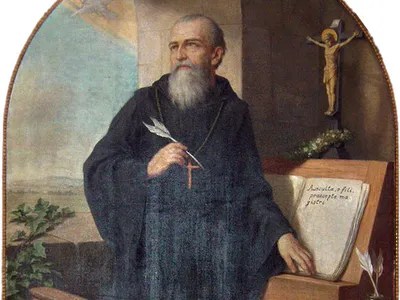
The Feast Day of St. Benedict

Preferring Christ: The Rule of St. Benedict

Today is the Feast Day of St. Benedict of Nursia. St. Benedict is among the posse of saints that surround my life, interceding for me before the LORD, our God. The Rule of St. Benedict which is so revered in the history of The Church is a rich tapestry of wisdom that is tightly woven with Sacred Scripture to guide us in living our ordinary life in an extraordinary way.

The Rule orientates us to the knowledge that God is everywhere, all the time, and because of this, every element of our ordinary day is potentially holy. Ascending to this truth that seems a little homely reorients us to our created identity because we learn to recognize that daily life is the grist for the mill of our consecration to our Creator. Does your day-to-day life seem stressful, challenging, hum-drum, or dull? Then St. Benedict is your guide through the ordinary into the extraordinary life in God.

The title, The Rule of St. Benedict, is better understood in its ancient context of the Latin word, regula, or guidepost. The prologue of The Rule begins with this: Listen, my child….incline the ear of your heart. Hearing and listening are two different things. Have you ever spent time with someone who hears you but doesn’t incline their spirit toward you enough to listen to you? Worse yet, do we hear the Word of the LORD without our spirit leaning toward him in order to really listen? St. Benedict emphasizes the importance of turning toward Christ with the posture of a child leaning into him to hear every word of beauty, goodness, and truth. In this way we are trained in preferring Christ above all things which is one of St. Benedict’s favorite themes. Praying with St. Benedict as we pray Sacred Scripture helps us look at our world through interior eyes. It helps us become better listeners to our Father and, in turn, better observers of the people and events of our lives.

Early in The Rule, we are guided in three monastic virtues: obedience, restraint of speech, and humility. Hmm? That sounds like the folk in the sixth century were just like us. St. Benedict makes it clear that these timeless virtues are inseparable. As we practice these virtues, we gain everything the LORD has promised us of the abundant life with Him. We, like St. Benedict, live in a culture of protest, excessive self-promotion, and overweaning pride. You and I can choose from the vices of the culture or we can pursue the virtues of God’s Kingdom; how is it going for you? It’s hard work to swim upstream in our downstream society! So let’s briefly consider these primary virtues.

Here’s a little side note, each of these virtues has its own chapter in The Rule. Obedience gets 19 verses of attention; Silence gets one verse of attention, and Humility has a whopping 70 verses of attention! Take a knee with me at this observation!

Regarding the virtue of obedience, St. Benedict writes that the first step of humility is obedience without delay. He encourages us to, immediately leave all that is our concern and forsake our own will, with our hands disengaged from what seems urgent to us. I am driven by goals, so much so that finding balance in the daily round is a consistent prayer I offer to the LORD. Do you suffer from tunnel vision as I do? Disengaging my hands from what seems so important to me in a moment takes monumental effort sometimes. I am learning to appreciate the slowness that St. Benedict emphasizes throughout The Rule because it is in slowing down my pell-mell thoughts and actions I’m trained in obedience. What I am discovering as I slow down is there’s very little in life that is worth the whims and appetites of my self-indulgent grasping.

Regarding the virtue of Silence, St. Benedict writes Let us do as the prophet says: “I said, I will take heed to my ways that I do not sin with my tongue: I have placed a watch over my mouth… He draws our attention to the importance of silence with scriptures from the book of Proverbs: In too much speaking you shall not avoid sin. (Proverbs 10:19) And, Death and life are in the power of the tongue. (Proverbs 18:21) Oh, so much could be said here (pun not intended). I kindle to what fellow Benedictine oblate Norene Vest wrote about this: it seems to me that the more we love words, we tend to let ourselves be satisfied by them, thus stopping short of the true satisfaction [that comes from Jesus alone]. It calls to mind St. Paul’s observation that people are always learning but never understanding. I respond to that verse by praying, Lord, I don’t want to be so caught up in speaking about what I am learning at the expense of not understanding it and living it out. Lord, remind me that it is through listening and silence that you teach and lead me into rest.

And finally, regarding the virtue of humility, St. Benedict gives us extensive guidance, beginning with the straightforward point: the problem of the spiritual life is pride (self-exaltation); the remedy is humility. St. Benedict emphasizes the need to contemplate Sacred Scripture; it comes down to this, the more we immerse ourselves in praying with Sacred Scripture we become acutely aware of our prideful leanings.

He writes that we must, by our ever-ascending actions, erect a ladder, like the one which the proud and fearful Jacob beheld in his dream in his flight from duty and responsibility. Daily life offers plenty of opportunities to learn how to descend and ascend the ladder of humility. As we practice humility, the ladder is lifted by the LORD to heaven; I like that! Yet, some days when I’ve forgotten to allow the LORD to teach me this way, the Holy Spirit remains on each rung with me, guiding me. How about you, friend? When you face an old struggle and bristle at someone’s words or actions, does pride knock you off the ladder of humility? I regularly find myself flat on my backside, wondering how I could fall off the ladder again!

When we follow the guideposts in St. Benedict has provided us, we receive the remedy for the consumer-driven society that peddles discord, disenchantment, and dis-ease. We live in the chaos of evil times, full of anxiety, anger, and the noise of modernity! St. Benedict shows us the path away from it into preferring Christ over all things (no matter how entertaining or attractive they are) and abiding in the dailiness of our extraordinary life with God.

Let’s pray with St. Benedict:

O Lord, I place myself in your hands and dedicate myself to you. I pledge to do your will in all things: To love the Lord God with all my heart, soul, strength

I desire to prefer nothing to the love of Christ…To desire eternal life with spiritual longing…to pray often. To ask forgiveness daily for my sins, and to seek ways to amend my life…Not to desire to be thought holy, but to seek holiness…Never to despair of your mercy, O God of Mercy.

I ask this in the name of the Father and the Son, and the Holy Spirit.

As it was in the beginning, it is now, and ever shall be, world without end.

Amen
The Little Foxes Steel the Vine

The Old Testament reading for Mass today is well worth our consideration. As is The Church’s way, we are offered the daily scripture readings that require more than a cursory glimpse, for in keeping with the Sacred Tradition of the Church–all of Sacred Scripture is written for our salvation. As we open our spirit to the Holy Spirit’s inspiration contained in the written word, we are tutored on how to live the virtues in order to fight the good fight against the vices of sinful thought that can lead to sinful actions which are on display in the narrative of Ahab and Jezebel. So, with that in mind, let’s examine the reading to discover what the Holy Spirit desires to accomplish in our thoughts, motives, and actions.

If you have been following the daily readings in the Old Testament, then you know much of the backstory of King Ahab and his wife Jezebel. I bet you already know today’s recorded event won’t end well for them. Ahab and Jezebel refused to accept God’s authority over them by acting on the many vices that festered in their spirits. Those actions eventually led to a messy ending for them where God’s justice was served. Let’s pick up the narrative of I Kings 21: 1-17 as the extent of their spiritual disease reveals their evil; I will paraphrase parts of the lengthy narrative.

Naboth the Jezreelite had a vineyard in Jezreel
next to the palace of Ahab, king of Samaria.
Ahab said to Naboth, “Give me your vineyard to be my vegetable garden,
since it is close by, next to my house.
I will give you a better vineyard in exchange, or,
if you prefer, I will give you its value in money.”
Naboth answered him, “The LORD forbid
that I should give you my ancestral heritage.”
Ahab went home disturbed and angry..
.

[Ahab seethed in his anger, complaining to his wife Jezebel]

His wife Jezebel came to him and said to him,
“Why are you so angry that you will not eat?”

[I wanted something Naboth had and he wouldn’t give it to me!]

His wife Jezebel said to him,
“A fine ruler over Israel you are indeed!
Get up.
Eat and be cheerful.
I will obtain the vineyard of Naboth the Jezreelite for you.”

[Jezebel used the power of Ahab’s office as king to plot against Naboth with lies and accusations to paint him into a corner that he would not be able to get out of alive]

And they
[the bribed accusers] led Naboth out of the city and stoned him to death.
Then they sent the information to Jezebel
that Naboth had been stoned to death.

[Jezebel went in to the king with the “good” news]

“Go on, take possession of the vineyard
of Naboth the Jezreelite that he refused to sell you,
because Naboth is not alive, but dead.”
On hearing that Naboth was dead, Ahab started off on his way
down to the vineyard of Naboth the Jezreelite,
to take possession of it.

Such evil people! Such duplicity! Such injustice! But wait, let’s consider the heart and soul of Ahab and Jezebel. A small parable comes to mind from another Old Testament book; The Song of Solomon 2:15. It reads:

Catch us the foxes,
    the little foxes,
that damage the vineyards—
    for our vineyards are in blossom.

The putridity of Ahab and Jezebels’ behavior reveals that somewhere along the way, they had little foxes that snuck into their minds and began to damage them from the inside out. Those little foxes had names: pride, lust, gluttony, greed, sloth, anger, and envy: the seven vices. Those vices motivated their actions and ended in God’s judgment against them.

This is why The Church keeps the Sacred Scripture ever before us. This is why our Triune God sends his Holy Spirit into our lives to grant us his wisdom to live our lives. The Holy Spirit gifts us so that we may fight against the vice that motivates us to act unjustly toward another. Because of Christ’s Passion for us, we can confess those vices and be forgiven. Because of Christ’s resurrection from death, hell, and the grave, we can be strengthened in virtue and transformed to live in the abundance of a well-tended vineyard!

How does the vineyard of your soul look today? Are their little foxes running amuck in your heart and mind? If you are anything like me, friend, you regularly have to walk the wall of your vineyard looking for the holes that allow the little foxes into your soul. The Holy Spirit comes alongside us as we examine the wall, giving us the grace and mercy of our Lord Jesus Christ, helping us repair what has broken down in us. The Church comes alongside us, as well, to give us the Sacrament of Confession and the Daily Examine as tools for the repair. Sometimes I need to do minute-by-minute examinations of my thoughts and motivations; do you feel me? I invite you to pray with me the prayer of examen with the seven vices with the seven virtues.

Triune God, please grant me your humbleness to remove my prideful self-promoting thoughts and actions.

Grant me your purity and self-restraint to remove my lustful striving after more; for excess.

Grant me your patience to remove my judgmental assumptions that lead to an angry spirit.

Grant me your temperance to remove my gluttonous consumption of all the distractions that I use to ignore the sickness in my soul.

Grant me your kindness to remove the envy of others that traps me in comparisons, jealousy, and self-loathing.

Grant me your forbearance to remove the sloth of spirit that causes me to sink under the weight of what I perceive is demanded of me or causes me to despair that I will never change.

I ask this, in the name of the Father and the Son and the Holy Spirit.

As it was in the beginning, it is now and ever shall be, world without end.

Amen


A Living Sacrifice

Yesterday we celebrated the descent of the Holy Spirit upon the Early Church at Pentecost, and now we enter Ordinary Time in the Liturgical calendar. The Church has prepared us through the extraordinary days of Lent and Eastertide for the coming of the Holy Spirit. Holy days, sacramental days, sanctified and set apart for us to enter into the eternal mysteries of our salvation. Ordinary Time is sacramental as well, but the eternal mysteries are revealed as we live and move and have our being in the unfathomable Truths of The Faith. Who can understand how this steadfast hope we have transforms us into the image of Christ? Just as day gives way to night and then day again, our lives rhythmically turn toward a beauty that surpasses our understanding. We are like bees to flowers–ever pursuing the truth in God’s ways and means so that we may taste and see the goodness of our LORD.

How can this unfold in our daily lives? I believe St. Paul says it best when he refers to us as living sacrifices that we offer every moment to our LORD; our very existence is an altar before our Triune God. That altar stands in the varied landscapes of life as we ascend into the fulfillment of who we are as God’s beloved. Sometimes it requires a lot of rock picking to build the altar of sacrifice; we approach with reluctant steps. Yet other times, we run to the altar with a skip toward all that is good, beautiful, and true.

Living sacramentally in every moment imparts these good favors from The Lover of our soul; the stuff of our existence suffuses with sacred significance. In effect, living the quotidian is kneeling before an altar where our humanity meets the divine, and we transform as we allow Christ to incarnate our flesh-soul, mind, and body.

Our Blessed Mother, the saint of all saints, whom we venerate today as The Mother of The Church, was the vessel of this mystery; she knew a thing or two about how the ordinary can become extraordinary. Let’s consider the disposition of Mary’s heart and learn how to kneel at the altar of sacrifice in all the happenstances of our lives. Artist, Fra Angelico, depicts Mary in a garden when the Archangel Gabriel appeared to her; I can imagine she may have been washing clothes or grinding wheat for bread or any other mundane task of a given day. So too, for us, what each day holds is not a vague or general mercy from a far-off God. God’s flesh sees each day as good, and with delight and wisdom, he comes to us in the monotony of our daily round and asks us to be his living sacrifice. How our Blessed Mother responded to the LORD’s coming into her ordinary moment is the exemplar for us,

The angel said to her, “The Holy Spirit will come upon you, and the power of the Most High will overshadow you; therefore the child to be born will be holy; he will be called Son of God…Then Mary said, “Here am I, the servant of the Lord; let it be with me according to your word.”

This same Holy Spirit comes to us in every passage of time inspiring us through the written Word, which is Jesus. Go figure that mystery out! The more we say, Here I am by immersing ourselves in the worship of the Mass and the written Word of God, the more our flesh is filled with his wisdom, understanding, counsel, fortitude, piety, and reverence. This is how we build the altar of our life, this is how our lives transform into living sacrifices! The LORD Jesus comes to each of us according to our natures–the good, the bad, the ugly–and he waits for us to bow before him to echo Our Blessed Mother; the first receiver of Christ’s flesh, responded, “Here am I, the servant of the Lord; let it be with me according to your word.”

So how does this play out for us, only the LORD knows, but I have an inkling. By praying the Word of God, we gather the courage to not only kneel at the altar of our life but also lay ourselves down on the altar. The humility of our Blessed Mother mirrors to us how to do that, My soul magnifies the LORD, and my spirit rejoices in God, my Saviour. As we treasure reading and meditating on the Sacred Scriptures each day, we magnify the LORD rather than the distractions and fascinations around us. Let’s do that together by praying with the Word.

LORD, I magnify you in this confusing circumstance, I know that You, O LORD, are my lamp, my God who lightens my darkness. With you I can break through any barrier, with my God I can scale a wall. (Psalm 18)

LORD, I magnify you in my motivations that would cause me to use words as weapons against this difficult person; change my mind so that the words of my mouth and the meditation of my heart are acceptable to you, O Lord, my rock and my redeemer. (Psalm 19)

LORD, I magnify you in this relationship that requires more of me than I want to give. Search me, and know my heart; test me and know my thoughts. Reveal any wicked way in me, and lead me in the way everlasting. (Psalm 139)

LORD, I magnify you in this decision I need to make, help me to be attentive to wisdom and incline my heart to understanding; then I will understand how to reverence you in this decision…[You alone I desire to honor] (Proverbs 2)

LORD, I present my body as a living sacrifice, holy and acceptable to You, which is my spiritual worship. Train me in not being conformed to this world, so that I may be transformed by the renewing of my minds, so that I may discern what is Your will for my life—what is good and acceptable and perfect. [Romans 12]

In the name of the Father, and the Son, and the Holy Spirit.

As it was in the beginning, it is now, and ever shall be, world without end.

Amen

A Waste of Time?

How’s the lenten journey going for you, fellow pilgrim? Do you ever wonder if you’re wasting your time on your lenten vows? It’s a question I asked myself recently; it’s a question I ask myself all the time, not just during Lent. I got to thinking about if Jesus ever wondered if he was wasting time being the Savior of the World? A quick survey of the gospel readings reveal that Jesus seemed to always be on his way to somewhere or leaving somewhere; entering and departing the circumstances of the human condition. A familiar phrase from the gospels goes something like this, “While they were on their way…” We know Jesus got tired; he wearied of people’s refusal to see things the way he saw them; got angry with hypocrites; and wept over people’s suffering. And we know Jesus often parted company with people to retreat into prayer. I wonder what he and our Heavenly Father conversed about during those prayer retreats; we can only imagine.

When questioned by the spectators of his life, he would reply that he was doing the will of the Heavenly Father. It follows that Jesus would never have doubted how he spent his time. It was the Father’s will to incarnate himself into our humanity; therefore, it was the Father’s will that he invested the entirety of his mind, body, and spirit in us! That just blows my mind! Every word that came out of Jesus’ mouth was motivated by the Father’s will! Perhaps when I stop questioning if I’m wasting my time, I will live all of my life as Jesus lived his life, and every word I speak or don’t speak will invest in God’s will. Rather than thinking interruptions and delays are a nuisance, I would see them as opportunities for investing in every little movement of my life. The here and there and to-and-fro of my life would become an investment of thanksgiving. Wouldn’t that be something?! To live and move and have my being in the will of my Beloved Father!

There are some questions I’ve started asking the LORD lately about doing his will as I’ve been meditating on the Sacred Scripture readings for our Lenten season.

When I fret or get angry over circumstances beyond my scope as your beloved daughter; am I wasting my time rather than investing trust in Your will? You answer, “Love righteousness…think of [my] goodness and seek me with integrity of heart.” (Wisdom 1:1)

When I insert myself beyond my rightful place as a child of God; am I wasting my time rather than investing obedience to Your will? You answer, “A jealous ear hearkens to everything, and discordant grumblings are not secret. Therefore guard against profitless grumbling, and from scoundrel mongering withhold your tongue.” (Wisdom 1:10-11)

What do I invite into my mind, body, and spirit when I waste energy on pursuits other than investing in Your wisdom? You answer, ‘Learn wisdom…for when you revere the holy precepts, you will find holiness…desire my Word; long for it, and you will be instructed.”

Who do I think is a waste of time? Do they need my emotional investment? You answer, “Beloved daughter, regard the life of the poor [in spirit]; do not keep needy eyes waiting. Do not grieve the hungry [in spirit]….do not turn your face from the helpless…in their pain, they cry out bitterly…listen to them for me.” (Ben Sira 4:1-4)

Am I wasting emotional energy on this relationship; it wears me down. They don’t care about what I have to say; why bother? You answer, “Beloved, ..let no one intimidate you…do not refrain from speaking at the proper time, and do not hide your wisdom…even to death, fight for what is right, and I will do battle for you…Do not let your hand be open to receive, but clenched when its time to give.” (Ben Sira 4: 23-31)

LORD, your very presence invests peace, love, acceptance, forgiveness, mercy, grace! You were always inviting us to join you on the way of abundant life here and in eternity. Every person, every circumstance, every suffering you encountered was an investment on our behalf! Jesus, you are still investing us with your Holy Spirit’s power to go and do likewise. Grant us new eyes to see, new ears to hear, and new hearts to love.

In the name of the Father, and the Son, and the Holy Spirit.

As it was in the beginning, it is now, and ever shall be, world without end.

Amen

Say Yes More Than You Say No

Jesus said to his disciples:
“Be merciful, just as your Father is merciful.

“Stop judging and you will not be judged.
Stop condemning and you will not be condemned.
Forgive and you will be forgiven.
Give and gifts will be given to you;
a good measure, packed together, shaken down, and overflowing,
will be poured into your lap.
For the measure with which you measure
will in return be measured out to you.”

The Gospel according to St. Luke 6:36-38

The best advice I received as a parent of young children was this: “Say yes more than you say no.” It’s a lesson that stayed with me long after our children left home because it applies to all relationships. The child psychologist that wrote that advice was referring to the spirit of “no” that we must guard against in parenting children with rigidity and close-mindedness. We can soften by saying “yes” in the important task of raising children with love, acceptance, and forgiveness. I thought of this as I read the gospel reading today for Jesus; the Master Psychologist is the perfect example of saying yes more than no. His mercy is his yes to us!

The response of mercy is the prerequisite of living as God’s child, you could say it’s in our DNA as a beloved child of the Most High God; woefully dormant sometimes, but it is there. The heart of the good news of Jesus is this: “God so loved the world that he gave…” and the entirety of his giving to us is revealed in Jesus’ actions and teachings. We witness the if/then of saying yes to God as Jesus lived among us giving practical insight into how to say yes more than we say no to our neighbor, be it our child, spouse, sibling, friend, co-worker, or acquaintance.

Perhaps you grew up under the supposition of God as Judge rather than of God as Lover; that kind of thinking can entangle us in a briary patch that only the Lover of our Soul can rescue us. Do you feel me? I think what hinders us in saying yes with mercy and acceptance to others is that we’ve deluded ourselves by believing this of the LORD because sometimes we transfer this thinking to our reactions to others. We so easily default to judgment in our thoughts, words, and actions that others have a hard time seeing mercy and love in us; it’s as though the word “No” is flashing with neon lights from our countenance. The LORD desires to purge us of this sin.

The remedy is the confession of the judgmental spirit we excuse in ourselves. But then, we must allow the Holy Spirit to guide us in choosing to say yes to others as the LORD says yes to us! What makes me think that I can do otherwise? Remembering “For God so loved the world that he gave…..” is helping to remove the proverbial log in my eye as I live beside others in this life; this is how I have been praying that truth over my life, “For Lois so loves God that she gives…..” Wow! That stops me in my tracks when judgment and condemnation begin to poison my thought life. It’s hard work, but Christ is yoked with us as we plow through the weeds that entangle us!

Today’s gospel reading happens to be one of the many “Come-to-Jesus” readings that are helping me relearn the LORD as Lover by unlearning the attitudes and actions I can accumulate in saying “no” to others through my judgmental thoughts and words. I invite you to pray with me the Gospel according to St. Luke 6:36-38

“[Lois] Be merciful, just as your Father is merciful.”

Father, your forbearance and grace cannot be measured; it’s beyond my comprehension. Help me learn to extend my “yes” of love and acceptance of others. Holy Spirit, reveal all the thoughts I have that are contrary to love. Purge them from my mind.

“[Lois] Stop judging and you will not be judged.
Stop condemning and you will not be condemned.”

LORD Jesus, you rubbed shoulders with anyone and everyone, even those that we would avoid if left to our own devices. You love! No matter the creed or ethnicity or sexual identity or state of existence! Holy Spirit, expand mercy in me until I no longer see anyone as unequal to me. I love you so much that I choose to give acceptance to everyone. We are your children.

[Lois] Forgive and you will be forgiven.

Savior and Redeemer, you love me so much that you forgive me–my sins and failings, my raw edges, my pride, fear, and anger. I choose to love you so much that I desire to forgive others. I choose to love you so much that I extend grace rather than second-guessing judgment when I don’t understand another’s words or actions. I love you so much that I choose to look for you in another’s eyes; I choose to see your face looking back at me. I love you so much that I choose my countenance says yes to everyone, EVERYONE!

“[Lois] Give and gifts will be given to you;
a good measure, packed together, shaken down, and overflowing,
will be poured into your lap
.”

Father of all Good Gifts, you overwhelm me with your grace and mercy, your joy and peace. Your love is endless! Forgive me for putting limits on my love for others. You did not create me this way; would you recreate generosity of spirit in me? I don’t want to give by counting what it will cost me because it already cost you everything to love me. I choose to love you so much that I freely give the gifts of love, joy, peace, patience, kindness, goodness, generosity, gentleness, and faithfulness to others.

[Lois]… the measure with which you measure
will in return be measured out to you.”

Holy Spirit of God, I’m ashamed at how quickly I measure others by impossible standards! Forgive the stingy thoughts that creep into my unguarded mind. Train me to say yes to your love at the first hint of my withholding love from another.

I love you so much that I give my thoughts, words, deeds to you without any measure. I love you so much that I choose to love as you have loved me, laying my life down in favor of the love you desire to give through me.

In the name of the Father, and the Son, and the Holy Spirit.

As it was in the beginning, it is now, and ever shall be, world without end.

Amen

“I Do Believe, Help my Unbelief!”


As Jesus came down from the mountain with Peter, James, John
and approached the other disciples,
they saw a large crowd around them and scribes arguing with them.
Immediately upon seeing him,
the whole crowd was utterly amazed.
They ran up to him and greeted him.
He asked them, “What are you arguing about with them?”
Someone from the crowd answered him,
“Teacher, I have brought to you my son possessed by a mute spirit.
Wherever it seizes him, it tears at him;
he foams at the mouth, grinds his teeth, and is withered up.
I asked your disciples to drive it out, but they were unable to do so.”
He said to them in reply,
“O faithless generation, how long will I be with you?
How long will I endure you? Bring him to me.”
They brought the boy to him.
And when he saw him,
the spirit immediately threw the boy into convulsions.
As he fell to the ground, he began to roll around
and foam at the mouth.
Then he questioned his father,
“How long has this been happening to him?”
He replied, “Since childhood.
It has often thrown him into fire and water to kill him.
But if you are able, have compassion on us and help us.”
Jesus said to him,
“‘If you able!’ All things are possible to one who has faith.”
Then the boy’s father cried out, “I do believe, help my unbelief!”
Jesus, on seeing a crowd rapidly gathering,
rebuked the unclean spirit and said to it,
“Mute and deaf spirit, I command you:
come out of him, and never again may you enter him!”
Shouting and throwing the boy into convulsions, it came out.
He became like a corpse, which caused many to say he had died.
But Jesus took him by the hand, raised him, and he stood up.
When he entered the house, his disciples asked him in private,
“Why could we not drive the spirit out?”
He said to them, “This kind can only come out through prayer.”

The Gospel According to St. Mark 9:14-29

I’d be hard-pressed to choose a favorite gospel account of Jesus’ healings, but I know this one would be among my top choices. The interaction between the father and Jesus reveals guidance for my prayer life. The truth that “Jesus became flesh and dwelt among us” is in full array in this encounter, and we can receive the same graces through prayer with Jesus as the father and son received from his physical presence to them. Jesus’ life on this side of eternity was a prayer with our heavenly Father, and he consistently invited the observers of his life into the same intimacy. His actions, healings, and teachings, his very flesh, were united with humanity to show us the way back to our created identity of intimacy with our Triune God, and that only comes through the communion of his body and flesh in The Eucharist and the communion of prayer with him.

The father was just another whobody to everyone else, but he was the very reason Jesus approached the folk surrounding him. Long before the father emerged from the crowd, Jesus knew him and how the father had suffered for his son and how the son had suffered because of the presence of an unclean spirit in his life. How life happened to them is not as important to Jesus; no need to connect the dots to cast blame. It had happened to the father and the son, and now Jesus would happen to the father and the son. It is the same for you and me. We are sometimes like father and son, aren’t we? We either suffer on behalf of someone or we are the one who suffers. Jesus sees us just as he saw the father and son long before that encounter. He knows what we silently carry in our hearts and souls.

Jesus comes to us without condemnation, and he sees into our hearts, not our past. He doesn’t see how we may have fumbled; he doesn’t bring up what could have been or what should have been. No, he, the suffering servant of mankind, absorbs our suffering as he did for the father and son, and then, healing transformation unfolds in us. He asks us the same question, “How long have you carried this? Do you want to be made whole…what are you looking for?” He knew the father needed to pour out the pain he had carried before him. The act of speaking our pain before the LORD is a part of healing because it requires humility to confess our need, doesn’t it? The psalmists often prayed, “Hear, O Lord, and be gracious to me! O Lord, be my helper!” (Psalm 30:10) And I can’t help but hear Jesus’ words echoing in the encounter with the father and son, “Come to me, all you that are weary and are carrying heavy burdens, and I will give you rest. Take my yoke upon you, and learn from me; for I am gentle and humble in heart, and you will find rest for your souls.” (St. Matthew 11:28-29)

If you are able, have compassion on us and help us.” Jesus said to him, “‘If you are able!’ All things are possible to one who has faith.” Then the boy’s father cried out, “I do believe, help my unbelief!”

The scene unfolds in what I imagine to be an intimate conversation between Jesus and the Father. Do you feel the father’s guarded hope as he says to Jesus, “If you are able…” Ever doubted like that? I have. When you’ve tried your best but your best wasn’t good enough, or when you are so attached to a hindrance that you can’t believe it is possible to be free from thinking about it! When you suffer for another who has been seized by a spiritual or emotional disease that has withered them up, tossing them to the ground over and over. Helplessness is too anemic a word to describe that kind of parental anguish. Jesus replies to the father, what he whispers to us, “All things are possible to one who has faith.”

The narrative of the account closes with Jesus’ words to his disciples, “This kind can only come out through prayer.” Interesting conclusion. Something worth remembering when we carry our or another’s struggle to Jesus. We can choose to ignore our pride, fret in our fears, or wallow in our anger, or we can pray, “I believe, help my unbelief.”

“Jesus became flesh and dwelt among us!” to reveal the impossible to those who seek him! He exorcises the evil spirit from the boy and takes him by the hand to raise him to stand. Did Jesus lose any holiness by touching the boy? No, instead, he infused wholeness into the boy so that he and the father and the onlookers could witness the holy compassion of God that saves and heals, restores, and resurrects! How does that come about? What does that mean for us in our life of prayer with Jesus? St. Theresa of Lisieux wrote, “…prayer is a surge of the heart; it is a simple look turned toward heaven, it is a cry of recognition and of love, embracing both trial and joy.” What causes your heart to surge toward God? Joy, Hope, Faith or despair, doubt, and unbelief. It’s all the same to the LORD Jesus because in the surge, the upward glance, he stands ready to reveal himself to us in the embrace of intimate communion with him. How beautiful! How lovely! How mysterious the presence of God is to us, but as we incline toward Jesus, we are saved!

“The whole reason why we pray is to be united into the vision and contemplation of God to whom we pray.”

–Julian of Norwich

LORD Jesus, you took on flesh and dwelt among us to save us from the fear, pride, and anger that cause us to doubt your love!

LORD Jesus, we are flesh of your flesh, restore us to wholeness of life in you!

LORD Jesus, open our eyes to recognize your presence before us!

In the name of the Father, and the Son, and the Holy Spirit.

As it was in the beginning, it is now, and ever shall be, world without end.

Amen

What Is Your Name?

Night and day among the tombs he was always crying out….

Jesus and his disciples came to the other side of the sea,
to the territory of the Gerasenes.
When he got out of the boat,
at once a man from the tombs who had an unclean spirit met him.
The man had been dwelling among the tombs,
and no one could restrain him any longer, even with a chain.
In fact, he had frequently been bound with shackles and chains,
but the chains had been pulled apart by him and the shackles smashed,
and no one was strong enough to subdue him.

Night and day among the tombs and on the hillsides
he was always crying out and bruising himself with stones.
Catching sight of Jesus from a distance,
he ran up and prostrated himself before him,
crying out in a loud voice,
“What have you to do with me, Jesus, Son of the Most High God?
I adjure you by God, do not torment me!”
(He had been saying to him, “Unclean spirit, come out of the man!”)
He asked him, “What is your name?”
He replied, “Legion is my name.  There are many of us.”
And he pleaded earnestly with him
not to drive them away from that territory.

Now a large herd of swine was feeding there on the hillside.
And they pleaded with him,
“Send us into the swine.  Let us enter them.”
And he let them, and the unclean spirits came out and entered the swine.
The herd of about two thousand rushed down a steep bank into the sea,
where they were drowned…

“…Go home to your family and announce to them
all that the Lord in his pity has done for you.”
Then the man went off and began to proclaim in the Decapolis
what Jesus had done for him; and all were amazed.

St. Mark 5:1-13; 19b-20

The scripture points out straight away that Jesus and his disciples sailed to the other side of the sea to the city of Gerasa, one of the ten cities of the Decapolis east of the Jordan river (present-day Palestine or The East Bank). It was predominantly Gentile, who were considered unclean by a law-abiding Jew, but Jesus never let conventions stand in the way of his mission to bring the Light of the World to all people. On several occasions recorded in the Gospels, Jesus knowingly hangs out with “other” people: social-misfits; diseased; despised; unclean–the nobodies of lost causes.

An outcast demonic is the welcome party for Jesus and his disciples as they land on the shore of the Decapolis, and he did not waste any time for at once he came from the tombs where he lived. He was among the worst of the worst of all of society–an exemplar of Satan himself. Let’s take that in for a moment. Now, let’s reflect on why this exorcism is included in the Gospels. The Church teaches us that all of Sacred Scripture is written for the purpose of our salvation; with that in mind, I make a habit of placing myself in the sandals of my ancestors in The Faith to understand the depth of the salvation God grants us through Jesus Christ, his only begotten Son. Join me in reflecting.

LORD God, the malignant enemy of my soul, tries to drive me into a dystopia of death in my spirit. He lurks in all the temptations that lead me away from the abundant life you have given me. Sometimes, what attracts me appears shiny and enticing, but they are the enemy’s glittering shackles and chains lying in wait for me as soon as I act on the temptation. A manacle and chain wrench around me and I am dragged toward the tombs. Above the dark path, the gate that reads  “Pride…Fear…Anger.” Just beyond, I see them there. I see engraved on tombs “Lust of the Eyes,” a stone’s throw away I see engraved on tombs “Lust of the Flesh,” and over there in the deep shadows, I see engraved on tombs “Boastful Pride of Life.”  The further I’m dragged I start to forget who I am as your beloved daughter; I forget my name!

Beloved, I am writing you no new commandment, but an old commandment that you had from the beginning. The old commandment is the word that you have heard. At the same time, it is a new commandment that I am writing to you, which is true in him and in you because the darkness is passing away and the true light is already shining. Whoever says he is in the light and hates his brother is still in darkness. Whoever loves his brother abides in the light, and in him, there is no cause for stumbling. But whoever hates his brother is in the darkness and walks in the darkness, and does not know where he is going, because the darkness has blinded his eyes.

 I am writing to you, little children,
    because your sins are forgiven for his name’s sake.
I am writing to you, fathers,
    because you know him who is from the beginning.
I am writing to you, young men,
    because you have overcome the evil one.
I write to you, children

    because you know the Father.
I write to you, fathers
    because you know him who is from the beginning.
I write to you, young men
    because you are strong,
    and the word of God abides in you,
    and you have overcome the evil one
.

Do not love the world or the things in the world. If anyone loves the world, the love of the Father is not in him. For all that is in the world—the lust of the flesh and the lust of the eyes and pride in possessions—is not from the Father but is from the world. And the world is passing away along with its desires, but whoever does the will of God abides forever.

I John 2:7-17

I look back from where I came, and I see you coming toward the shore of this dreadful place: something within me starts to remember some truth about me so, I run to you despite these death chains. I fall before you, splayed out in my weariness. You see my bruises, you’ve heard my cries, with incredulity you whisper to me, “I died for you, I’ve already been to those tombs where I conquered death, hell, and the grave. Why did you go looking for your name there? You don’t belong there!” And you say to me, “What is your name?”.

What is my name? As soon as I can remember my name, I’ll be free! It takes a bit; longer than I’d like because I have a legion of voices in my head enticing me to run back to the tombs and climb into one of those graves. But then I dare to look into your eyes! Oh, Jesus, I remember you! You are the Son of the MOST HIGH GOD! I suddenly go limp; something has fallen from me. I look back to see what it could be and see what was once, the glimmering manacle and shiny chains now all rust and decay. They’re scattered into thousands of pieces fleeing back to the tombs!

You take my hand and lift my body, now light as a feather, to stand on the two feet that I’d forgotten how to use! And I gaze into your beautiful eyes to answer you, “I am Lois, your beloved daughter!”

Jesus, Son of the Most High God, help us to never forget our name!

I ask this in the name of the Father, and the Son, and the Holy Spirit.

As it was in the beginning, it is now, and ever shall be, World without end!

Amen

O Jesus, I Surrender Myself to You, Take Care of Everything!

The Surrender Novena* was written by Fr. Don Dolindo Rutolo and handed down to us in the praying tradition of The Church. I’m sure you are familiar with it as it seems to be the go-to novena for so many who struggle with surrender, I being among them. A few years ago, I learned that Fr. Rutolo was a contemporary of St. Padre Pio, this gave me pause as St. Padre Pio is another saint who stocked me. Through a fortuitous encounter during a long recovery from a surgery that went very wrong, my priest introduced me to St. Padre Pio. Since that time, I often pray the Surrender Novena with St. Padre Pio, for he lived a life that demanded surrender to the LORD’s purpose at great cost. Today I would simply like to share with you one of my journal entries during one of the many times I have prayed this heartening novena. Pray with me as I pray with you, friend.

“Jesus, I trust in you. I surrender myself to you, take care of everything.” It is the surrendering that is hard, there are some things I have a loose hold on, and others things are in my death grip! I pray these words in so many moments of my day because I do trust in you–praying the words are like exercise for my soul and mind, little sprints of affirmation to loosen the tensions that can overwhelm my mind and steal my joy. Surrender is the hurdle to jump before the finish line. The problem seems to me, that the finish line seems to always move farther away from me the more that I allow your Holy Spirit to train my heart and mind in holiness and wholeness. St. Augustine rings in my ear, “I am restless until I find rest in you.”


Me, myself, and I, a dysfunctional trinity of a life lived with narrowed vision, clenched fists, and halting steps, walking the path toward oneness with you. You seem to allow me the pratfalls of hard lessons learned, but I’m still on the path. I, like the father of the convulsive son, say to you, “I do believe, help my unbelief!” I don’t know how you can make my life a life of complete trust in you, so I struggle in this place with doubt and fear, and not just a little bit of pride! I, like Jacob wrestling with you until you clear my vision, will step back on the path, limping from the struggle of surrender to your sovereign will, yet my feet will fall in step again. I will let go of the arguing spirit within me and trust you as a child held in your embrace. A child who trusts, not needing explanations from you about the how and why and when of my life. I don’t need to understand my past or control my present or see how it all ends. I am a beloved daughter in the arms of my Beloved Creator.


Jesus, I trust in you. You already know what the path of holiness holds on this day. I have no idea, nor would I want to know. I just want to walk peacefully on the path of surrender.


Jesus, I trust in you. You have created my body with a mangled spine, for what reason, I do not know. Help me to walk, quite literally, the path of healing. Like the paralytic, I answer your question of “Do you want to be healed?” with a resounding yes and a whisper in your ear, “I do believe, help my unbelief!”


Jesus, I trust in you. You are my portion, overflowing the banks of my doubts. Pouring out your blood into the newly discovered nooks and crannies of my soul that need to be emptied of pride! Right now, I suppose we are passing yet another fork in the path of holiness where I am forced to answer your question, “Do you love me more than this?”

Yes, LORD, you know that I love you!

In the name of the Father, and the Son, and the Holy Spirit. Amen.

*Below is a link to the pdf of the novena:

“And who is my neighbor?”

The Mass readings for today draw our attention to two men who lived hundreds of years apart but had the same trouble with their vision. They could see alright; it just wasn’t past the end of their noses. They suffered from self-preoccupation that caused a spiritual myopia. Let’s examine the problem these two men had and examine what led to their problem and what we can learn from them about our own spiritual myopia.

Firstly, let us examine Jonah, who was a prophet of Israel in the 8th century B.C. His vocation was to keep the Israelites eyes and ears open to the word of the LORD. He did such a fine job with it that the LORD told him to go to Nineveh (modern-day Iraq). And what did the LORD want Jonah to proclaim to the pagan Ninevites? He was to teach that the LORD’s compassion is boundless, not limited just to us (Israelites) but also available to them (Ninevites). Jonah was offended by God’s assignment, so much so that he allowed pride to rule in his heart. He hopped a boat and traveled away from the LORD’s presence in the opposite direction to Tarshish (modern-day southern Spain). Jonah did not seem to mind Spaniard pagans as much as he did Ninevite pagans.

The Scriptures mention two times that Jonah went away from the presence of the LORD. That choice was Jonah’s first indication of his pride; in effect, Jonah was telling God that the Ninevites don’t deserve his compassion. Another indication of Jonah’s pride was his anger that the LORD showed compassion to the people of Ninevah despite Jonah’s half-hearted message to them. They repented, and together as a city, they chose to worship the LORD. Ninevah was spared! Jonah should have been celebrating God’s great mercy toward them; instead, his pride consumed him. He argued with God about it.  We don’t hear anything more of Jonah in the Sacred Scriptures. But perhaps Jonah’s spiritual myopia was cured once he examined his motivations behind his prejudice and anger.

Let’s turn our attention to a lawyer who lived in 1st Century A.D. His spiritual myopia wasn’t manifest in his anger toward God. No, he was a good and faithful Jew who lived by the Law of God. His disordered pride was indicated by a question he asked Jesus. St. Luke writes, “…but wanting to justify himself, he asked Jesus, ‘And who is my neighbor?‘” The need to justify one’s self quite often belies the doubt about one’s actions. Jesus, in his beautiful way, answers the lawyer with the timeless parable of The Good Samaritan.

The lawyer’s first indication of his disordered pride was his pressing question about what he could DO to inherit eternal life, as if he could control God’s acceptance of him. The narrative portrays the lawyer as a man of fervent attention to the black and white understanding of the Law of God. I can imagine he was a man that “crossed every t and dotted every i”; meticulous and precise in his adherence to the particulars, but sloppy in his attention to others. Jesus knew the lawyer’s lack of mercy, he would have disregarded the Samaritans (who didn’t follow the Law of God exactly like the Jews). Jesus’ description of the priest and Levite, who ignored the wounded man’s plight, staying as far away from that side of the road as possible must have stung the ears of the lawyer. His sense of the Law of God would have been blown out of the water by the Samaritan’s mercy and compassion to the wounded man.

The narrative ends with Jesus examination question for the lawyer: “Which of these three, do you think, was a neighbor to the man who fell into the hands of the robbers?” He said, “The one who showed him mercy.” Jesus said to him, “Go and do likewise.” I would like to believe that once the lawyer examined his own disordered pride, he would have been cured of his spiritual myopia.

Friend, do you find yourself in these men? I do. Take heart, for the Church remembers another man today who was cured of his spiritual myopia. He lived in the 13th century A.D., yet the culture of his day was suffering from the same epidemic of spiritual myopia as the men who preceded him. St. Francis of Assisi was immersed in the wealth and hubris of his society until the LORD got his attention in an encounter with a leper. St. Francis was instantly cured of his spiritual myopia when he repented of his disregard for the spirit of the Law of God. Before that vision, he loved himself and all the pleasure he was surrounded by; after that vision, he loved God with all his heart, mind, soul, and strength; and he died in his love and compassion for the marginalized and forgotten people of his day. St. Francis left us with a treasury of beautiful prayers that revealed his complete love for the LORD. One particular prayer comes to mind as we close.

Most High, Glorious God,
enlighten the darkness of our minds.
Give us a right faith, a firm hope and a perfect charity,
so that we may always and in all things act according to Your Holy Will.

In the name of the Father, and the Son, and the Holy Spirit. As it was in the beginning is now and ever shall be world without end.

Amen